
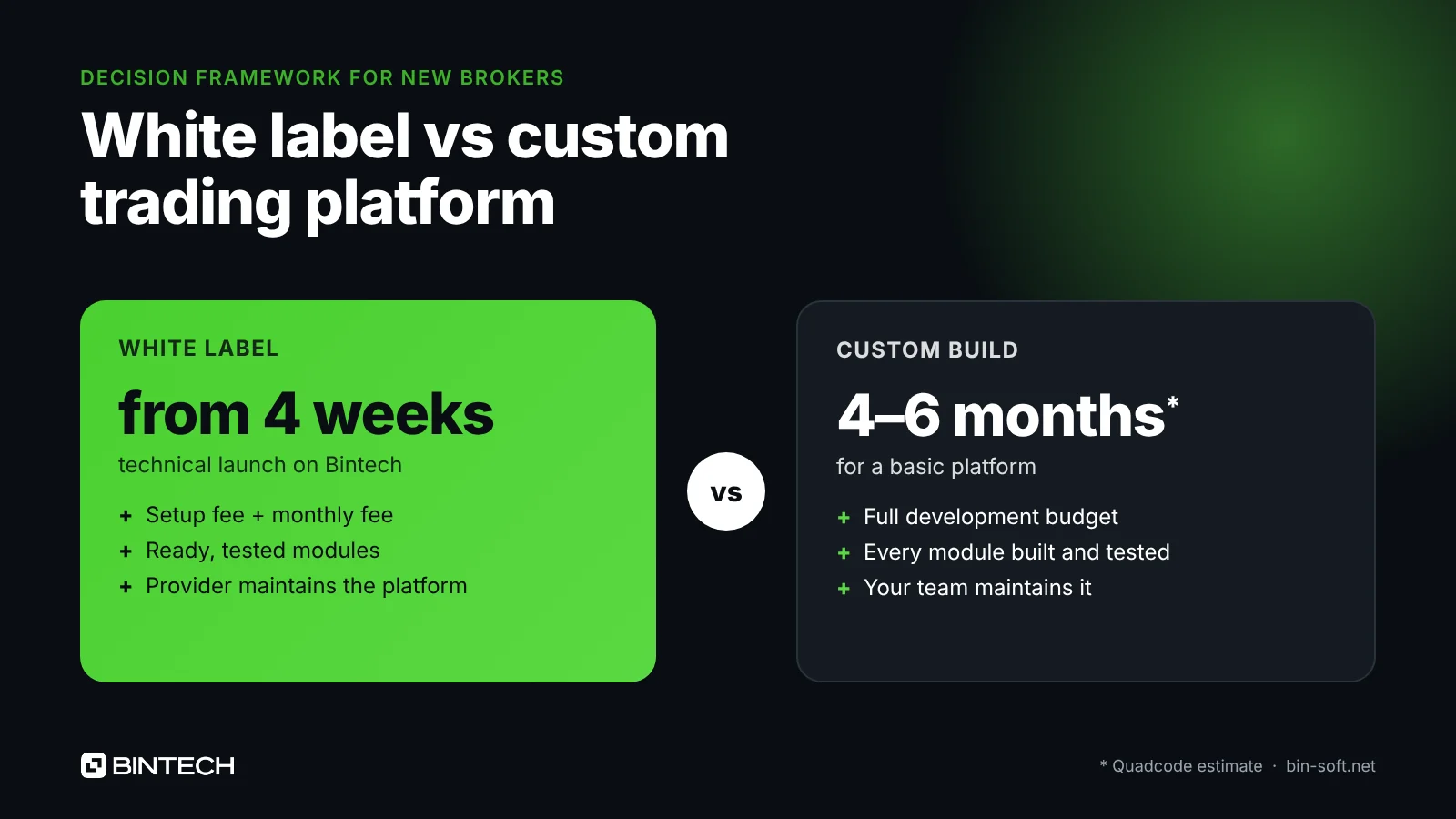
Every new brokerage faces the same early decision: license a white label platform or build your own. Most comparisons answer with a generic “white label is faster, custom gives more control.” That is true, but it does not tell you what to choose. This framework does — by your business type, your budget and how much control you really need.
Key takeaways
- White label wins on speed and upfront cost; custom wins on control and differentiation.
- The right choice depends on your business type: influencers and affiliate teams usually start on white label.
- Vendor lock-in is the real risk of white label — reduce it by owning your domain and data.
- A hybrid path — launch on white label, add custom features later — fits most growing brokers.
The short answer
When white label wins
You want to launch within weeks, your budget is limited, and your advantage is traffic or audience rather than technology.
When custom wins
You need a product feature no provider offers, you plan to operate for years at scale, and you can fund a permanent development team.
When a hybrid makes sense
You want to start fast but already know that some parts of your product will need to be unique. Launch on white label and invest in custom components once the business is proven.
Side-by-side comparison
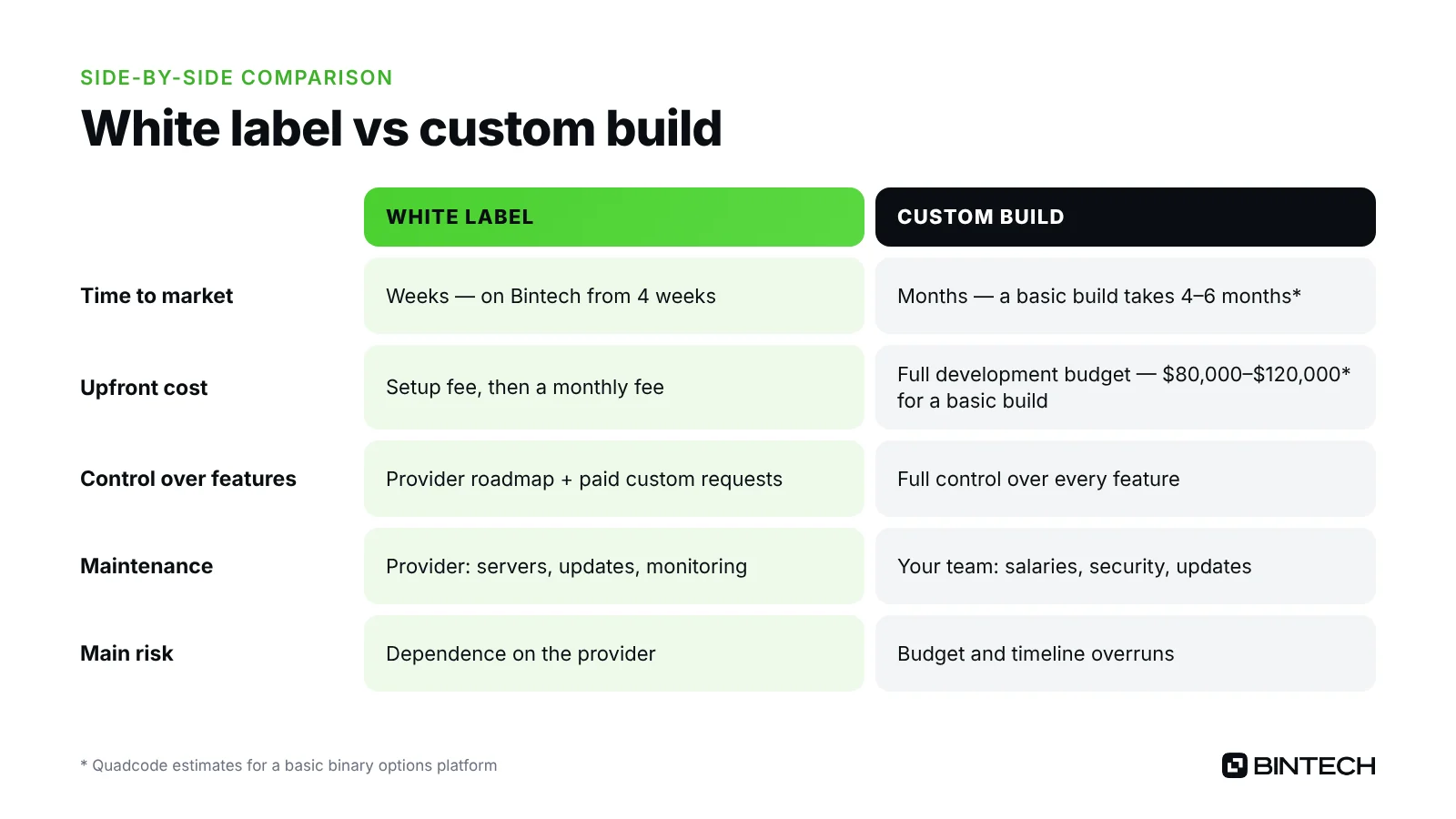
| Criterion | White label | Custom build |
| Time to market | Weeks | Months; Quadcode puts a basic build at 4–6 months |
| Upfront cost | Setup fee | Full development budget; Quadcode estimates $80,000–$120,000 for a basic build |
| Ongoing cost | Monthly fee (fixed or turnover-based) | Salaries, hosting, security |
| Feature control | Provider roadmap + paid custom work | Full |
| Maintenance | Provider | Your team |
| Main risk | Dependence on the provider | Budget and timeline overruns |
Time to market
On white label the technical launch takes weeks — on the Bintech platform, from 4 weeks, with the exact timeline confirmed by a manager. A custom build adds hiring, design, development and testing before launch.
Upfront vs ongoing cost
White label spreads cost over time; custom concentrates it at the start and keeps adding salaries. A detailed breakdown is in our binary options platform cost guide.
Control over features and roadmap
With white label, your requests share the provider’s roadmap with other clients. With custom, you decide — but you also pay for every decision.
Maintenance responsibility
Security patches, uptime and DDoS protection are the provider’s job on white label and your team’s job on a custom build.
Technical launch vs market readiness
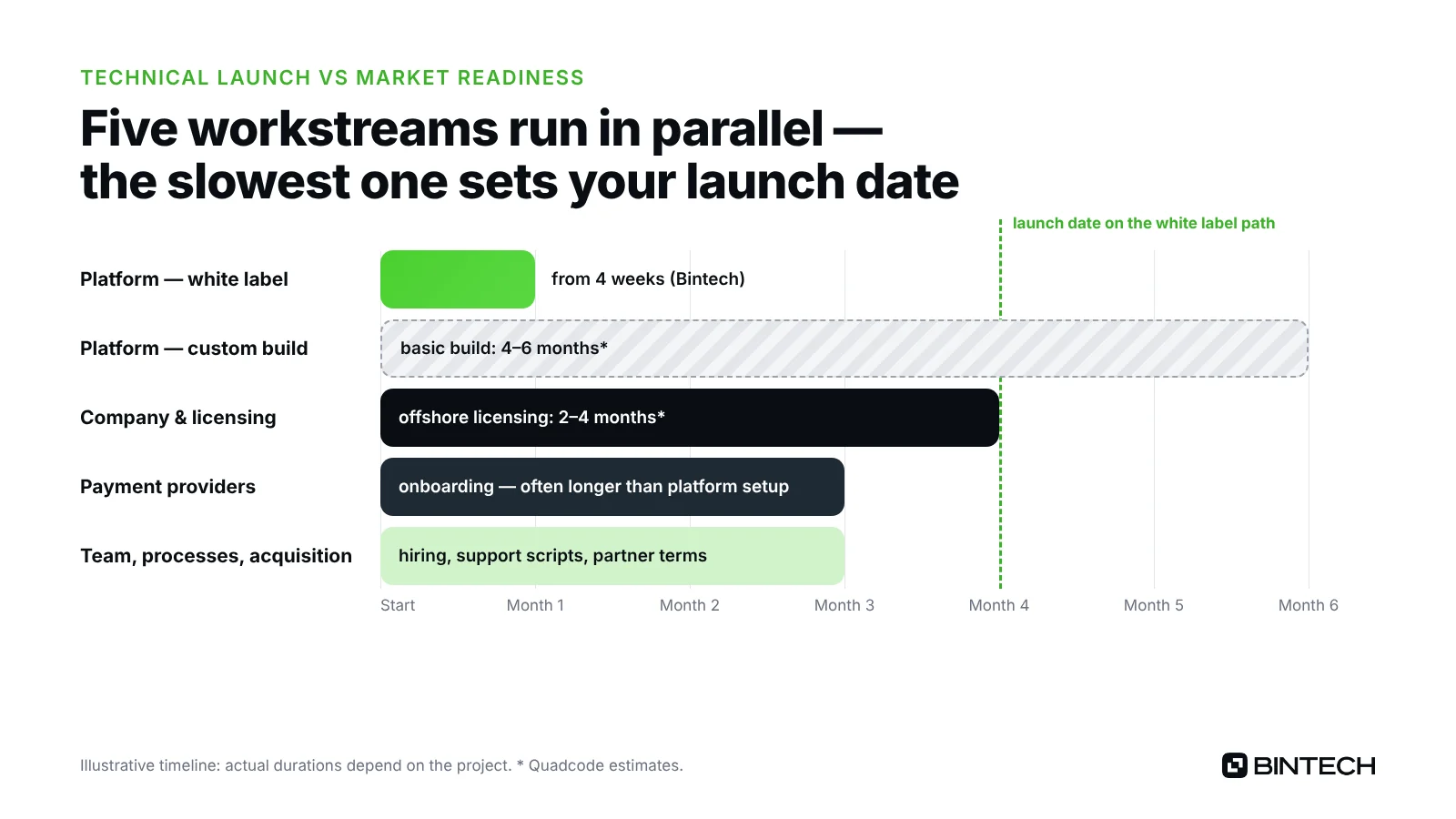
Build-vs-buy comparisons usually measure the time until the software works. Your business does not start then. It starts when the first client can register, verify, deposit, trade, withdraw and get an answer from support. That moment depends on five workstreams, and only one of them is changed by the platform decision.
| Workstream | White label | Custom build |
| Platform | Configuration and branding — on Bintech, from 4 weeks | Design, development and testing — Quadcode estimates 4–6 months for a basic platform |
| Company and licensing | Same in both cases — Quadcode estimates 2–4 months for offshore licensing | Same |
| Payment providers | Integration of compatible providers is usually part of the platform work | Every integration is built and tested by your team |
| Team and processes | Support, withdrawals, risk, partners | The same, plus engineering and DevOps |
| Acquisition | Owned channels, partners, content | Same |
Why the slowest workstream decides
If licensing or payment onboarding takes three months, a platform ready in four weeks waits for them. If development takes six months, licensing finished in three waits for the platform. White label shortens the platform line; it cannot shorten the others. Plan all five in parallel from the day you sign.
Next step: write the five workstreams down with an owner and a realistic date. The latest date is your real launch date.
What a custom build really involves
The team you need to hire
Backend and frontend developers, a designer, QA, DevOps, and a product owner who understands trading logic, payouts and risk. Hiring alone can take months.
Timeline realities
Trading platforms need extensive testing: quote handling, trade settlement, payments, reports. Delays are normal, and every month of delay is a month without revenue.
Security and uptime from day one
Your platform will handle client money from the first deposit. Monitoring, backups and DDoS protection must be ready at launch, not added later.
Questions to ask a development agency
- Which trading platforms have you built and launched, and are they live today?
- Who owns the source code and infrastructure accounts after delivery?
- How are quote feeds, settlement and payout logic tested?
- What does post-launch support cost per month?
- How do you handle scope changes and delays?
An agency that cannot answer these clearly is a risk to your timeline and budget, whatever its hourly rate.
Takeaway: choose custom only if you can fund the team for years, not just for the first release.
What white label really gives you
Ready modules
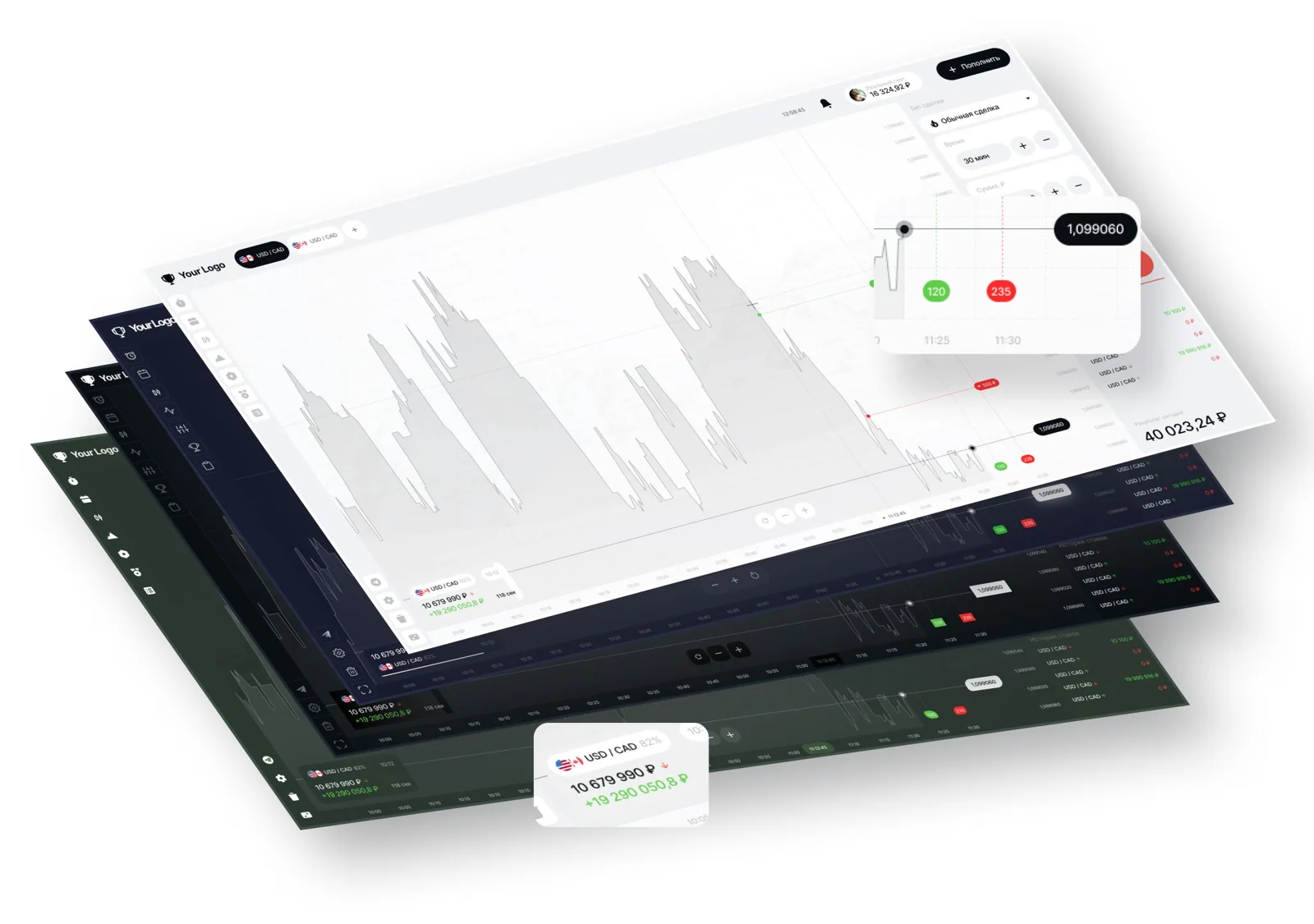
A tested terminal, back office, payments, affiliate system and mobile access. On the Bintech platform, for example, that includes a terminal with animated and TradingView charts, real, demo and tournament accounts, a PWA for iOS and Android, and an admin panel with fraud detection and quote monitoring.
A shared roadmap
New features arrive for all clients at once, which is cheap for you — but your priorities may not be the provider’s priorities.
Customization limits
Design, content and settings are usually flexible. Deep changes to trading logic need custom development. Ask how such requests are handled: at Bintech, a manager estimates each request in money and time before scheduling it.
What stays the same for both options
Whichever way you go, some work does not change: legal setup and licensing, payment provider onboarding, client support, fraud control and acquisition. Neither white label nor custom development removes these — so do not let the platform decision distract you from them.
What a binary options platform must include
Teams that decide to build often scope the trading screen and underestimate everything around it. A production binary options platform needs all of the following on day one, not as a later phase.
Trading core
- Fixed-time trades on different expiries, pending trades and correct settlement on the quote at expiry.
- Asset and currency pair management with payout percentages that can change in real time.
- Market quotes and, where offered, OTC quotes — plus monitoring that pauses trading if incoming data looks wrong.
Accounts and retention
- Separate real, demo and tournament accounts that never mix in reporting.
- Bonuses, promo codes, tournaments, leaderboards, statuses and achievements — with accounting that keeps bonus money apart from real balances.
Operations and control
- Back office with financial and traffic-source analytics, payouts via payment provider APIs and role-based access.
- Full action logs, multi-account and suspicious activity detection.
- A built-in affiliate system with partner statistics.
Client experience
- Responsive web terminal and mobile access, for example a PWA.
- Multi-language interface, multi-currency balances and several payment methods.
- Support module with chats and tickets.
On a white label platform such as Bintech these modules are part of the standard package. On a custom build, each line is a development task with its own testing. Our guides to the binary options back office and the white label mobile app show how much sits behind two of these lines alone.
Takeaway: if your development estimate covers only the terminal, it covers the smallest part of the product.
The decision by business type
Trading influencers and communities
Your asset is audience trust, not technology. White label lets you test whether your audience converts before you invest in development. See our guide on turning traffic into your own broker.
Affiliate teams and media buyers
You know your acquisition costs and need a platform that converts and retains. Speed matters more than unique features, so white label is the natural start.
Existing brokers adding binary options
You may already have developers, but adding a new product line on white label lets you test demand without pulling your team off the core business.
Takeaway: if your edge is distribution, rent the technology; if your edge is technology, build it.
Hidden risks of building
Scope creep
Every stakeholder adds “just one more feature” before launch. Without a fixed first-release scope, the launch date moves every month while costs keep running.
Key-person dependency
Small teams often depend on one or two engineers who understand settlement logic or the quote feed. If they leave, maintenance slows down or stops.
Correctness under real load
Trades must settle on the right quote at the right second, also during traffic peaks. Errors here create disputes and refunds, and they only show up with real clients.
Security and abuse
Logging, role-based access, multi-account detection and DDoS protection are rarely in the first estimate, but a trading platform is a target from the first deposit.
Maintenance debt
Shortcuts taken to hit the launch date become expensive later. Plan a permanent share of the budget for refactoring and updates.
Hidden risks of white label
Roadmap dependency
Features you need may not be a priority for the provider. Ask how custom requests are estimated and scheduled — at Bintech, a manager prices each request in money and time before it goes into the plan.
Pricing changes
Check whether the monthly fee can change, on what terms, and how it scales with turnover. Model it at your expected turnover and at five times that.
Shared infrastructure
Some providers run many clients in one environment, so one client’s incident can affect others. Ask whether your project runs on a dedicated server.
Limited differentiation
If several brands use the same product with similar settings, they compete on brand, service and marketing rather than features. That is fine for most businesses — but know it before you choose.
Code ownership
On white label the platform code stays with the provider. Your protection is ownership of the brand, domain and client data, written into the contract with a clear export procedure.
A simple decision matrix
Score each criterion from 1 to 5 for your business, multiply by the weight and add up each column. The weights below are a starting point; change them if your situation is different.
| Criterion | Weight | Favours white label when… | Favours custom when… |
| Time to market | 3 | You need to launch within weeks | You can wait many months |
| Upfront budget | 3 | Budget is limited or must be preserved for marketing | You can fund development and a permanent team |
| Need for unique features | 2 | Standard modules cover your model | Your core advantage is a feature no provider has |
| In-house engineering | 2 | You have no technical team | You already have experienced trading-platform engineers |
| Control over code | 1 | Owning brand, domain and data is enough | You need to own the code itself |
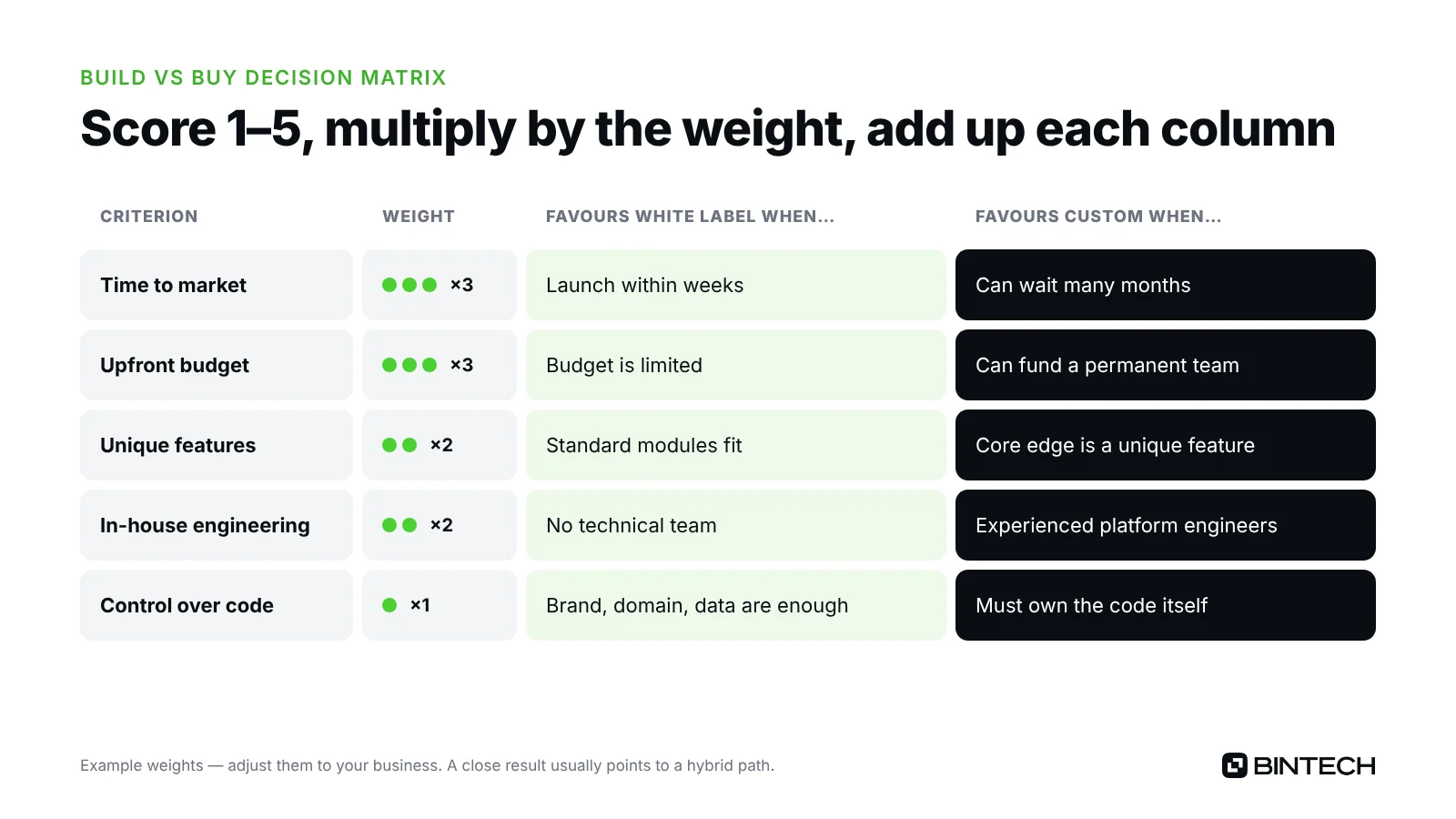
How to read the result
If most of your weighted score sits in the white label column, start on white label and revisit the decision when the business is proven. If the custom column wins clearly, make sure you can fund the team for at least two years, not just the first release. A close result usually points to the hybrid path.
Questions to ask before buying a white label platform
Send these questions to every provider on your shortlist and compare the written answers side by side.
Product
- Which modules are included in the standard package, and which cost extra?
- Which binary-options-specific settings can my team change without your help?
- How does the terminal work on mobile, and is there a PWA or native app?
Infrastructure and support
- Does my project run on a dedicated server or in a shared environment?
- Who monitors the platform at night and on weekends, and how am I notified about incidents?
- How are backups made and how quickly can data be restored?
Commercial terms
- What is included in the one-time fee and in the monthly fee?
- How is the monthly fee calculated as turnover grows, and can it change?
- How are custom requests estimated, priced and scheduled?
Ownership and exit
- Who owns the domain, brand and client data?
- In what format can I export clients, balances and history if we part ways?
Our guide on comparing turnkey broker providers includes a full comparison matrix for a shortlist.
Vendor lock-in and exit options
Who owns the domain, server and data
The domain should be registered to you, the platform should run on a server dedicated to your project, and you should be able to export your client data. These three points decide how free you are later.
Migration if you switch providers
Moving to another platform means migrating clients, balances and history. Ask in advance which data formats are available for export.
Contract terms to check
- Notice period and termination conditions.
- Data export on termination.
- How fees change as turnover grows.
- Ownership of custom developments you paid for.
A practical exit-readiness check
Once a year, check whether you could leave your provider if you had to: Is the domain registered to your company? Can you export clients, balances and transaction history in a usable format? Do you have copies of your content, design files and terms? Are your payment provider contracts in your name? Four “yes” answers mean you are a client by choice, not by lock-in.
The hybrid path
Start on white label, customize over time
Launch on proven modules, measure what clients use, then pay for changes where they make a difference. This keeps early risk low and directs development money to proven needs.
Custom features on top of white label
Many changes — a unique design, specific bonuses, extra content modules — can be added on a white label platform as custom work, without building everything yourself.
Moving from white label to your own platform later
Starting on white label does not lock you in forever — if you prepare. Brokers that later move to their own platform usually follow the same sequence.
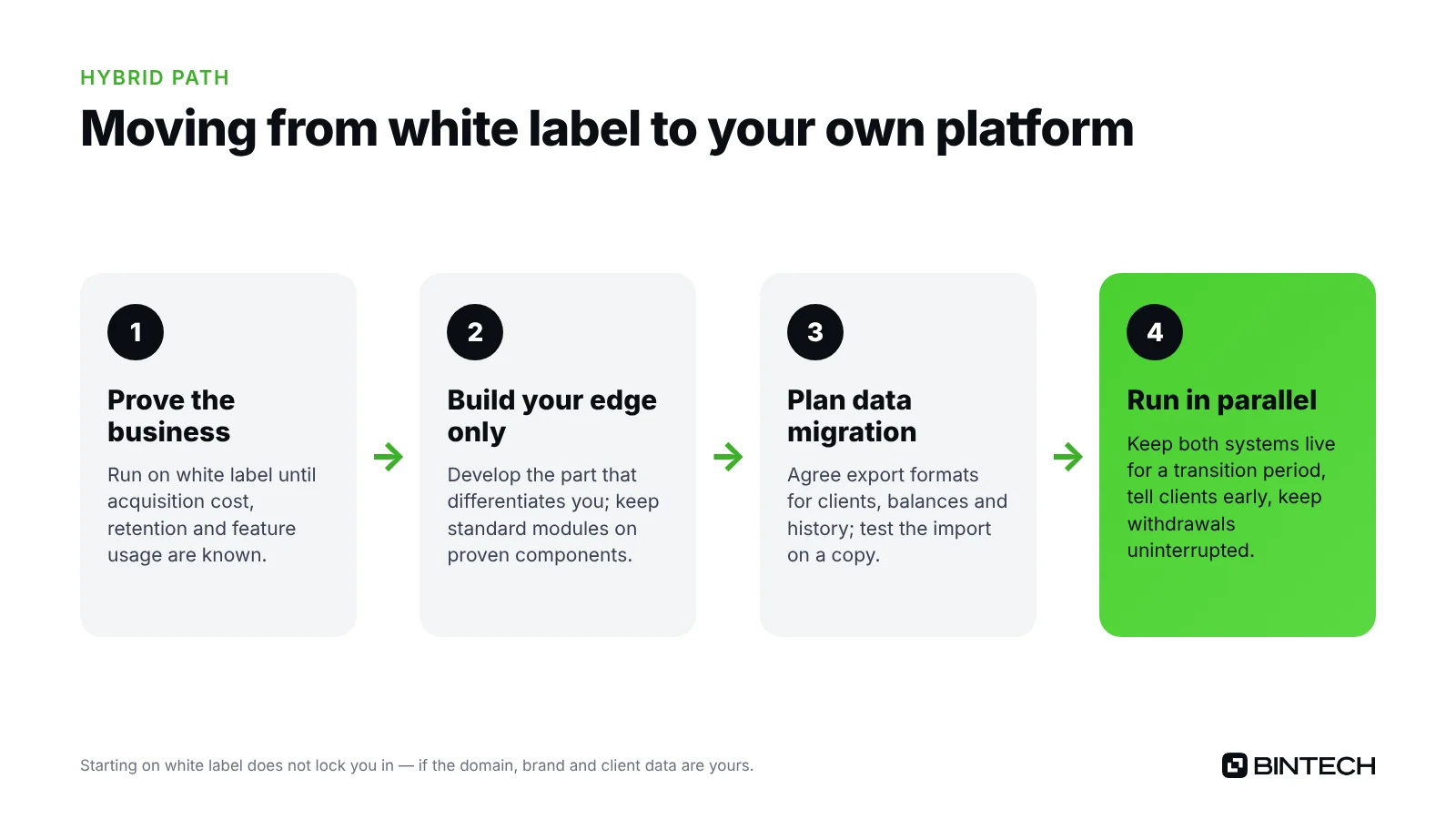
1. Prove the business first
Run on white label until you know your acquisition costs, client lifetime and which features clients actually use. This data turns a vague development wish list into a precise specification.
2. Build only what differentiates you
Rebuilding standard modules rarely pays off. Focus your own development on the part of the product that gives you a real advantage, and keep the rest on proven components as long as possible.
3. Plan the data migration
Agree with your provider on the export format for clients, balances, transaction and trade history well before the switch. Test the import on a copy before moving real clients.
4. Run in parallel and communicate
Keep both systems available for a transition period, tell clients in advance what changes for them, and make sure withdrawals work without interruption. A smooth migration is invisible to clients; a rushed one costs trust that took years to build.
Total cost of ownership over three years
Comparing setup costs alone favors white label too strongly in year one and custom too strongly in year three. Look at what drives cost in each year instead.
| Period | White label | Custom build |
| Year 1 | Setup fee, monthly fees, custom requests | Full development budget, hiring, infrastructure, months without revenue |
| Year 2 | Monthly fees growing with turnover (if turnover-based) | Maintenance team, security, new features |
| Year 3 | Monthly fees; possible migration costs if you switch | Team salaries; technical debt from early shortcuts |
When custom becomes cheaper
A custom build can become cheaper only if your turnover is high enough that platform fees exceed the cost of a permanent development team — and if that team delivers without long delays. Model this with your own numbers before assuming it.
The cost of delay
Every month a custom platform is not live is a month without revenue, while marketing, legal and staff costs may already be running. This opportunity cost rarely appears in build-vs-buy spreadsheets, but it often decides the outcome.
Next step: calculate three-year cost for both options at your expected and at half your expected turnover.
Three scenarios
These are illustrative scenarios, not client cases, to show how the decision plays out.
Scenario 1: a trading educator with a large audience
The educator has trust and content but no technical team. A custom build would take months while the audience waits. White label lets them launch a branded platform, test conversion and invest later in custom features their audience asks for.
Scenario 2: an affiliate team with stable traffic
The team knows its acquisition cost and wants better margins than affiliate payouts. Speed and a reliable affiliate module matter most. White label with configurable partner terms is the natural fit; custom work goes into landing pages and retention.
Scenario 3: an established broker with developers
The broker has a team and a product roadmap. Adding binary options on white label lets them test demand without diverting developers. If the line succeeds at scale, they can reconsider a custom or hybrid approach with real data.
Decision checklist
10 questions to answer before you decide
- How soon must you launch?
- What is your total budget for the first 12 months?
- Is your advantage traffic, audience or technology?
- Which features do you need that providers do not offer?
- Can you hire and keep a development team?
- Who will handle security and uptime?
- Which markets will you serve, and are they legal for your product?
- Who will control your domain, server and data?
- How will your costs change as turnover grows?
- What is your exit plan if the platform no longer fits?
Next step: if most of your answers point to speed and distribution, shortlist white label providers — our guide on how to compare turnkey broker providers will help.
A practical recommendation for most new brokers
For most first-time brokers — trading educators, affiliate teams and entrepreneurs entering the market — the most practical path looks like this:
- Launch on a proven white label platform with the standard modules, a ready design template and one or two target markets.
- Spend the money you saved on development on legal setup, payment providers, support and acquisition — the parts that decide whether the business works.
- Measure for three to six months: cost per depositing client, retention, withdrawal times, which features clients use.
- Order custom features only where the data shows a clear benefit.
- Revisit build vs buy once turnover and team size justify a permanent engineering function.
This keeps early risk low, gets you to market in weeks rather than months and turns the build decision from a guess into a data-driven choice. If you want to see what the standard package looks like in practice, our white label platform for binary options page lists every module.
FAQ
Is white label or custom development better for a new broker?
For most new brokers white label is the better start: it launches in weeks and costs less upfront. Custom development makes sense when you need features no provider offers and can fund a permanent development team.
Can I move from white label to my own platform later?
Yes, if you keep control of your domain and client data and agree on data export in the contract. Many brokers start on white label and build custom components once the business is proven.
What is vendor lock-in?
Vendor lock-in means it is hard or expensive to leave a provider because they control your domain, servers or data, or the contract makes exit costly. Check these points before signing.
How long does a custom trading platform take to build?
Published estimates for a basic build are several months — Quadcode, for example, cites 4–6 months — before licensing and payment work. Complex platforms take longer.
Can I customize the design of a white label platform?
Yes. Providers usually offer ready templates and custom design. Deeper changes to trading logic require custom development, which is estimated separately.
Is white label cheaper in the long run?
For most new brokers, yes, because a custom build needs a permanent engineering team after launch. It can become more expensive at very high turnover if the monthly fee scales with turnover. Model both options over three years at your expected turnover.
Do I own the source code on a white label platform?
Usually not. The platform code stays with the provider, while the brand, domain and client data should belong to you. Write data ownership and export into the contract.
How soon can I accept the first client?
On white label the technical launch takes weeks — on Bintech, from 4 weeks, with the exact timeline confirmed by a manager. The real date also depends on company setup, licensing and payment onboarding, which should run in parallel.
Conclusion
The choice between white label and custom is not about which is better in general, but about where your advantage lies. If it is traffic or audience, rent proven technology, keep control of your domain and data, and customize later. If it is technology itself, build — and budget for the team for years.