
Turnkey Broker Solutions: How to Compare Platform Providers
Choosing a turnkey broker solution is one of the most important decisions when planning a branded trading platform. The right provider gives your business an existing technological foundation, practical tools for daily operations, and a clear framework for technical support. Instead of coordinating the development of multiple software components, you can concentrate on building your brand and developing the commercial side of the project.
However, not every product advertised as a turnkey brokerage solution offers the same scope. One provider may specialize in binary options, another may cover several trading products, and a third may offer a development service with extensive individual customization. Even when two websites advertise similar features, the responsibilities included in their commercial proposals may be different.
That is why choosing a provider should go beyond comparing screenshots, headline prices, or promised launch dates. The most useful approach is to evaluate how well each solution fits your intended business, which features are included, what can be customized, and which technical services the provider will handle.
This guide explains how to compare turnkey broker solution providers, examines several established approaches to ready-made trading technology, and shows what to look for when evaluating a platform for your own brand. It also explains how Bintech’s All Inclusive offering fits businesses that want a ready-made binary options platform with ongoing technical maintenance.
What Is a Turnkey Broker Solution?
A turnkey broker solution is an existing software product or coordinated technology offering designed to help a business establish a branded trading service without commissioning every underlying component individually.
Depending on the provider, the solution can include a trading interface, customer account functionality, administrative tools, supported payment integrations, partner management, configuration options, and technical infrastructure.
The word “turnkey” describes the commercial approach rather than a universal technical specification. There is no single feature list shared by every product under this label.
For example, a supplier may include affiliate management and technical maintenance within its standard package. Another may provide the basic trading environment while offering these capabilities under additional arrangements.
Both products may be marketed as turnkey platforms, but the actual deliverables are not identical.
For a business evaluating several offers, the relevant question is therefore not simply whether a supplier calls its product turnkey. It is how much of the intended operating environment is already included and which responsibilities remain outside the standard offering.
Start by Comparing the Right Type of Product
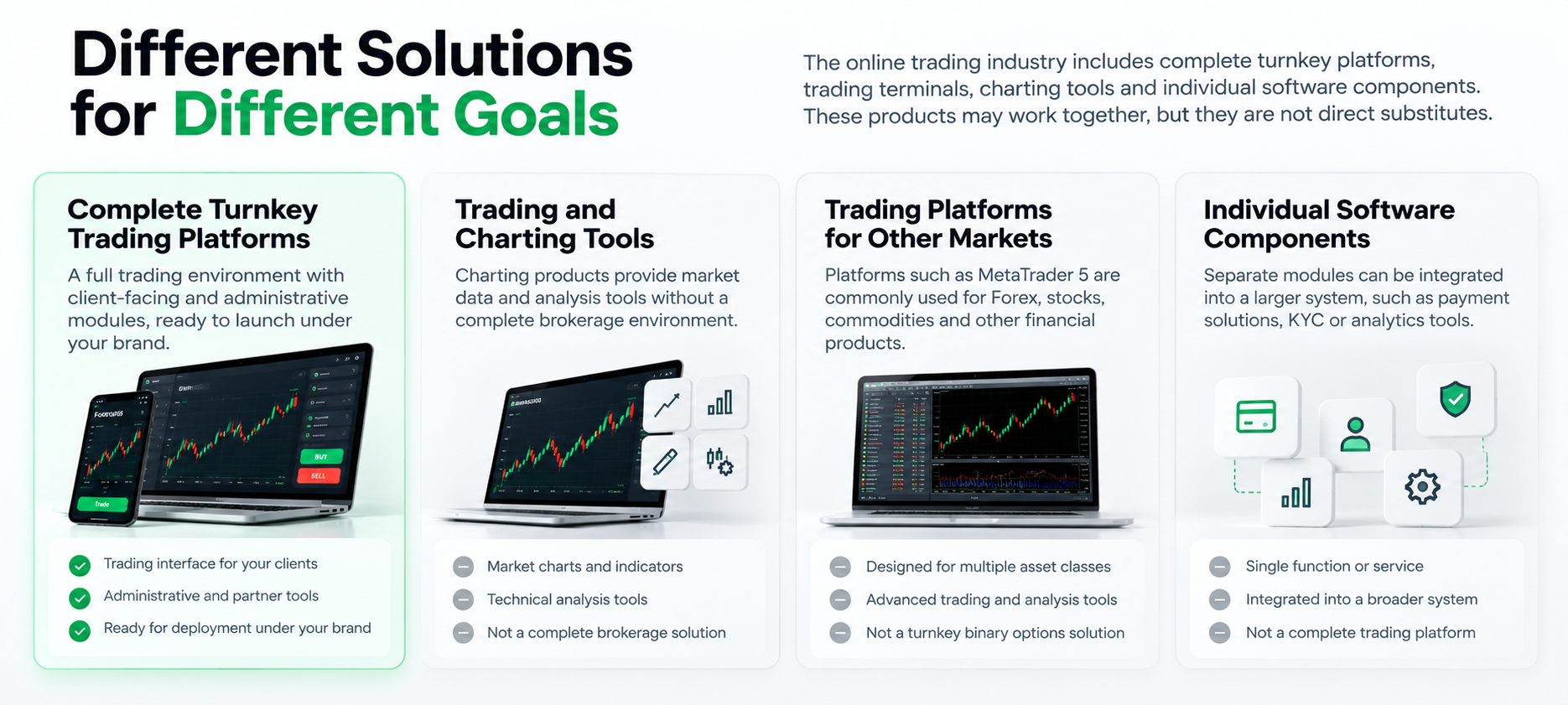
Before comparing individual providers, determine whether their products belong to the same category.
The online trading industry includes charting services, trading terminals, brokerage management software, white label platforms, and complete trading technology offerings. These products may work together, but they are not necessarily substitutes for one another.
Complete Turnkey Trading Platforms
A complete turnkey platform is intended to provide a coordinated software environment for an operator. It combines a customer-facing trading experience with supporting administration and the services described in the provider’s offering.
Examples of companies marketing ready-made trading platform solutions include Quadcode, TradeSmarter, and Bintech.
Their software products and commercial models should still be evaluated individually. A company that offers several trading products may not provide identical functionality in every package.
Trading and Charting Tools
Charting tools help users visualize and analyze market information. A charting product may offer indicators, drawing tools, and advanced market analysis features without supplying the entire operating environment required for a specific brokerage project.
TradingView, for example, is widely known for its market charts and analytical functionality. It should not be treated as a directly interchangeable product with a complete binary options brokerage solution.
Charting technology can be incorporated into a broader trading product. Bintech itself supports TradingView-based charts alongside its other available charting options.
Trading Platforms for Different Financial Products
Another important distinction concerns the type of trading service being offered.
MetaTrader 5 is a trading platform associated with markets such as Forex, stocks, and futures. It also has a broader technology offering for brokers.
That does not make a generic MetaTrader 5 installation equivalent to a turnkey binary options platform.
If your intended project focuses on binary options, the comparison should involve software designed to support that product and the associated account and operating functions.
If your business intends to offer a different type of trading service, another product category may be more appropriate.
Turnkey Broker Solution Providers: A Market Overview
Several companies offer ready-made trading technology, but their positioning and product scope differ. Understanding these distinctions helps prospective operators identify which providers deserve closer examination.
The following overview is based on publicly described offerings. It is not a ranking, an independent performance test, or a representation that every advertised module is included in every commercial package. Final availability should be verified directly with the relevant provider.
Bintech: Ready-Made Binary Options Software
Bintech focuses on providing a complete binary options trading platform that can be configured under the customer’s brand.
The company’s standard offering includes the documented trading and administrative modules, built-in affiliate functionality, supported payment integrations, multilingual capabilities, and ongoing technical services.
Bintech uses an All Inclusive model rather than separating its standard software modules into multiple product tiers. The platform is deployed on the client’s selected domain and dedicated server, with technical maintenance, monitoring, backups, and 24/7 support provided by the Bintech team.
This approach can be particularly suitable for affiliate teams, media businesses, and entrepreneurs who want to establish their own trading brand while leaving the underlying software maintenance to a specialist provider.
Quadcode: White Label Binary Options and Other Brokerage Products
Quadcode markets a dedicated white label binary options platform alongside other brokerage technology solutions.
Its public binary options offering highlights ready-made infrastructure, brand customization, an affiliate module, back-office functionality, engagement tools, and supported integration options.
The company also markets separate solutions for other trading products. Prospective customers should therefore select the relevant product line before comparing the quoted scope with another provider.
When reviewing Quadcode, useful questions concern the exact configuration being offered, the included partner tools, the relevant administration features, and the services covered by the commercial proposal.
TradeSmarter: Multiple Trading Products and Brokerage Tools
TradeSmarter markets a broader range of trading technology, including digital options, Forex and CFD products, and other trading formats.
Its public offering describes white label trading platforms, back-office and CRM capabilities, affiliate functionality, payment integrations, and multiple customer-facing trading interfaces.
This breadth can be relevant to a business considering several product categories. However, it also makes it important to distinguish the features associated with each product from capabilities available elsewhere in the supplier’s portfolio.
When requesting a quotation, the operator should specify the intended trading product and ask for the features, integrations, and services relevant to that exact configuration.
Merehead: Ready-Made Platforms and Development Services
Merehead presents binary options platform development and white label solutions, with different levels of customization and project scope.
Its published materials distinguish relatively straightforward deployment of an existing product from broader individual development work.
This may be relevant to businesses with specialized technical requirements or a product concept that differs significantly from standard ready-made functionality.
When evaluating this model, the buyer should establish which features exist in the current product, which are part of a proposed development project, and how maintenance will be organized after delivery.
Comparing Turnkey Providers by Business Fit
The value of a supplier depends on how closely its offering matches the intended project. A provider with a broad range of products is not automatically preferable to a company specializing in one trading format. Likewise, the most visually impressive terminal does not necessarily represent the most suitable complete operating environment.
| Provider | Publicly Described Focus | What to Clarify in the Proposal |
| Bintech | Ready-made binary options platform with an All Inclusive standard software package | Brand configuration, available standard modules, recurring service terms, and any individual development requirements |
| Quadcode | White label binary options technology and additional brokerage products | Exact product line, included back-office and affiliate functions, integration scope, and support conditions |
| TradeSmarter | Multi-product trading platform solutions, including digital options and brokerage management tools | Features included for the selected trading format, relevant integrations, and the specific quoted configuration |
| Merehead | White label trading platforms and individually scoped development | Existing functionality versus additional development, delivery scope, customization work, and ongoing maintenance |
The purpose of this comparison is to identify differences in positioning, not declare one provider universally superior.
A prospective operator can use it to create a shortlist and then request comparable proposals. The most informative comparison comes from reviewing the actual offered configuration rather than generalized descriptions on marketing pages.
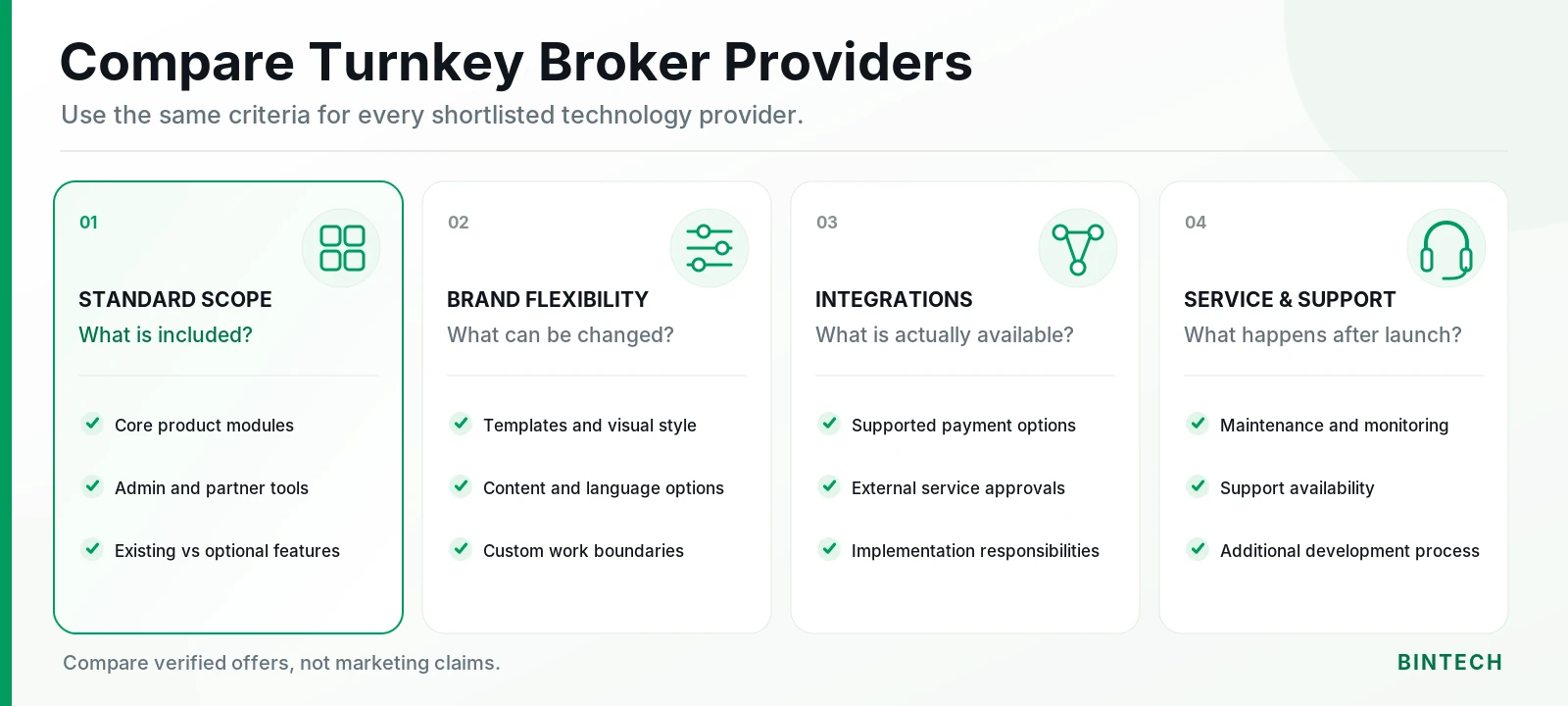
Compare Standard Packages, Not Just Advertised Features
One of the most significant differences between turnkey broker solutions is the boundary between included functionality and additional services.
A supplier may advertise an advanced affiliate system, customer communication tools, mobile interfaces, and promotional capabilities. Yet some of these may be included only in selected packages or require separate configuration and commercial terms.
To compare offers fairly, request the exact standard feature list attached to each quotation.
Which Functions Are Available from the Beginning?
Start with the modules required for the intended operation. Identify which are already available in the provider’s standard product and which are described as optional.
A complete list is more useful than a collection of screenshots because it provides a reference for the commercial discussion.
The objective is not necessarily to purchase the software with the highest number of features. It is to select a platform that includes the functionality relevant to your initial business without requiring unnecessary additional work.
Which Features Depend on Separate Services?
Some capabilities may involve external providers or commercial arrangements beyond the software itself.
For example, a platform can support payment integrations without guaranteeing that a particular payment company will approve every prospective operator.
Similarly, support for a communication or analytics service does not automatically mean that all of the service’s external charges are included.
The supplier should distinguish what the software supports from what the project must arrange independently.
Are Standard Modules Charged Separately?
Providers may use different approaches to packaging their software. Some offer multiple product tiers, while others provide one standard package with additional development available when required.
Bintech uses the latter approach. Its All Inclusive offering contains the standard modules described in the current product presentation.
That makes it possible to evaluate the complete existing package without comparing multiple versions of Bintech’s core software.
Additional features and non-standard development can still be assessed separately when the project calls for them.
Brand Customization: What Can Be Changed?
A white label platform should support the creation of a recognizable customer-facing brand. However, the term “customizable” can describe several different levels of flexibility.
One solution may provide a selection of templates and color options. Another may allow extensive changes to layouts, content, navigation, and supported platform settings. Individual software development can offer additional possibilities beyond the existing configuration.
The right level of customization depends on your brand concept and the amount of individual design work the project actually needs.
Visual Branding
Visual customization includes elements such as logos, colors, typography, and the general appearance of customer-facing pages.
When comparing providers, ask whether the standard offer includes ready-made templates and what happens if your brand requires a different design direction.
The answer should distinguish ordinary brand configuration from individually quoted design work.
Content and Localization
Website text, supported languages, and localized content can be important for businesses intending to communicate with different audiences.
The ability to display an interface in multiple languages does not necessarily mean that every brand-specific document will be written or translated automatically.
Establish which content functions are available and who prepares the material unique to your project.
Operational Configuration
A platform may include supported settings for account experiences, relevant trading parameters, notifications, promotional modules, or other operating functions.
Instead of asking whether the system is fully customizable, identify the particular settings your team expects to manage.
The supplier can then explain which changes are available through the standard administration interface and which would require additional technical work.
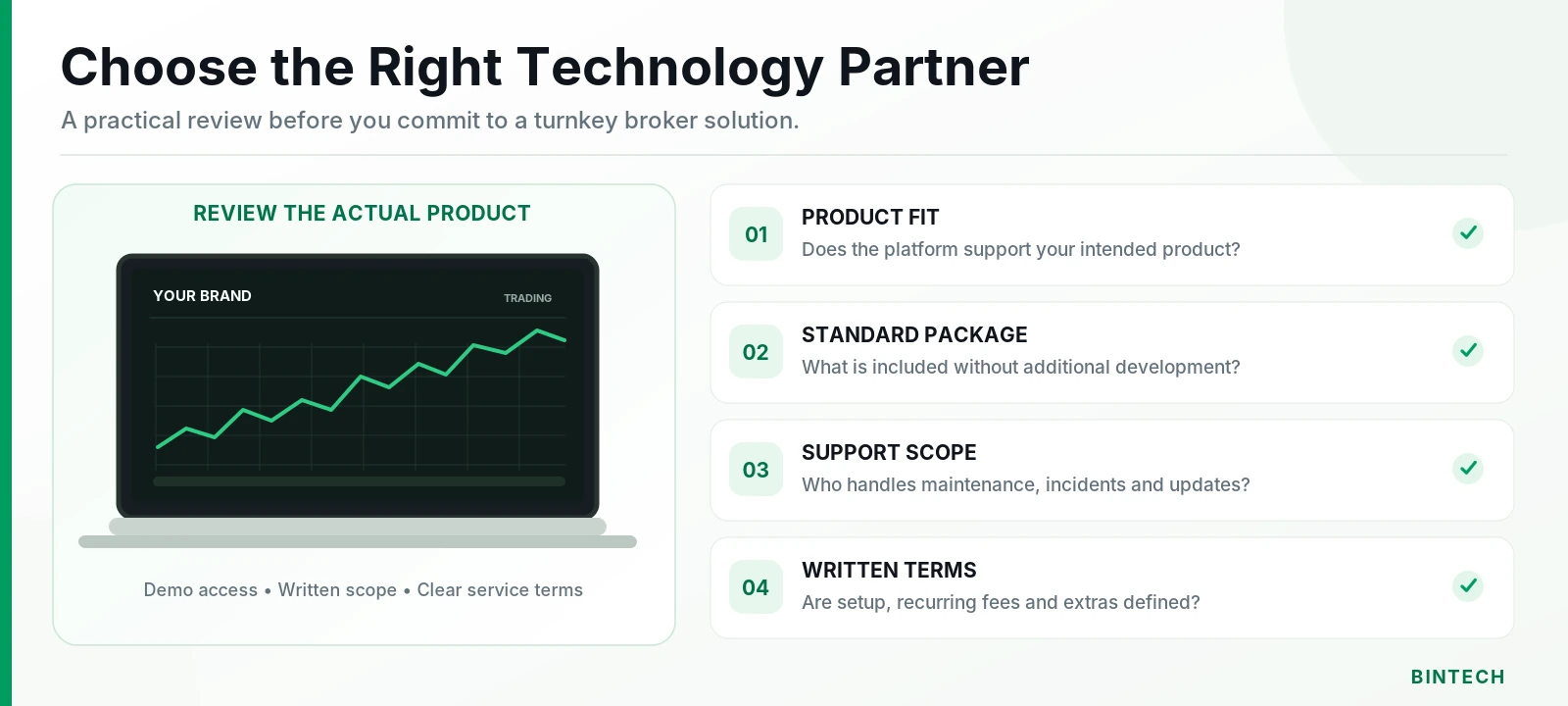
How to Evaluate a Provider’s Demonstration
A demo is the most practical opportunity to understand the difference between a provider’s marketing description and its existing product.
However, demonstrations are more informative when every shortlisted supplier is asked to show comparable scenarios.
Without a consistent evaluation method, one presentation may focus on attractive charts, another on administrative reporting, and a third on branding. The buyer is then left comparing different experiences rather than equivalent product capabilities.
Use One Evaluation Scenario for Every Provider
Prepare a short description of your intended project and select the functions that matter most to it.
For example, an affiliate-focused business might want to see how the provider presents the customer-facing platform, what administrative partner information is available, and which functions can be configured without development.
A team with a distinctive visual concept might place greater emphasis on available templates, responsive layouts, and individual design possibilities.
These priorities should be shared with every provider before the demonstration.
Distinguish Existing Software from Planned Development
During the presentation, ask whether each important feature is part of the existing product.
Some demonstrations may include simulated information or restricted administrative access. That is not automatically a problem. The supplier should simply explain what is being shown and which functions will be available under the proposed package.
If a requested feature does not exist in the standard product, ask how additional development would be evaluated rather than assuming it is already included.
Evaluate the Working Relationship
The demonstration also provides an opportunity to understand how the supplier communicates.
Can the team explain the available options clearly? Does it distinguish standard functionality from custom work? Can it provide understandable information about deployment and maintenance?
These interactions matter because cooperation with the technology provider continues after the initial sale.
A good demonstration should leave the prospective client with a clearer understanding of the actual product and the next commercial decisions.
Technical Maintenance: Compare the Service Behind the Platform
Two providers may offer similar customer-facing interfaces while organizing their technical services differently.
For a business without an internal software development department, this difference can strongly influence the day-to-day operating model.
The supplier’s responsibility may include some combination of platform maintenance, infrastructure monitoring, backups, technical incident handling, and updates to the existing software.
These activities should be understood as part of the overall technology service rather than treated as an afterthought.
Identify What the Provider Maintains
Ask whether the supplier handles the environment in which the software operates and which maintenance activities are included in the service.
For example, the client should know who manages relevant server maintenance and backup routines, and how technical issues are escalated.
The objective is to establish a clear division of responsibilities rather than make assumptions based on the phrase “full support.”
Understand Support Availability
Support availability should be evaluated in the context of the service being provided.
A provider may advertise 24/7 technical assistance, but the client should still understand the available communication channels and how issues are handled under the relevant agreement.
Bintech’s documented offering includes 24/7 technical support, continuous monitoring, server maintenance, backups, and DDoS protection.
The company also provides onboarding guidance and consultations to help clients understand the available administrative functions.
Consider Future Changes
An operating platform may require adjustments as the business develops.
Some changes can be made using existing settings. Others may involve individual design or software work.
A useful commercial proposal explains how such requests are submitted and evaluated.
With Bintech, non-standard features and design modifications can be discussed with the technical team and assessed separately for cost and implementation timing.
Payment Integrations: Compare Actual Availability
Payment functionality can be a major consideration when evaluating a turnkey broker solution, but provider integration lists should be interpreted carefully.
A software company may advertise support for many payment systems. That describes technical integration possibilities, not necessarily the external commercial arrangements available to every client.
The operator should distinguish the software-side functionality from the approval, geographic availability, settlement conditions, and charges established by the payment service provider.
Start with the Methods Relevant to Your Project
Instead of comparing the total number of integrations advertised by different software suppliers, identify which payment services are appropriate for your intended operating markets.
Ask each shortlisted provider whether those integrations are supported, how they are configured, and what is required from the operator.
A platform with a large integration catalog may be useful, but the practical value depends on the services you actually need and can access.
Clarify Integration Responsibilities
Find out which party will configure the software connection and which external arrangements the operator must obtain.
If the intended method requires additional integration work, that should be identified in the quotation.
This helps the buyer compare the actual project scope rather than assume that every supported external service is ready for immediate activation.
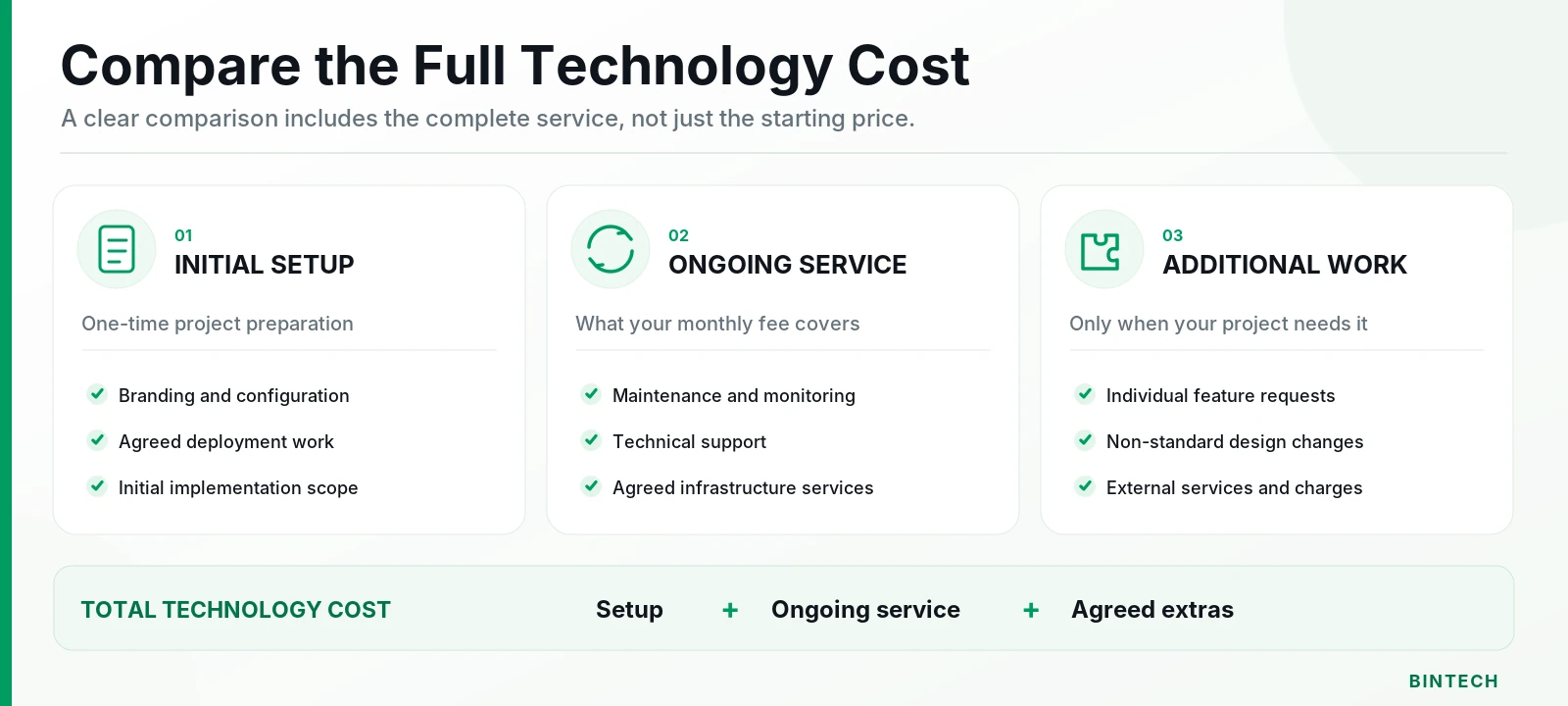
Compare Pricing as a Complete Commercial Offer
Turnkey broker solutions are sold through different commercial structures. Some providers advertise starting packages, while others supply individual quotations based on the required product and service scope.
As a result, the lowest published setup fee is not necessarily the lowest overall cost for a comparable project.
A useful comparison considers the agreed initial setup, recurring technology services, the standard software modules, the relevant infrastructure arrangement, and any individual work needed for the intended configuration.
Initial Payments
An initial payment may cover branding, project configuration, software deployment, or other agreed implementation services.
The exact scope should be identified in the commercial proposal. Two offers with similar initial prices may include different amounts of work.
Recurring Service Charges
Recurring payments may cover technical support, ongoing maintenance, infrastructure services, or other agreed responsibilities.
Some pricing structures also depend on a defined measure of platform activity. When this applies, the buyer should understand exactly how that measure is calculated.
Bintech’s current commercial proposal uses an initial branding and deployment payment together with a recurring service arrangement. The latest presentation should be used to confirm the applicable figures and conditions.
Additional Development
Individual modifications can affect the total project cost.
Before comparing quotations, identify which requested changes are already supported by the existing product and which would require new work.
A quotation for a standard package should not be compared directly with a proposal that includes extensive custom development unless the difference is made clear.
Compare the Same Operating Period
If one provider quotes a lower initial price but higher recurring charges, while another has a different balance of payments, the offers should be compared over the same period.
A practical cost comparison may use the following structure:
Estimated technology expenditure for the selected period = initial setup + recurring supplier charges + agreed custom work + relevant external technology costs.
This is a comparison framework, not a forecast of business profitability. It helps organize the technology-related expenses attached to each proposal.
For an accurate result, use written quotations and supplier-specific definitions rather than hypothetical amounts or figures taken from unrelated businesses.
A Practical Comparison Matrix for Shortlisted Providers
Once the initial research is complete, create a shortlist and compare every provider using the same criteria.
The goal is not to award arbitrary points based on marketing claims. It is to establish which product best fits your project and which information still needs to be confirmed.
| Evaluation Criterion | Evidence to Request | What to Compare |
| Product suitability | Relevant product demonstration | Whether the software supports the intended trading product |
| Standard functionality | Written module list | Functions included in the quoted package |
| Brand customization | Design examples and configuration options | Available templates, content controls, and individual design scope |
| Administrative tools | Controlled demonstration or product documentation | Available management functions relevant to the operator |
| Affiliate functionality | Partner module description | Included partner tools and available configuration options |
| Payment integration | Supported integration information | Relevant methods, implementation conditions, external dependencies |
| Technical services | Service scope | Maintenance, monitoring, backups, and support responsibilities |
| Customization requests | Individual development process | How new requirements are evaluated and priced |
| Commercial terms | Current written quotation | Initial payment, recurring charges, and additional costs |
| Project cooperation | Named contacts and agreed communication process | Clarity of responsibilities and ease of coordination |
Complete the matrix using information supplied by each shortlisted provider. Where an answer is not yet confirmed, mark it as requiring clarification instead of guessing.
This makes the final selection easier to explain and prevents a decision from being dominated by a single attractive screenshot or headline price.
How to Request Comparable Proposals
The quality of the final comparison depends on the information provided to the suppliers.
If every provider receives a different description of the project, the quotations may contain different assumptions, making them difficult to compare.
A short, consistent request can improve the process considerably.
Describe the Intended Business
Explain which trading product your brand intends to offer, the customer-facing experience you are looking for, and the basic commercial requirements of the project.
Where relevant, describe whether the team already has experience in affiliate marketing, operates media channels, or intends to develop a partner network.
This context helps the provider understand the intended use of its software.
Identify Essential Requirements
Specify the capabilities that matter most to your business.
For example, a team planning to build its own affiliate network may regard partner management and traffic reporting as essential. Another business may prioritize specific languages or design flexibility.
Distinguish essential requirements from preferences. This gives providers the opportunity to explain how their standard offering fits the project without treating every optional idea as mandatory.
Request an Itemized Scope
Ask for a clear description of the existing product, the included services, and any proposed individual work.
The response should make it possible to distinguish the standard software from additional requirements and identify the recurring technical responsibilities.
Once the information is available, the operator can compare proposals based on the same business concept.
Which Turnkey Solution Is Right for Your Business?
Different operating models can place different demands on a software supplier. The best choice depends on the specific project rather than the general size or reputation of the provider.
For an Established Affiliate or Traffic Acquisition Team
A team that already knows how to attract relevant traffic may prioritize a complete existing platform, an integrated partner system, administrative reporting, and ongoing technical support.
Its goal is often to focus on marketing and commercial development while avoiding the need to maintain the software independently.
Bintech’s All Inclusive model is designed around this type of arrangement: ready-made binary options technology, supported configuration, partner functionality, and technical maintenance provided by the supplier.
If your team is exploring the transition from affiliate marketing to a branded project, our guide to building your own trading brand explains that business opportunity in more detail.
For a Business Considering Several Trading Products
A company planning to evaluate Forex, CFDs, digital options, or other trading formats should compare providers according to the specific products they support.
A supplier with a broader product portfolio may be worth examining, but the relevant functionality, technical requirements, and commercial conditions should be confirmed for each selected product.
The buyer should not assume that a feature described for one trading vertical is automatically available in another.
For a Project with Extensive Individual Requirements
Some businesses have a distinctive product concept requiring significant changes to the available software.
In this situation, the key comparison concerns the supplier’s ability to evaluate and implement the additional scope, rather than simply the breadth of its standard feature list.
Before choosing a provider, determine which requirements are essential to the business and which can be addressed through existing configuration.
This can prevent unnecessary individual development and create a clearer understanding of what the selected supplier will deliver.
Why Bintech Is Worth Considering
For businesses focused on binary options, Bintech offers an established ready-made software foundation rather than a project that must be built from the beginning.
The company’s commercial model is straightforward: one All Inclusive standard package, supported branding and configuration, and an ongoing technical service arrangement.
Existing modules include the documented trading and administrative functionality, built-in affiliate tools, account management, supported integrations, and platform communication features.
The software is deployed on the client’s selected domain and dedicated server. Bintech handles the agreed technical implementation and continuing maintenance, with 24/7 support and monitoring.
The source code remains with Bintech and is not transferred to clients. The client uses the configured platform under its own brand and manages the commercial direction of the project.
This division of responsibilities can be particularly attractive for businesses whose strengths are marketing, audience development, and partner management.
Instead of managing an internal team to maintain the standard trading software, the operator can concentrate on developing a recognizable brand and organizing its business activities.
Additional design or functionality requests can be discussed separately with Bintech when the project calls for something beyond the existing standard configuration.
For the full product description, including included modules and commercial arrangements, explore the Bintech White Label Binary Options Platform.
What Happens After You Choose a Provider?
Once a suitable supplier has been selected, the comparison process turns into a concrete project discussion.
The operator can agree on the initial configuration, provide the relevant brand materials, identify the intended integrations, and coordinate the implementation requirements with the technical team.
With a ready-made solution, the underlying software already exists. The project can therefore concentrate on the selected configuration and the preparations necessary for its intended use.
Bintech typically describes standard technical launch periods of approximately 2-4 weeks, depending on the agreed configuration and individual project requirements. The final schedule should be confirmed directly with the team.
Technical deployment is separate from any external commercial approvals or market-specific requirements the operator must address.
A more detailed explanation of project preparation, configuration, testing, and the go-live process is available in our practical guide to launching a binary options broker.
Frequently Asked Questions About Turnkey Broker Solutions
Are all turnkey broker solutions essentially the same?
No. Providers differ in their supported trading products, standard software modules, customization options, technical services, and commercial terms. A meaningful comparison should use the specific configuration and written proposal being offered.
Should I compare binary options platforms with MetaTrader 5?
Only when the comparison reflects your intended business. MetaTrader 5 is associated with Forex, stock, and futures trading technology. A business specifically planning a binary options platform should compare products designed for that trading format rather than treating every trading terminal as an equivalent turnkey solution.
Does TradingView provide a complete turnkey binary options brokerage?
TradingView is primarily a charting and market analysis technology provider. Its tools can be relevant within a broader trading system, but its charting product should not be confused with a complete binary options platform offering. Bintech supports TradingView-based charting within its software.
How can I compare providers with different pricing models?
Review the same operating period and compare the initial implementation scope, recurring supplier charges, standard functionality, and any individual work required for your project. Request current written quotations rather than relying exclusively on starting prices from marketing pages.
Is the provider with the most features necessarily the best choice?
No. A relevant standard package, suitable operating tools, clear technical responsibilities, and understandable commercial terms can be more valuable than features your business does not intend to use.
How do I know whether an advertised feature is included?
Request a written description of the exact standard package and verify important functions through a demonstration. Clarify whether the feature is already available, requires configuration, or depends on additional development.
Does Bintech offer different software packages?
Bintech provides one All Inclusive standard package rather than multiple tiers of core software modules. Additional individually requested development can be discussed and priced separately.
Does Bintech provide maintenance after deployment?
Yes. Bintech provides ongoing technical services, including 24/7 support, continuous monitoring, server maintenance, and backup routines under its documented offering.
Can I compare Bintech with other providers before deciding?
Yes. The most useful approach is to review the existing Bintech demo and commercial presentation, then compare the functionality and service scope with other suppliers using the same requirements.
Choose a Technology Partner That Fits Your Business
A turnkey broker solution is more than a trading interface. It is the technological foundation around which an operator can develop a branded trading business.
The best provider for your project is one whose existing software, configuration options, technical responsibilities, and commercial conditions match what you want to build.
Comparing providers systematically helps you look beyond marketing claims and focus on the actual product: what is included, how it can be adapted to your brand, and which technical services will continue after deployment.
Bintech combines ready-made binary options software, standard modules, configurable branding, integrated affiliate tools, and ongoing technical support in its All Inclusive offering.
If you already have experience attracting trading traffic or are exploring your own branded platform, reviewing the existing Bintech product is a practical next step.
Explore the demo, review the current presentation, and discuss how the available platform can support your project.