
Turn Traffic into Your Own Broker: Platform for Affiliates

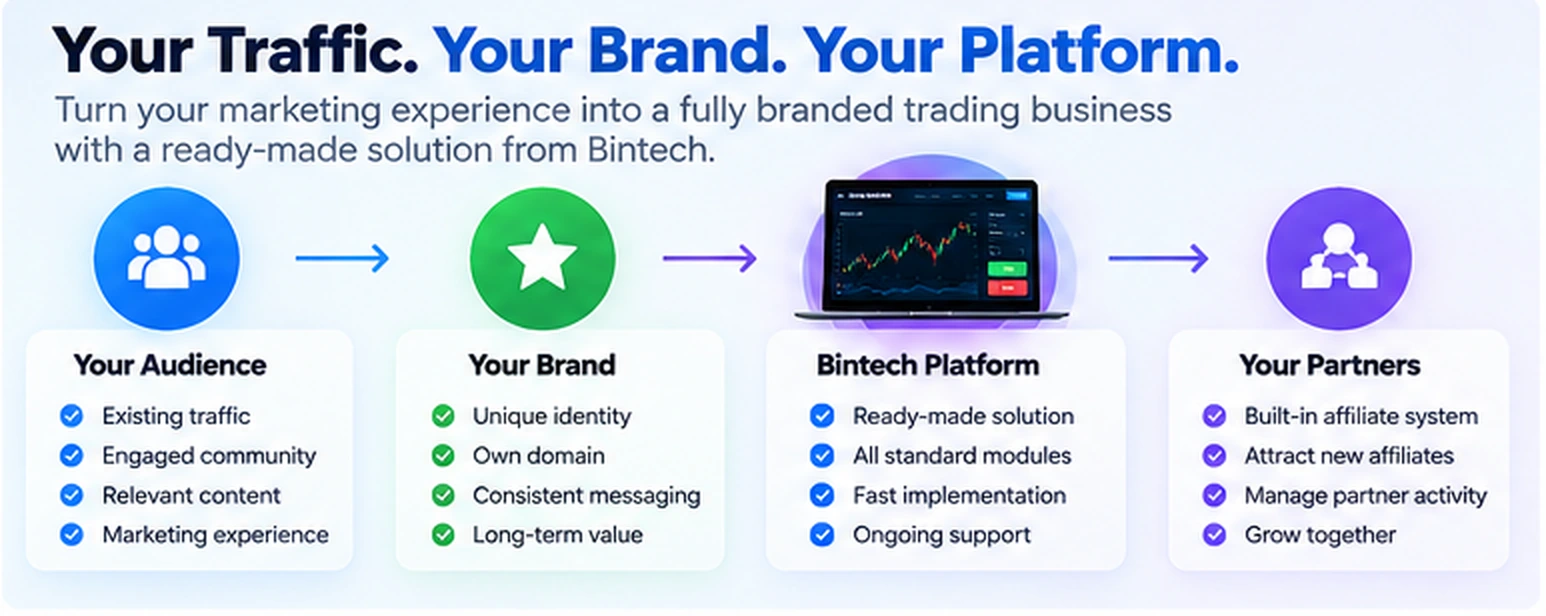
If you buy traffic for binary options brokers, you already do the part of the business that most new brokers find hardest and most expensive: bringing in clients. You know which sources convert, what a depositing client costs and how to scale a working campaign. What you do not have is the engine your traffic runs into – the trading platform, payments, back office and everything that turns a click into revenue. That engine belongs to someone else, and so does most of the money it makes.
This page is for affiliate marketers, media buyers and partner teams who are thinking about how to turn traffic into their own broker. We explain what actually changes in the money, how a binary options broker earns and where its risks are, what a white label broker platform takes off your hands, what stays with you, and when it is still too early to make the move. At Bintech we provide a white label platform for binary options, so the examples come from our product; the economics are illustrative and meant for you to replace with your own numbers.
The engine and the fuel
A useful way to think about a brokerage is a car. The broker is the engine: trading terminal, price feed, deposits and withdrawals, admin panel, analytics, affiliate system, retention tools, servers and security. Traffic is the fuel: buying, creatives, funnels and partners who bring people in. Neither works without the other. A broker with a perfect platform and no traffic makes nothing, and every broker, however large, depends on good affiliates for exactly that reason.
A new broker who arrives with money but without traffic experience can buy a platform and launch it. Then the expensive part begins: months of testing geos, sources and creatives, paying for every mistake. A media buyer has already been through that stage. The difference is that until now you have been fuelling someone else’s engine.
Where affiliate income hits a ceiling
Affiliate work is a good business, and many teams run it profitably for years. But it has a ceiling, and it comes from four places. First, you earn a rate or a share, not the revenue itself: whether you work on CPA or RevShare, most of what your client generates stays with the broker. Second, the client is not yours. How support answers, how fast withdrawals go through, which bonuses the client is offered – the broker decides, and if they get it wrong, your traffic burns. Third, transparency: you see the statistics you are shown, and when your numbers and the broker’s disagree, there is little you can prove. Fourth, you have no say in the product. If your geo needs a different deposit page, a tournament or a different bonus, you can ask, but you cannot decide.
What changes when the broker is yours
The work itself stays the same: you bring clients. What changes is how much of the result stays with you and what you control.
| Aspect | As an affiliate (CPA / RevShare) | scope=”col”>As a broker owner |
| Income per client | A rate or a share | All revenue, minus your costs |
| How long you earn | As long as the offer terms allow | As long as the client trades |
| Clients who come by referral | Usually go to the broker | Yours, at no acquisition cost |
| Conditions and bonuses | Set by the broker | Set by you |
| Data | The broker’s report | Full analytics in your admin panel |
| Costs | Traffic only | Traffic, team, platform, payment fees |
The last row matters. Owning a broker does not automatically mean more money; it is a different business with fixed costs that an affiliate does not carry. The upside comes from three things an affiliate rarely gets: revenue for the whole lifetime of the client, clients who arrive through recommendations, and the margin on traffic brought by your own sub-affiliates.
Referrals: the effect affiliates never see
Take an illustrative example. You bring in 500 clients through paid traffic at $40 each and spend $20,000. If the platform is fast, clear and pays out without friction, some clients start sending friends the link. Say one in five brings one person. That is 100 more clients for free, and your $20,000 is now spread across 600 people: the real cost per client falls to about $33 instead of $40. As an affiliate, those 100 clients go to the broker. As the owner, they are yours.
The practical conclusion is that product quality directly affects acquisition cost. A slow platform, an unanswered chat or a withdrawal that hangs for a week does not just lose a client; that client will never bring anyone else.
How a binary options broker earns – and where the risks are
In a binary options trade, the client predicts whether the price will be higher or lower after a set time. A correct prediction earns a fixed payout, for example 80% of the trade amount; a wrong one loses the amount. The broker is the client’s counterparty. Its revenue is the net result of all client trades, minus bonuses, payment fees and affiliate payouts. Unlike forex, where brokers choose between passing orders to liquidity providers (A-book), taking the risk themselves (B-book) or a hybrid, binary options have one model: the broker is always the counterparty. That makes two things critical – the right payout percentages and protection against abuse.
| Risk | What the Bintech platform provides | What you decide |
| Faulty or anomalous quotes | Quote monitoring that detects anomalies and suspends trading automatically | How clients are informed |
| Payouts that are too high or too low | Real-time control of currency pairs and payout percentages | Which conditions to set |
| Multi-accounts and bonus abuse | Multi-account and suspicious activity detection | Bonus rules and measures |
| Disputes with clients or affiliates | Full logging of player and partner actions | Who reviews and replies |
| Attacks and downtime | DDoS protection, 24/7 monitoring, backups | – |
What the platform takes off your hands
A white label broker for media buyers only makes sense if it removes the technical side completely. On Bintech, the platform is one system: a trading terminal with animated and TradingView charts, real, demo and tournament accounts, real-time market and OTC quotes, payment system integration with multiple currencies and API-based payouts, an admin panel with finance and traffic-source analytics, a built-in affiliate program, retention tools, live chat and tickets, notifications on the site and in Telegram, and a PWA for Apple and Android. It runs on your domain and a dedicated server, and our team handles monitoring, updates, backups and DDoS protection around the clock.
Several things on that list matter more to a media buyer than to anyone else. Analytics by traffic source with full separation of financial flows means you measure each source by the money it brings, not by registrations. The PWA installs from the browser, so mobile traffic does not depend on app store moderation. Page speed is optimised across the platform, so fewer paid clicks are lost before registration. And if a domain gets blocked, we help you move to a new one quickly. Our specialists also advise on management, finance, traffic acquisition and player relations, not only on technical questions.
| You | Bintech |
| Traffic, partners and brand | Platform, updates and new releases |
| Conditions, bonuses, tournaments | Dedicated server, 24/7 monitoring, backups |
| Support and finance team | Quotes and DDoS protection |
| Legal structure and licensing questions | Fast domain replacement in case of blocking |
| Agreements with payment providers | Advice on management, traffic and player relations |
Your own affiliate program: from partner to network owner
Once the broker is yours, you can bring in other media buyers and teams who are not ready, or do not want, to run a brokerage themselves. The built-in affiliate program shows each partner their registrations, deposits and earnings, and every partner action is logged in the admin panel, so payout disputes are settled on facts. Reward models are agreed during setup. This is where your background is a real advantage: you know from experience what affiliates are missing – clear statistics, transparency and reliable payouts. Give your partners that, and they will work longer and better for you. On partner traffic you pay the partner’s share and keep the rest; your own traffic stays entirely yours.
Setting up your own affiliate program: what to define
An affiliate program on paper is a reward percentage. In practice it is a set of rules that decides whether partners trust you and whether their traffic is worth paying for. Before you invite the first sub-affiliate, define the following – you have seen what happens when brokers leave these vague.
| What to define | Questions to answer | Why it matters |
| Reward model | CPA, RevShare or hybrid; for which geos; what counts as a qualified client | Determines your margin on partner traffic |
| Hold and payout schedule | How long rewards are held, how often and how they are paid | Partners judge you by how predictable payouts are |
| Traffic rules | Allowed sources and creatives, what claims are forbidden, brand bidding | Protects your payment providers and your reputation |
| Quality checks | How multi-accounts, bonus hunting and fake traffic are detected and handled | Stops you paying for clients who never generate revenue |
| Reporting | Which metrics partners see and how often | Transparency is the main reason good partners stay |
| Dispute handling | Who reviews a claim and what data is used | Logged partner actions let you resolve disputes on facts |
Moving your traffic step by step
You do not have to switch all your campaigns on day one, and you should not. The safest way to turn traffic into your own broker is to move it in stages, keeping part of your volume on existing offers while your brand proves itself. Each stage has a question it must answer before you move to the next.
| Stage | Share of your traffic | What you check |
| Soft launch | A small test volume from one or two proven sources | Registration, first deposit, first withdrawal and support work end to end |
| Validation | A noticeable part of your volume in one geo | Conversion to deposit and revenue per client compared with your affiliate offers |
| Expansion | Most of your traffic in the first geo; sub-affiliates invited | Repeat deposits, withdrawal times, partner traffic quality |
| Scale | Your traffic plus partner network; new geos one at a time | Cumulative cash flow and break-even point |
Exact shares depend on your volume and reserve; the principle is that every step is decided by numbers from the previous one, not by enthusiasm. Keeping some offers running also protects your income while your own brokerage climbs towards break-even.
The funnel you now own
As an affiliate, your view of the funnel usually ends at registration or first deposit. As an owner, every stage is yours to measure and improve – and that is where much of the extra margin comes from.
| Funnel stage | As an affiliate | As a broker owner |
| Click to landing | You control | You control, plus page speed on the platform |
| Registration | Broker’s form | Email or social login, your design |
| Demo to real account | Not visible | Demo account as a step in your funnel |
| First deposit | Broker’s deposit page | A conversion-optimised deposit page, your payment methods |
| Repeat deposits | Not visible or not paid | Bonuses, tournaments, missions, notifications |
| Referrals | Lost to the broker | Yours |
How to compare sources by money rather than by registrations is explained in our guide to the broker onboarding funnel.
Mistakes affiliates make when they become brokers
The mistakes we see are rarely about traffic – that part affiliates handle well. They are about the new half of the business. The first is treating withdrawals as a back-office detail: clients forgive a lot, but not a payout that hangs without explanation, and nothing kills referrals faster. The second is switching every campaign over at once and losing affiliate income before the brokerage covers its costs. The third is copying aggressive bonus mechanics from the offers you used to promote, without the rules and fraud checks that made them affordable. The fourth is running sub-affiliates the way you were run – with vague statistics and unpredictable payouts – and losing the best partners within months. The fifth is postponing the legal and payment work because the platform is ready, and then waiting with a finished platform and no way to accept deposits. Each of these is avoidable with the steps on this page.
Retention: the job affiliates never had
An affiliate is paid for bringing a client and moves on. An owner earns while the client trades, so retention becomes part of the job. The platform includes “Risk-Free Trades” bonuses that take the fear out of a first trade, tournaments and a monthly leaderboard that give clients a reason to come back, statuses, achievements and missions, a daily login reward, bonuses and promo codes for repeat deposits, and notifications you send from the admin panel. Tournaments and promo codes also double as marketing material for your creatives and partners. Switch these tools on one at a time, with a clear goal and written rules for each, and watch the numbers.
The economics: an illustrative example
Every geo, deposit size and traffic price is different, so treat the numbers below as a model to copy, not a forecast. Assume an active client deposits $150 a month on average and the broker’s revenue is 30% of deposits, or $45. Subtract bonuses at 5% of deposits ($7.50), payment fees at 4% ($6) and affiliate payouts – if half your traffic comes from sub-affiliates on a 40% RevShare, that averages 20% of revenue ($9). That leaves $22.50 per active client per month, or $31.50 for a client you brought yourself.
| Month | 1 | 2 | 3 | 4 | 5 | 6 |
| Active clients | 300 | 500 | 700 | 850 | 1,000 | 1,100 |
| Left to the broker | $6,750 | $11,250 | $15,750 | $19,125 | $22,500 | $24,750 |
| Team and traffic | −$14,000 | −$14,000 | −$14,000 | −$14,000 | −$14,000 | −$14,000 |
| Monthly result | −$7,250 | −$2,750 | +$1,750 | +$5,125 | +$8,500 | +$10,750 |
| Cumulative | −$7,250 | −$10,000 | −$8,250 | −$3,125 | +$5,375 | +$16,125 |
Fixed costs in this example are $8,000 a month for the team and services plus $6,000 for traffic. The platform fee is deliberately left out – add it from our commercial proposal. Break-even here is 623 active clients ($14,000 ÷ $22.50). A team that has to find working traffic from scratch can sit at 200–300 clients for months; a media buyer who redirects campaigns that already work passes that point much faster. Run your own numbers in our broker profit calculator.
Influencers and communities
The same logic applies to a trading platform for influencers and community owners. A blogger or channel with an engaged trading audience faces the same choice as an affiliate: promote someone else’s broker for a fee, or build a brand of their own and keep the relationship with the audience. The audience is the traffic; the platform is the engine. The conditions are also the same – a legal structure, payment providers, a support team – plus one more: marketing that follows the rules of each market and is honest about risk, because an audience’s trust is the asset the whole model rests on.
When it is too early
We would rather you launch when you are ready and stay in business than launch early and close in three months. It is too early if your traffic is not yet stable: debug your campaigns on affiliate offers first, where mistakes are cheaper. It is too early if you have no reserve for the first months, since the example above runs at a loss before it turns. It is too early if the legal side is not settled: jurisdiction and permitted markets must be confirmed with a lawyer, and in the EU and the UK binary options cannot be sold to retail clients at all. A platform provider, including us, does not replace a licence, and agreements with payment providers are signed by your company. And it is too early if nobody is ready to handle support, withdrawals and partners from the first client. If you have an answer to all four, you are ready.
How the launch works
We agree the configuration with you – geos, languages, currencies, payment solutions and team roles – then set up the brand on a ready template or a custom design, deploy the platform on your domain and a dedicated server, test the full client journey from registration to withdrawal and train your team with an admin panel guide, a product overview and an online consultation. The technical launch usually takes up to 4 weeks, and longer for custom development or when our team is at full capacity. Start the legal and payment work on day one, in parallel. For the wider business checklist, see how to start an online brokerage, and for the model itself, what is a white label broker.
Bintech has a single All Inclusive plan: the affiliate program, PWA, retention tools and support are all included, with no packages to upgrade. Current terms are in our presentation. If you are ready to turn traffic into your own broker, message us on Telegram – we will show you the terminal, admin panel and affiliate program in a demo.
FAQ
Can an affiliate marketer launch their own broker?
Yes. An affiliate already handles the hardest part of a brokerage, client acquisition. With a white label platform the technology is supplied and maintained by the provider, while the affiliate adds a legal structure, payment providers, a small team and their own brand.
Do I need developers to run my own broker?
No. On the Bintech platform our team runs the servers, updates, monitoring, backups, quotes and DDoS protection. Your team manages clients, conditions and money through the admin panel.
Can I keep working with my own affiliates?
Yes. The platform has a built-in affiliate program with statistics for each partner and a full log of partner actions, so you can bring in other media buyers and teams on your own terms.
Is a trading platform suitable for influencers?
An influencer with an engaged audience faces the same choice as an affiliate: promote someone else’s broker or launch a brand of their own. The same conditions apply – a legal structure, payment providers, a team and marketing that follows the rules of each market.
How long does it take to launch?
The technical launch on Bintech usually takes up to 4 weeks, and longer for custom development or when our team is at full capacity. Legal setup and payment provider approval run in parallel and often take longer.