
How to Start an Online Brokerage: Where to Begin
How to start an online brokerage is usually asked as if the platform were the main question. In reality the platform is the most predictable part: you can choose it, see it in a demo and launch it within weeks. Far more time goes into everything around it – which product to offer and where, what legal form to operate in, how to get payment providers to approve you, who processes a client’s first withdrawal and who answers them in chat at night. Most new brokerages that launch late do so not because of technology, but because these questions were answered in the wrong order.
This guide walks through how to launch a broker as a business, not just a website: choosing a business model, preparing the legal side, getting ready for payment providers, choosing a platform, building the team and policies, planning the first twelve weeks, budgeting and measuring the first ninety days. We write as a platform provider, so legal matters are covered as the questions to ask a lawyer rather than ready answers. For the step-by-step setup on a ready-made platform, see our separate guide on how to launch a binary options broker.
Step 1. Choose the business model
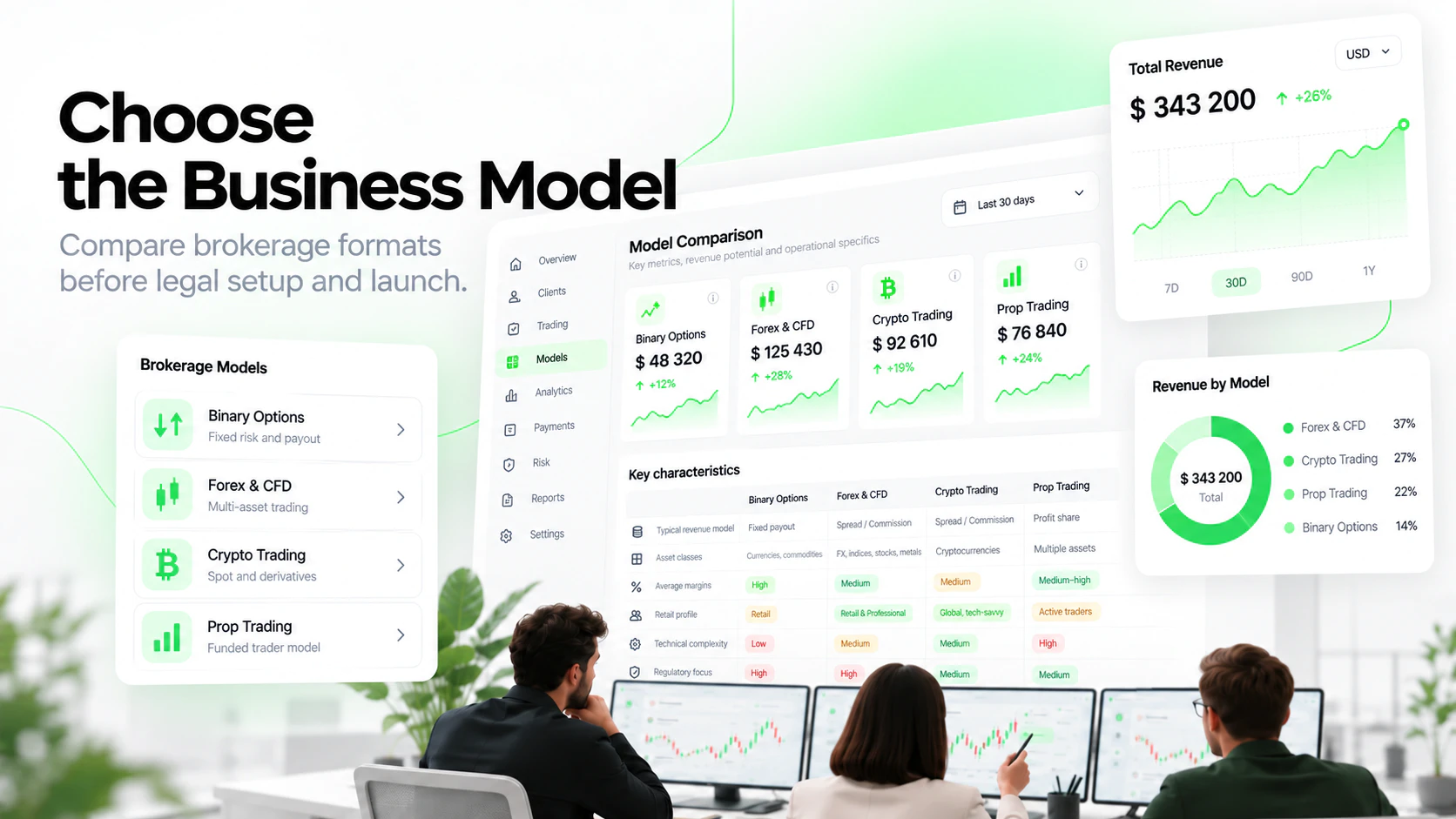
“Brokerage” covers several different businesses. They differ in how the company earns, how it is regulated, which payment providers will work with it and what the platform has to do. This choice comes before everything else, because it determines the jurisdiction, the licence question, the audience and the budget.
| Model | How the broker earns | What it means for the launch |
| Forex and CFD, agency (STP / A-book) | Spreads and commissions; client orders are passed to liquidity providers | Needs liquidity relationships and typically a licence in serious markets |
| Forex and CFD, market maker (B-book) | Takes the other side of client trades and earns on their net results | Needs strong risk management and capital; regulation is strict in major markets |
| Crypto trading platform | Trading fees, spreads, listing or service fees | Crypto-specific rules that differ widely by country; custody questions |
| Binary and fixed-payout options | Net revenue from client trades with fixed payouts | Banned for retail clients in the EU and UK; projects target other markets; simpler product and terminal |
| Prop trading firm | Evaluation fees; payouts to funded traders | A different model from a classic broker; its own legal and payment questions |
For binary options the regulatory context is especially important. In the European Union, marketing and selling binary options to retail clients was prohibited by a 2018 ESMA decision, later made permanent by national regulators, and in the UK the FCA introduced a permanent ban. Companies working with this product therefore choose other markets and confirm with a lawyer whether and how they may serve residents of each one.
Whatever the model, start with one or two markets you understand. A company that tries to operate “worldwide” from day one gets every legal question, every payment restriction and every support language at once – too much for a small team.
Step 2. Prepare the legal side: what to ask your lawyer
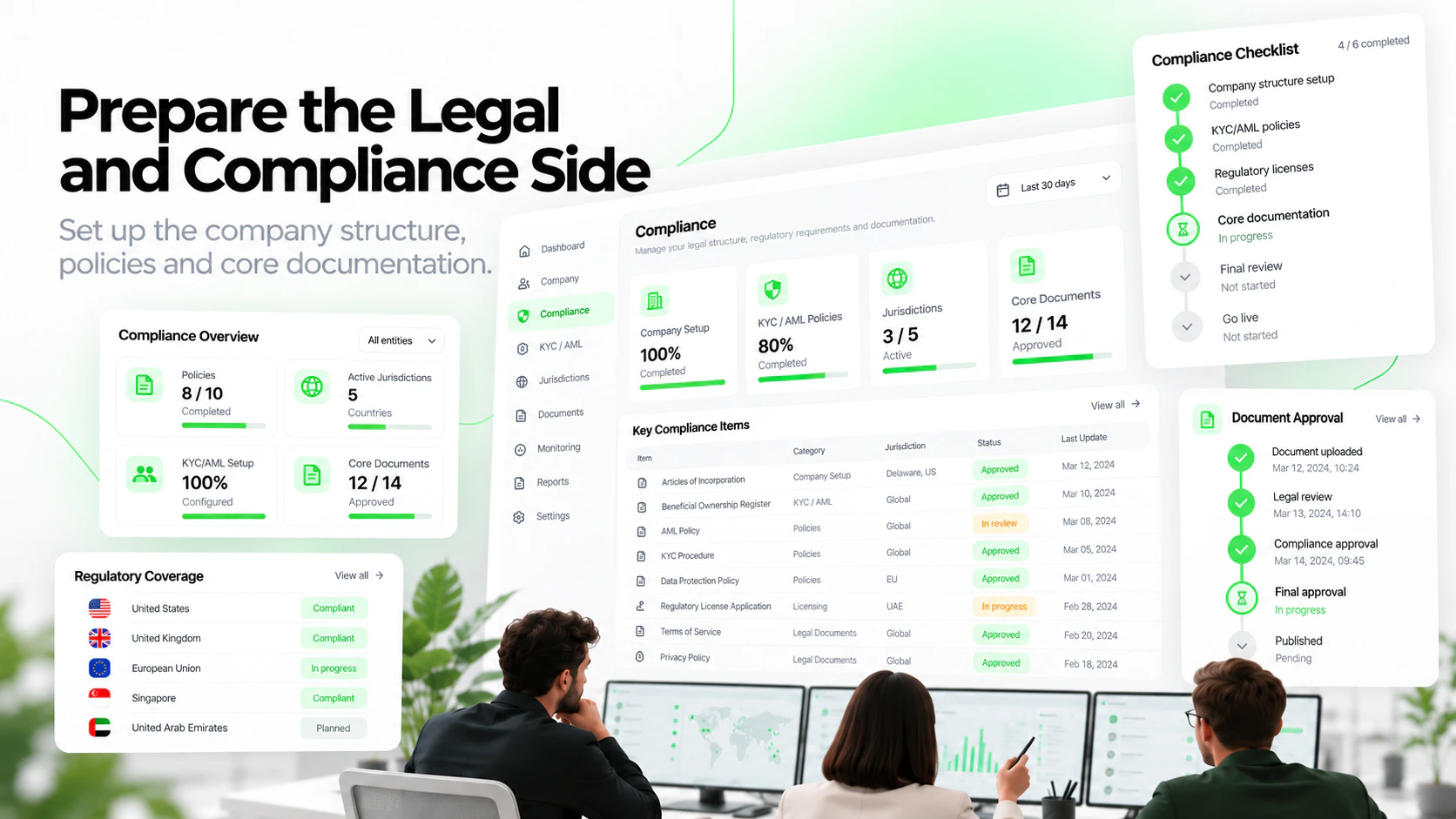
A brokerage is first of all a legal entity with a clear structure. Choosing it is work for a lawyer who knows the law of your target jurisdictions; the owner’s job is to arrive with the right questions and a clear description of the business. The table below is a working agenda for that first meeting.
| Area | Question to ask | Why it matters |
| Incorporation | Where should the company be registered given our product and markets? | Determines taxes, banking options and how providers see you |
| Licensing | Is a licence required for this product and for serving residents of each target country? | Operating without a required licence can end the business |
| Client documents | Which terms of service, risk warning, privacy policy and bonus rules do clients need before opening an account? | Payment providers ask for them; they also decide disputes |
| Client checks | What verification and anti-money-laundering obligations apply to us? | Affects onboarding flow, staffing and provider approval |
| Marketing | What may we say in ads and partner materials in each market? | Misleading claims create regulatory and payment risks |
| Data | Which data protection rules apply to our clients’ personal data? | Affects where data is stored and how it is handled |
The most common mistake is postponing this work “until after launch”. The platform can go live quickly, but without a structure and documents the company risks losing payment providers, losing its domain or facing claims that cost far more than a consultation. A platform provider, including us, does not take on legal responsibility for your company – we explain the split of responsibility in our article on white label platform risks.
Step 3. Get ready for payment providers

For most new brokerages, payment provider approval is the longest single task. Providers classify trading projects as high-risk and assess the whole company before connecting it. The faster you can hand over a complete, consistent package, the faster the approval – and the fewer refusals you collect along the way. The list below is what providers commonly want to see; exact requirements differ by provider.
| What providers usually review | What to prepare |
| The company | Corporate documents, owners and directors, business description |
| The website | A live site with terms of service, risk warning, privacy policy and contact details |
| Markets and clients | Target countries and the expected client profile |
| Traffic sources | How clients will be acquired: channels, partners, sample materials |
| Money flows | Expected volumes, average deposit, withdrawal policy and processing times |
| Controls | How you handle client checks, disputes, chargebacks and suspicious activity |
Start these conversations on day one, in parallel with the legal work, and aim for two or three providers with methods familiar to your market. A refusal or suspension by a single provider stops deposits completely. The Bintech platform supports multiple currencies and integration of compatible payment systems, and payouts are managed via API from the admin panel; the agreements with providers are signed by your company. More in our guide to payment integrations.
Step 4. Choose the platform: build, buy code or white label
There are three ways to get a trading platform, and for a new brokerage the choice is usually clearer than it looks.
| Option | What you get | When it makes sense |
|---|---|---|
| Build in-house | Full control, full responsibility, years of development | You already have clients, data, a unique model and an engineering team |
| Buy a script or source code | Code you must host, integrate, secure and maintain | You have developers and server administrators ready to own it |
| White label platform | A working system under your brand, maintained by the provider | You want to reach the market in weeks and focus on the business |
We compare scripts and platforms in detail in our guide to the binary options script. On the Bintech white label platform for binary options you get a terminal with animated and TradingView charts, real, demo and tournament accounts, an admin panel with finance and traffic-source analytics, a built-in affiliate program, bonuses, tournaments, missions and a leaderboard, a PWA for Apple and Android, and 24/7 support with monitoring, backups, DDoS protection and market and OTC quotes. The source code stays with us, which is why the technical side is our responsibility rather than yours. What the platform includes is described on our white label binary options platform page.
Step 5. Build the team around roles, not job titles
A brokerage differs from a website in that every process has an owner. At launch, two or three people usually combine several roles; the point is that no area is left without someone responsible.
| Phase | Roles to cover | Typical setup |
| Before launch | Owner and project lead, legal (external), payments and finance, marketing and partners | Two people plus an external lawyer and accountant |
| First three months | Support in the clients’ language, finance and withdrawals, retention and content, traffic and partners | Three or four people, some roles combined |
| Growth | Dedicated support shifts, an affiliate manager, an analyst, a compliance function | Roles split as volume grows |
Developers and server administrators are not needed on a white label platform. Each team member works in the Bintech admin panel under their own role – owner, administrator, content manager or support – and sees only what they need, with every action recorded in the log. How to organise that daily work is covered in our guide to broker CRM and back office.
Step 6. Write the policies before the first client arrives
More important than headcount are the rules the team follows. In the first weeks there is no time to invent them, and improvised decisions on withdrawals or disputes are what clients remember. These documents are short, but each one prevents a category of conflict.
| Policy | What it defines | Owner |
| Withdrawals | Checks before payout, internal processing time, reasons for delay or refusal, wording for clients | Finance |
| Bonuses and promotions | Conditions, eligibility, what happens with suspected multi-accounts | Finance and content |
| Disputed trades | How a complaint is investigated, what data is used, who decides | Administrator |
| Incidents | Who learns first, how the provider is contacted, what clients are told and through which channel | Owner |
| Support | Hours, languages, response time targets, escalation | Support lead |
| Partners | Allowed materials and claims, traffic quality rules, payout terms | Affiliate manager |
Step 7. Plan the first twelve weeks in parallel
The main reason launches drag on is sequential work where parallel work is possible: first a platform, then a lawyer, then payment providers – and the finished platform waits months for accounts. A realistic plan runs the workstreams side by side.
| Weeks | Business and legal | Payments | Platform and team |
| 1–2 | Product and markets fixed; lawyer engaged; incorporation started | Shortlist of providers for the target markets; first calls | Platform demo and commercial proposal; brand and domain chosen |
| 3–6 | Client documents drafted; marketing rules agreed | Application packages submitted | Platform configured on your domain – on Bintech usually up to 4 weeks; longer with custom features or when our schedule is full |
| 7–10 | Documents published on the site | Approvals and integration of approved methods | Team roles assigned; policies written; full test of the client path |
| 11–12 | Final legal check before go-live | Test deposits and withdrawals with real methods | Soft launch with limited traffic |
The weeks are a planning frame, not a promise: legal and payment timelines depend on jurisdictions and providers. The important thing is that none of the three columns waits for another to finish.
Step 8. Budget for more than the platform
The platform is one budget line among several, and for many brokerages not the largest. The biggest risk is not underestimating any single item but running out of money in the months when acquisition is already paid for and repeat deposits have not yet arrived.
| Budget line | One-time or recurring | What drives it |
| Legal and incorporation | One-time, then recurring | Jurisdiction, licensing, number of markets |
| Platform | Launch payment and ongoing fee | Pricing model and turnover; Bintech terms are in our presentation |
| Payment processing | Recurring | Provider fees, methods, volumes |
| Team | Recurring | Roles, languages, support hours |
| Client acquisition | Recurring | Channels, partners, markets |
| Bonuses and promotions | Recurring, tied to deposits | Promotion design and abuse control |
| Reserve | Held aside | Months until revenue covers costs |
We break down platform cost and compare buying with building in our article on binary options platform cost. To see how many active clients you need to break even, use our broker profit calculator.
Step 9. Launch small and measure the first 90 days
Opening the brokerage is the start of its most sensitive period. Everything that was not thought through becomes visible in the first weeks, and the cheapest way to find it is with a small volume of traffic. Scale only when the numbers below look stable and withdrawals are going through without delays.
| Metric | What it tells you |
| Registration to first deposit, by source | Which channels and partners bring real clients |
| Deposit success rate, by payment method | Where payments fail and which provider needs attention |
| Share of clients with a repeat deposit | Whether retention works |
| Withdrawal processing time | Whether clients will trust you enough to fund again |
| Support first response time and top topics | Where the product or communication is unclear |
| Revenue per client over 30 and 90 days, by source | Where to put next month’s budget |
The Bintech admin panel provides finance and traffic-source analytics with full separation of financial flows and detail on every player, partner and trade. How to read these numbers and why sources should be compared by money rather than by registrations is explained in our broker funnel guide; marketing channels are covered in our broker marketing guide.
The mistakes that cost new brokerages the most
We see the same mistakes again and again. A company chooses a platform before its markets and later finds that the chosen country requires something it does not have. Legal work is postponed, and payment providers refuse because documents are missing. The company relies on one payment provider, and a single suspension stops the business. Withdrawal and dispute rules are not written down, so the first conflicts with clients are resolved at random – and end up in reviews. The whole budget goes into traffic in the first month, leaving nothing for the period before repeat deposits arrive. Partners are paid for volume without quality checks and bring bonus hunters. None of these mistakes is about technology, and none is fixed by choosing the “best” platform; all of them are fixed by doing the steps above in the right order.
Conclusion
Starting an online brokerage means making a series of decisions in the right order: the business model and markets first, then legal structure and payment readiness, the platform and team in parallel, written policies before the first client, and a small, measured launch. The platform is the fastest link in this chain – with a white label solution there is no need to spend years building it. Bintech takes on the technology and 24/7 support so your company can focus on its market, clients and processes. Discuss your project with us on Telegram – we will show you the platform in a demo and send a commercial proposal.
Frequently asked questions
How do I start an online brokerage?
Choose the product and target markets first, then set up the legal structure with a lawyer, prepare for payment provider onboarding, choose a platform, build a small team with written policies and launch with a limited traffic budget. Legal, payments and platform work should run in parallel.
How do I launch a broker without building software?
Use a white label platform. The provider supplies the terminal, admin panel, payments integration, affiliate program and technical support under your brand, while your company runs clients, finance and marketing.
Do I need a licence to start a brokerage?
It depends on the product, the country of incorporation and the markets whose residents you serve. In the EU and the UK, selling binary options to retail clients is prohibited. Requirements for your specific structure must be confirmed by a lawyer before launch.
How long does it take to start a brokerage?
A realistic plan is around three months from decision to first clients. The platform on Bintech usually takes up to 4 weeks; legal structure and payment provider approval often take longer, so they start on day one.
What team does a new brokerage need?
At launch a few people cover client acquisition and partners, support, finance and payments, and retention, with an external lawyer and accountant. Developers are not required on a white label platform.
What should I measure in the first 90 days?
Registration-to-first-deposit conversion by source, deposit success rate by payment method, repeat deposits, withdrawal processing time, support response time and revenue per client by source.