
Broker Funnel: Why the Same Traffic Brings Different Money
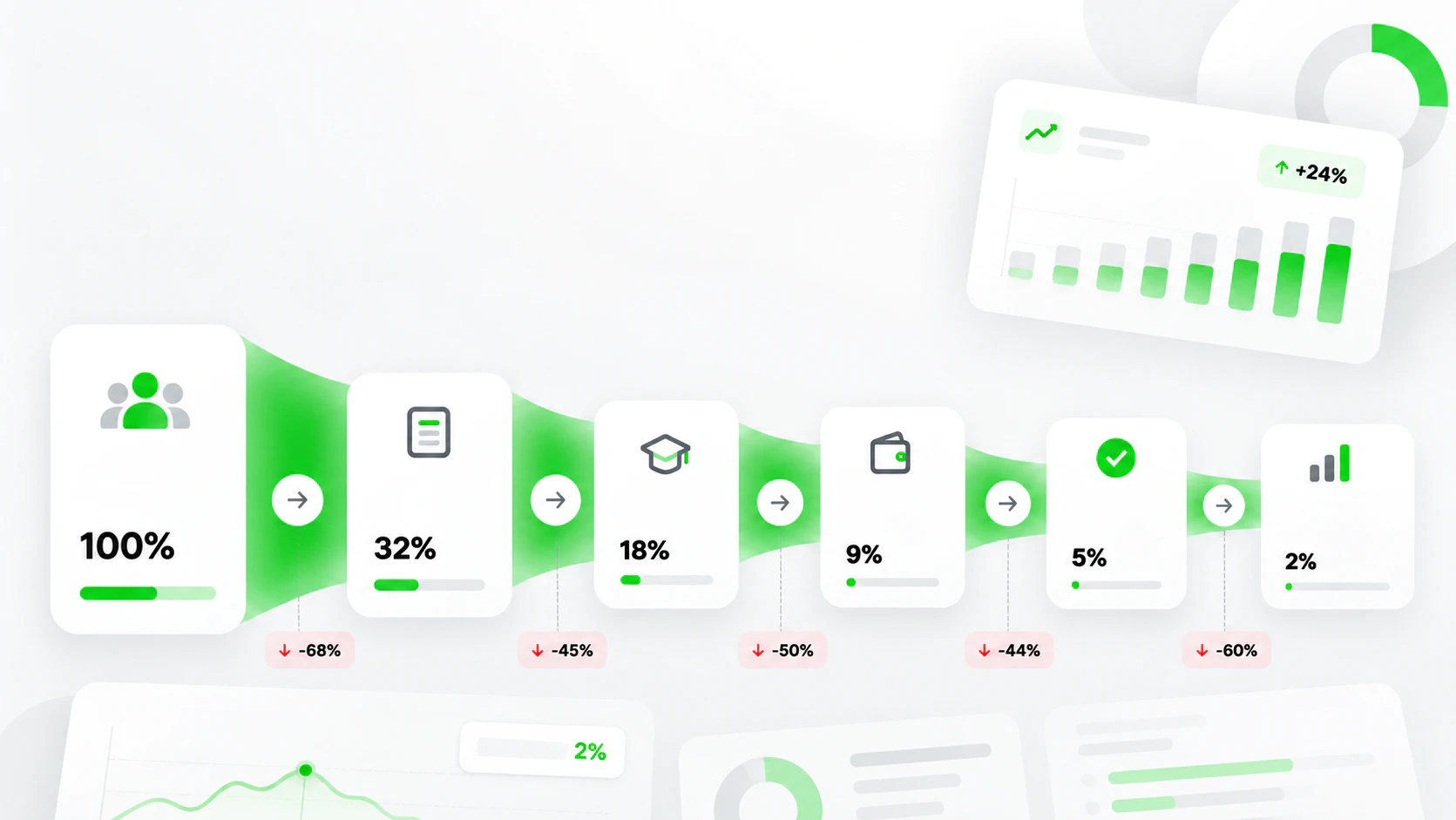
Imagine two traffic sources that each delivered a thousand registrations in a month. In the affiliate dashboard they look almost identical, and the first even has a slightly better deposit rate and a lower cost per deposit. Three months later it turns out the second source brought the project several times more money. There is nothing mysterious about it: everything that decided the outcome happened after the first deposit – where the affiliate dashboard never looks.
This article is about the broker funnel as a whole, from the promise in a creative to the third account top-up. We look at it from two sides: through the eyes of an affiliate team used to counting registrations and first deposits, and through the eyes of a brokerage owner who cares about revenue per client over months. The logic is the same for forex, crypto platforms and options, and where binary options have specifics of their own we say so separately. At the end there is a calculator that compares two sources by money rather than by volume.
The half of the funnel an affiliate sees, and the half a broker sees
An affiliate working on a partner program sees the funnel up to and including the first deposit. Their metrics are cost per click, registration rate, first-deposit rate, the CPA rate or the RevShare percentage. That is enough to optimize buying, but not enough to understand what a client is really worth. The broker sees what happens next: how many clients funded a second and third time, how much of the first deposit went to a bonus, who asked to withdraw the next day and never returned, which source brings people who trade for months.
When an affiliate team launches its own project, this difference becomes the main one. The habit of judging traffic by the first deposit stays, while the economics now depend on the second half of the funnel. That is why the first thing we advise teams moving from affiliate programs to their own brand is to track revenue per client at 30 and 90 days for every source from day one. Without it, it is easy to switch off the best placements and scale the worst. More on the move itself in our guide to launching your own trading business.
An example: two sources with the same registrations
The numbers are illustrative and only show the logic. Both sources brought 1,000 registrations on the same budget.
| Metric | Source A | Source B |
| Traffic spend | $6,000 | $6,000 |
| Registrations | 1,000 | 1,000 |
| First deposits | 220 (22%) | 150 (15%) |
| Cost per first deposit | $27 | $40 |
| Funded again within 90 days | 30 clients | 75 clients |
| Net revenue per client over 90 days | $22 | $70 |
| Project net revenue over 90 days | $4,840 | $10,500 |
| Result after traffic cost | −$1,160 | +$4,500 |
By cost per first deposit, source A looks almost one and a half times better. By money it loses, while B paid off comfortably. The reasons can vary: A may attract people with a generous welcome bonus, with a creative promise that does not match the product, or simply with an audience that gets bored quickly. What matters is that none of these reasons can be seen in the numbers before the first deposit.
Who on the team owns each stage
The funnel is often discussed as an abstract diagram, although every part of it has a specific owner. Without an owner, a leak goes unnoticed for months: marketing believes its job ended at registration, and support believes its job starts with a ticket.
| Part of the funnel | Owner | How the Bintech platform helps |
| Creative and partner promise | Traffic, affiliate manager | Analytics by partner and source, a log of partner actions |
| Registration and first login | Marketing, product | Registration via email or social networks, automatic language by region |
| Demo and first trade | Product, content | Demo and tournament accounts, missions and achievements for newcomers |
| Funding | Finance, payments | Optimized deposit page, multi-currency, payment integrations |
| Bonuses and abuse | Finance, anti-fraud | Bonuses and promo codes, multi-account and suspicious-activity detection |
| Retention | Content, retention manager | Tournaments, leaderboard, statuses, daily reward, website and Telegram notifications |
| Withdrawals | Finance, support | API-based payouts from the admin panel, chat and tickets linked to the profile |
In a small team one person covers several parts, and that is fine. It is not fine when nobody covers a part at all.
It all starts before the click
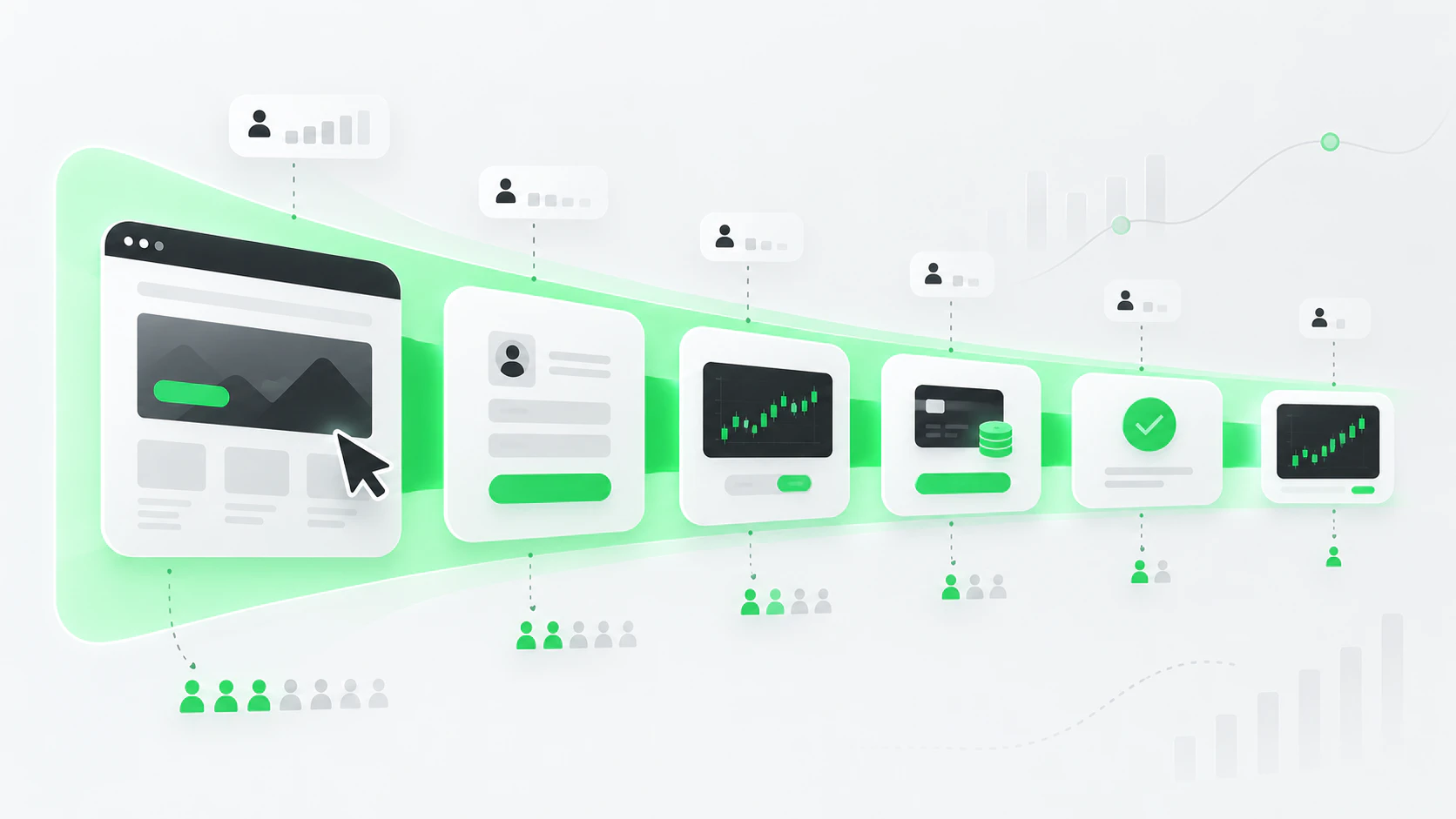
The earliest and cheapest point of influence on the funnel is the promise. Someone promised easy money by an ad arrives with an expectation the product cannot meet and leaves at the first losing trade, if not sooner. Someone shown the real interface and told honestly that trading involves risk registers less often but goes further. That is why, when a team complains about “poor traffic quality”, we look at creatives and partner copy before we look at placements.
This applies especially to partner materials. A webmaster paid per first deposit has a reason to promise more than the project can deliver, and the broker needs to agree on acceptable wording in advance. Otherwise the brand pays with complaints and payment provider refusals for words it did not write.
The bonus: an accelerator that distorts the numbers
A welcome bonus is the fastest way to lift registrations and first deposits, which is exactly why it misleads so often. It attracts both people who genuinely want to trade and people who came only for the bonus. Before the first deposit both groups look the same in a report. They differ later: the first trade and fund again, the second try to withdraw the bonus, open a second account or simply disappear.
A few signs show that a bonus is working against you. A sharp rise in registrations after a promotion launches with no rise in repeat deposits. A high share of clients who request a withdrawal right after their first top-up. Clusters of accounts from one device or subnet. The Bintech platform provides a full log of player and partner actions and multi-account and suspicious-activity detection, but the main tool is the habit of judging every bonus mechanic by revenue per client over a period, not by the number of participants.
A separate note on the “Risk-Free Trades” bonus available on the platform. It is good at removing the fear of the first real trade, but in ads and on the site it must be described as a bonus with specific conditions, not as a promise of trading without risk.
The demo account and the first real trade
For binary options, the move from demo to a real account is a separate funnel stage worth measuring. Demo removes the fear of making a mistake: the newcomer learns how to choose an asset and expiry time and what the payout percentage means. But demo can also become a trap if nobody offers the client a next step. On forex platforms leverage and margin play the same role, but the client’s question is the same – do I understand what will happen to my money?
A gentle, clear transition works best: a mission that suggests trying the real account after a few demo trades; a tournament invitation where the client can compete with a small amount; a first-deposit bonus with clear conditions. Bintech provides real, demo and tournament accounts, missions and achievements for this. One rule is non-negotiable: the client must always see which account they are trading on, and demo results must never be used as evidence of future income.
The payment: a moment you have already paid for
A client who clicks “Deposit” is the most expensive person in the funnel: you have already paid to acquire them, and they have already decided to trust the project with money. Losing them at this step hurts most, and the reasons are almost always mundane. There is no familiar payment method for their country. The minimum amount was set for a different audience. A bank or provider declined the payment, and the client did not understand what to do next. If the market or providers require client verification, it becomes a barrier too – not by itself, but when the person does not understand what is wanted and how long it will take.
What helps most here is separating attempts from successful payments and looking at them by method, country and provider. Then “clients do not pay” becomes “provider X in country Y declines a third of cards”, which can actually be fixed. Bintech’s deposit page is optimized for conversion, and the platform supports multiple currencies and payment system integrations for your market; more in our guide to payment integrations.
Second and third deposits: what retention really delivers
Almost every platform offers retention mechanics, and almost every team evaluates them wrongly. The typical mistake is to compare clients who joined a tournament with those who did not and see that the first fund far more often. “Tournaments work” does not follow: the most active clients join tournaments anyway. To see a mechanic’s real effect, compare comparable groups – for example, run a tournament for some of one month’s newcomers and compare their repeat deposits with the rest.
Each mechanic has its own role. A tournament and a monthly leaderboard give the client a specific date to come back for. Statuses and achievements give a sense of progress to those who trade regularly. A daily login reward builds a habit but means little on its own if the client has nothing to do after logging in. The “Market News” module gives a reason to open the platform without a sales message. Website and Telegram notifications tie it all together – provided that service messages about payments and support replies do not drown among marketing ones. More on retention in our broker marketing guide.
One thing we never recommend: building retention on client losses by suggesting that the next trades will “win back” past ones. In the short term it lifts activity; in the long term it turns into complaints, disputes with providers and lost reputation.
Withdrawals are part of the funnel too
Withdrawals are usually discussed as a cost or a risk, but for the client they are a test: can this project be trusted? Someone who received their first withdrawal quickly and without questions is far more likely to fund again and recommend the project. Someone whose withdrawal “hangs” without explanation writes to support, then to review sites, and almost certainly does not return.
That is why processing time for the first withdrawal and the number of support contacts about withdrawals deserve as much attention as deposit conversion. In Bintech, payouts are managed via API directly from the admin panel, and support sees the client’s profile and history in chat and tickets, which shortens the time between request and answer. Withdrawal rules are best explained upfront, on the deposit page: a client who knows them before the first deposit asks fewer questions afterwards.
How to read the funnel so it explains something
The first rule is to compare by money, not by volume. Registrations, first deposits and even their cost are intermediate numbers. Budget decisions are made on revenue per client over a period and on source payback.
The second is to segment. An average conversion rate for the whole project says almost nothing: the failure of one source or country hides behind the success of another. Look by source, country, device and payment method, and it becomes clear where the problem is traffic and where it is product or payments.
The third is to compare groups of the same age. Clients who arrived a week ago have not had time to make a repeat deposit, and comparing them with last month is unfair. Group clients by the week or month they arrived and compare equal stretches of their lifetime. The Bintech admin panel provides finance and traffic-source analytics with full separation of financial flows and detail on every player and partner; external trackers and cross-channel analytics are connected separately, which we discuss during project setup.
Calculator: which source really pays more
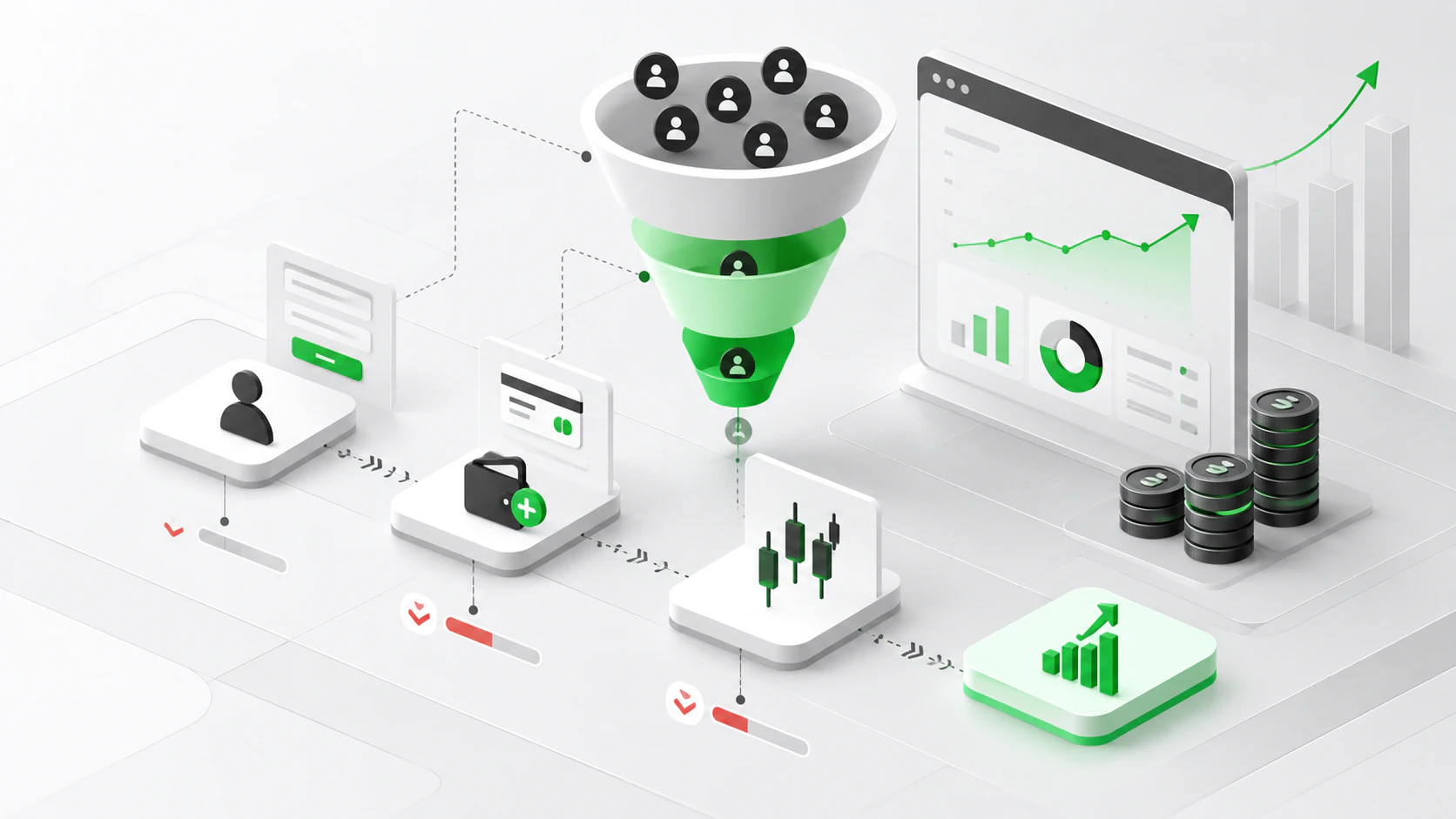
Enter data for two sources and the calculator compares them by cost per first deposit and by money over your chosen period. If the conclusions differ, trust the second one. This is a calculation, not a forecast.
| Source A | Source B | |
| Traffic spend, $ | ||
| Registrations | ||
| Registration → first deposit, % | ||
| Net revenue per client over the period, $ |
Conclusion
The broker funnel does not end at the first deposit – only the part visible from an affiliate dashboard ends there. Money is decided further on: in how a bonus affected client quality, whether a newcomer got from demo to a real trade, whether the payment went through, whether the client came back for a tournament and got their first withdrawal without stress. A team that tracks revenue per client by source and compares groups of the same age makes different traffic decisions from a team that looks at cost per registration – and usually more profitable ones.
If you drive traffic and want to see the whole funnel rather than its first half, see how it works on the Bintech binary options platform: request a demo on Telegram. We have also written about in-app traffic for trading offers and about the white label binary options platform.
Frequently asked questions
How does a broker funnel differ from an affiliate program funnel?
An affiliate dashboard shows clicks, registrations and first deposits. The broker sees everything else: repeat deposits, bonus costs, withdrawals and revenue per client over months. Whether traffic paid off is decided in that second half of the funnel.
Why can a source with cheap first deposits be unprofitable?
Because the cost of a first deposit says nothing about whether the client will return. A source with expensive first deposits but a high share of repeat funding often brings more money over 90 days.
How do bonuses affect the funnel?
A welcome bonus speeds up registrations and first deposits but can attract bonus hunters and multi-accounts. That is why a bonus is judged by repeat deposits and revenue per client, not by the number of registrations.
Why are withdrawals part of the funnel?
The first withdrawal is when a client checks whether the project can be trusted. A fast, clear withdrawal raises the chance of a repeat deposit, while a delayed one leads to complaints and churn.
Which funnel tools does the Bintech platform include?
Finance and traffic-source analytics, detail on every player and partner, an action log and multi-account detection, demo and tournament accounts, bonuses, missions, tournaments and a leaderboard, an optimized deposit page, API-based payouts from the admin panel, chat and tickets, and website and Telegram notifications.