
Binary Options Broker Marketing Strategy: 2026 Guide
A binary options broker marketing strategy needs to do more than generate website visits. It must connect the right audience with accurate product information, establish a recognizable brand, organize permitted acquisition channels, and give the operator a reliable way to evaluate marketing performance.
This is particularly important in a market where mainstream advertising channels have significant restrictions, competition for relevant search traffic can be intense, and misleading financial promotions create serious risks for both customers and businesses.
Many marketing plans fail at the planning stage because they begin with a list of channels: social media, affiliates, search engines, email, and video. A list is not a strategy. Without defined audiences, channel eligibility, measurable objectives, content standards, and a reporting framework, even substantial marketing activity may produce little useful information about what works.
This guide provides a practical approach to binary options broker marketing, from audience research and brand positioning to organic discovery, affiliate partnerships, conversion analysis, and campaign optimization. It also explains how an operator can organize a 90-day marketing plan and use available platform analytics without confusing marketing results with trading outcomes.
Why Binary Options Marketing Requires a Different Approach
The marketing environment for binary options differs from that of ordinary consumer products or general financial technology services. Financial promotions can affect people’s financial decisions, and binary options involve a substantial risk of loss. As a result, advertising rules and the availability of distribution channels can be much more restrictive than marketers initially expect.
For example, Google’s advertising policy identifies binary options advertising as prohibited, including certain associated informational websites and services. This means a marketing plan should not assume that ordinary Google Ads campaigns will be available for acquiring binary options customers.
Market eligibility is a separate issue. In the United Kingdom, the Financial Conduct Authority prohibits the marketing, distribution, and sale of binary options to retail consumers. Within the European Union, national product intervention measures also restrict their marketing and distribution to retail investors.
These conditions should be assessed before selecting an audience or funding any campaign. A channel may be technically accessible without being appropriate or permitted for a particular financial product, customer category, or destination market.
Consequently, a serious binary options marketing strategy starts with three questions: who can the business legitimately serve, what information does that audience need, and which channels permit the intended communication?
Only after answering those questions should the operator decide how much content to produce, which partnerships to pursue, or how to allocate the marketing budget.
Start with Market Research, Not Advertising Campaigns
Marketing planning begins by understanding the prospective audience and the competitive environment. The goal is not simply to identify countries with high search volume or low advertising costs. It is to establish where the business can operate, what demand exists, and whether the proposed brand can communicate a meaningful distinction from competitors.
Identify Eligible Target Markets
Before developing country-specific landing pages, marketing teams should confirm that the intended offering and promotional activity are permissible for the target audience.
This review influences more than legal documentation. It affects the relevance of search keywords, available media channels, language selection, partner recruitment, payment communication, and the types of claims that can appear in promotional content.
A marketing campaign directed at the wrong audience can create problems even if it generates registrations. Geographic targeting should therefore be based on the actual business model and applicable restrictions, rather than on traffic costs alone.
Study Search Intent
Different search queries reveal different information needs. Someone searching for an explanation of how binary options work has a different intention from a person comparing trading interfaces or looking for customer support information about an existing account.
A useful research process groups queries according to the questions behind them. Informational searches can reveal demand for clear explanations. Product-related searches may indicate interest in platform functionality and account conditions. Brand searches often reflect an effort to verify a company, find its official website, or resolve a specific concern.
These distinctions help determine which pages should exist and what each page needs to explain. They also reduce the temptation to publish numerous articles that repeat the same general keywords without offering new information.
Analyze Competitors Beyond Their Rankings
Competitor research should examine how other brands explain their products, communicate financial risk, structure their websites, and respond to recurring customer questions.
Review the clarity of important information: account conditions, payment procedures, support access, company details, and the distinction between demo and real-money functionality.
Search visibility is useful evidence of what users can find, but rankings alone do not establish that a competitor’s marketing practices are appropriate or that its claims are reliable.
A better outcome of competitor analysis is a list of unanswered questions and opportunities to improve the quality of information presented by your own brand.
Develop a Clear and Credible Brand Position
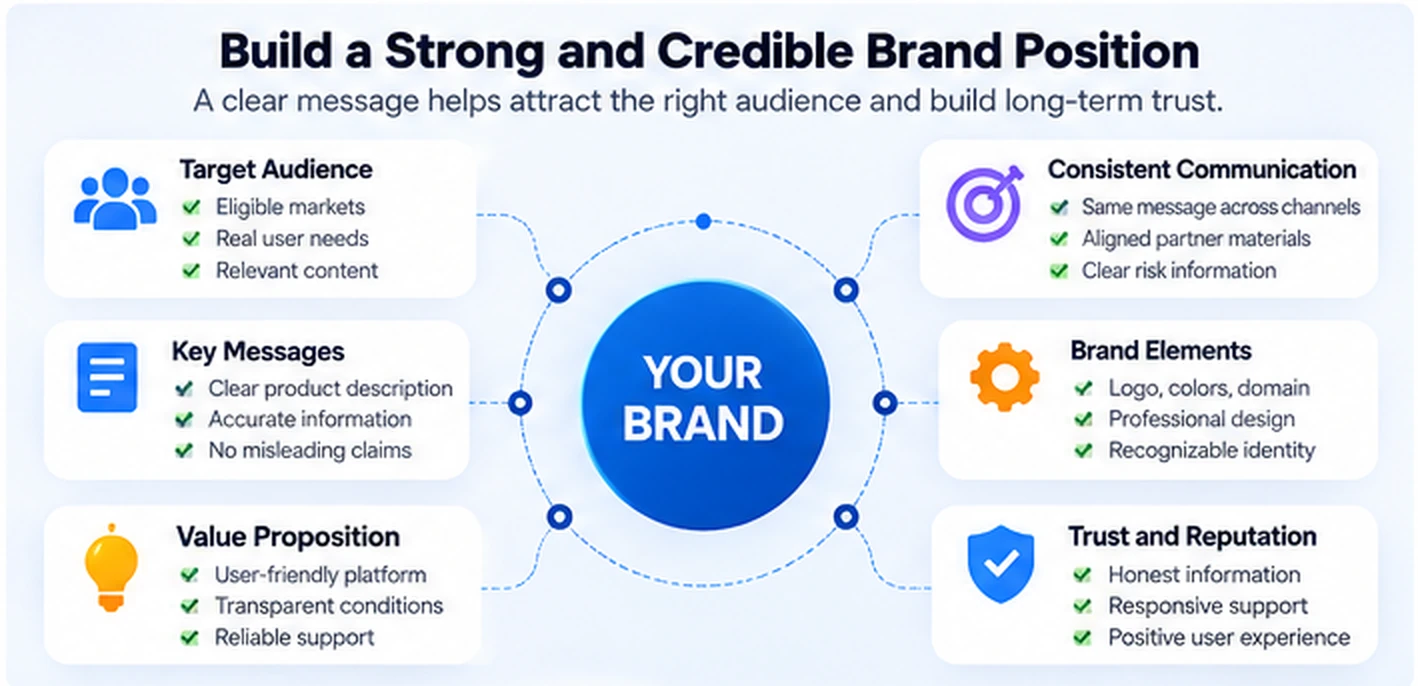
A broker’s positioning should explain what its service offers, who it is intended for, and what users can realistically expect. It should be specific enough to guide website content, partner communication, customer support, and promotional material.
Generic phrases such as “the best trading platform,” “guaranteed profits,” or “risk-free earnings” are poor foundations for a credible brand. Superlatives are difficult to substantiate, while promises about trading results can materially mislead an audience.
Instead, positioning can focus on verifiable aspects of the service, such as the clarity of the user interface, availability of a demonstration environment, published account conditions, accessible support information, and the presentation of trading history.
Build a Consistent Message Across Channels
Brand consistency is not limited to using the same colors and logo. The website, public content, email communications, and authorized partners should describe the product using the same definitions and conditions.
For example, if the official website explains that a demo account uses simulated funds, partner content should not suggest that the same demonstration results represent real-money earnings.
Similarly, the conditions described on a promotional page should not contradict the information users encounter in the account interface or customer support materials.
A concise brand messaging document can help the team keep communication consistent. It should define approved product descriptions, relevant audience characteristics, required risk information, prohibited claims, and the process for approving public materials.
Build an Acquisition Strategy Around Available Channels
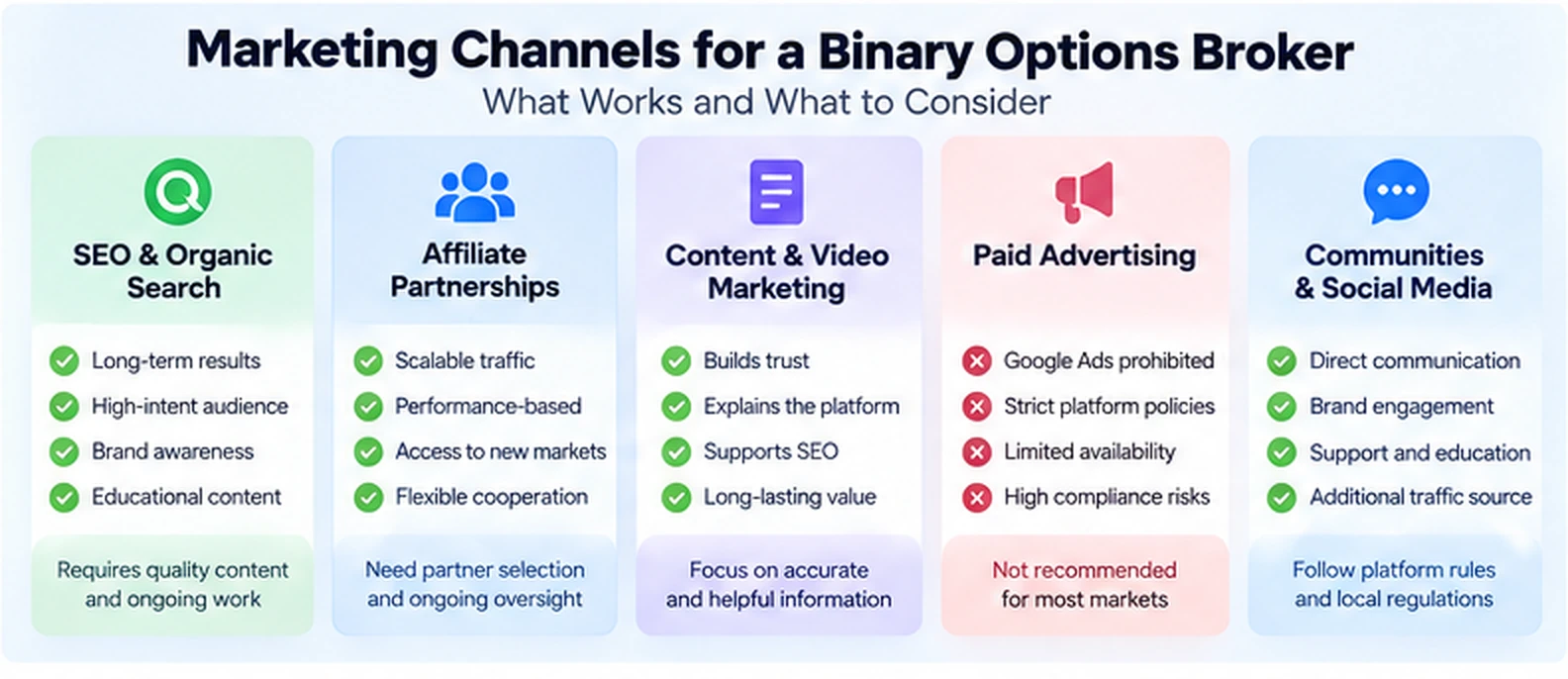
A marketing channel is valuable only when the business can use it appropriately and measure its contribution.
For binary options projects, the channel plan should not be copied from a conventional e-commerce or software-as-a-service business. Advertising restrictions affect which paid campaigns can run, and financial-product rules can also apply to affiliate promotions, social content, and other forms of communication.
Organic Search
Organic search can help users discover publicly available information when they are researching a topic, comparing products, or looking for answers to specific questions.
However, search engine optimization is not a substitute for market eligibility. Ranking organically does not authorize a company to offer or promote a prohibited product to a restricted audience.
For an eligible audience, organic content should aim to answer genuine questions accurately and thoroughly. The objective is to provide useful information rather than publish large volumes of pages designed only to capture variations of the same keyword.
Editorial Content and Educational Media
Articles, explanatory videos, and tutorials can clarify how a platform works and address common user questions. Their usefulness depends on factual accuracy, clear distinctions between demonstration and real activity, and the absence of misleading performance claims.
An educational article should not use an ordinary explanation as a pretext for promising easy profits. Where financial risk is relevant, the content should explain it rather than omit it to improve click-through rates.
Video content can be especially useful for demonstrating navigation, explaining account settings, or describing a process that is difficult to understand from text alone. Production quality helps, but clear explanations and accurate representations matter more than dramatic presentation.
Partnerships and Referrals
Partnerships can introduce a brand to established audiences, but they require controls over where and how promotional messages appear.
An affiliate or content partner should not be treated as an unrestricted advertising channel. The operator needs to understand the partner’s audience, traffic sources, promotional methods, and applicable disclosure responsibilities.
A referral program should also provide sufficient information for the operator to distinguish legitimate activity from duplicate accounts, misleading promotions, and other patterns that warrant review.
Community and Customer Communication
Public discussion spaces can help a company understand common questions and identify information that is missing or difficult to find.
The purpose should be genuine communication, not manufacturing the appearance of independent public approval. Company representatives and paid contributors should not impersonate ordinary customers or coordinate deceptive testimonials.
Comments, support requests, and recurring questions can instead become useful inputs for clearer documentation, better onboarding materials, and product explanations.
SEO for a Trading Platform: Build Topics, Not Duplicate Articles
A coherent SEO strategy begins with identifying the information that the intended audience needs and assigning each significant search intent to the appropriate page.
Publishing several articles with slightly different titles but nearly identical content can create unnecessary overlap. Readers may encounter repeated introductions, the same examples, and interchangeable conclusions without obtaining answers to their particular questions.
A better content structure separates foundational explanations, platform tutorials, account processes, terminology, and troubleshooting information.
Organize Content by User Questions
For example, a foundational article can explain a relevant concept and its risks. A product guide can describe supported functionality. A procedural article can show the steps required to complete a particular account task. A troubleshooting page can address a specific problem, including possible causes and the appropriate support process.
These pages serve different purposes and should therefore contain different information, examples, and supporting visuals.
A content map should record the primary question answered by each page, the intended audience, the canonical URL, and the related pages to which readers may reasonably navigate.
Use Internal Links to Help Readers Progress
Internal links work best when they connect related questions rather than merely repeating commercial keywords.
A user reading about demo accounts may benefit from a detailed explanation of account conditions. Someone reviewing a payment process may need information about transaction statuses or available support channels.
The anchor text should describe the destination naturally. Adding numerous links to the same commercial page rarely improves the usefulness of an article.
Show Evidence and Keep Information Updated
Financial topics require particular care because inaccurate information can affect important decisions. Articles should distinguish documented product facts from opinions, illustrative examples, and third-party claims.
Where an article refers to external rules, technical documentation, or a product provider’s conditions, link to the relevant authoritative source where practical.
Update information when it materially changes. Changing a publication date without making meaningful improvements is not a substitute for maintaining accurate content.
For broader editorial standards, consult Google Search Central’s guidance on helpful, reliable content.
Video Marketing: Explain the Product Clearly
Video can demonstrate processes that are difficult to communicate through static text. It may also help prospective users understand how the interface is organized before they decide whether the service is relevant to them.
The most useful subjects are often practical rather than sensational: navigating a demonstration account, understanding available chart controls, finding transaction records, reviewing account settings, and locating support information.
Each video should have a defined educational or explanatory purpose. A short tutorial can answer one question thoroughly, while a longer walkthrough can explain several connected actions in their proper sequence.
Use Realistic Demonstrations
Demonstrations should identify simulated activity clearly. Editing a video to create an artificial record of successful trades, fabricating account balances, or presenting a staged result as an independently verified outcome can mislead viewers.
If a demonstration uses sample information, explain that it is illustrative. Viewers should be able to distinguish an interface walkthrough from evidence of actual trading performance.
Repurpose Content Without Repeating Empty Claims
A useful tutorial may be adapted into a shorter video, a help-center explanation, and an illustrated article. The format can change while the essential information remains accurate.
Repurposing works best when each version is adapted to its purpose. A short clip might show where a setting is located, while the full article explains the conditions, possible limitations, and related account information.
Reposting identical promotional claims across many accounts does not create new information or establish credibility.
Affiliate Marketing: Quality, Transparency and Oversight
An affiliate program is not simply a mechanism for assigning referral links. For the operator, it is a managed relationship with external partners whose promotional activities may affect the brand, customer expectations, and the quality of incoming traffic.
A clear partnership structure should identify the information partners may publish, the audiences they may address, the approved promotional methods, and the relevant reporting arrangements.
Evaluate Partners Before Cooperation
A potential partner should be assessed by more than follower counts or screenshots of audience statistics.
Useful questions include where the audience is located, how it was built, what types of content the publisher produces, whether previous promotions are identifiable, and how the partner explains its relationship with advertisers.
Audience size alone does not prove that the traffic is relevant. An engaged but unrelated audience may provide fewer meaningful interactions than a smaller group actively researching an appropriate topic.
Make Commercial Relationships Clear
Paid partnerships and affiliate relationships should be disclosed where required. An influencer should not present a sponsored review as an independent evaluation simply because that format appears more persuasive.
The U.S. Federal Trade Commission, for example, explains that material connections between endorsers and brands should be disclosed clearly when its rules apply. Similar obligations may arise under other countries’ advertising standards.
Operators should provide partners with clear requirements and monitor whether published materials follow those expectations.
Review Traffic Quality
Partner reporting should distinguish basic exposure from meaningful engagement. Clicks and registrations provide useful information, but they do not necessarily establish that the referred audience is eligible, genuinely interested, or receiving accurate product information.
Unusual activity patterns should be investigated rather than automatically treated as either commercial success or misconduct.
For partners working with the same operator, reporting definitions should be consistent. Otherwise, different traffic sources may appear to perform better or worse simply because they are measured differently.
Separate Marketing Performance from Customer Trading Losses
A responsible performance framework should not reward deceptive claims, concealment of financial risk, or pressure on users to undertake additional trading activity.
Where a partner compensation model involves customer activity, the operator should carefully consider potential conflicts of interest and the incentives created by that arrangement.
Partner quality should be evaluated in light of traffic relevance, accurate communication, customer experience, and applicable requirements, not merely the financial losses incurred by referred users.
Conversion Optimization: Identify Where Users Become Confused
Conversion rate optimization is often interpreted as making more visitors complete a desired action. For a financial product, a better starting point is identifying whether visitors receive enough accurate information to make an informed decision.
A website may lose visitors because its content is irrelevant, its interface is difficult to use, or the available terms do not suit their needs. Those are different problems and should not be addressed with the same marketing tactics.
Examine the Journey from Discovery to Account Use
The journey may begin with an article, referral, direct visit, or branded search. A visitor then reviews information about the service and may choose to explore available account functionality.
Each stage presents a different question. Does the landing page answer the user’s search? Are important conditions easy to locate? Is the next action understandable? Are technical difficulties preventing access to information?
Observing these questions can reveal practical opportunities for improvement without relying on artificial urgency or misleading incentives.
Test One Meaningful Change at a Time
A/B testing is useful when it answers a clear question. For example, a team may compare two ways of presenting an explanation, two navigation structures, or different placements of existing factual information.
The test should define its success criterion in advance and avoid changing several unrelated components simultaneously when doing so would make interpretation difficult.
For financial-product pages, experiments should preserve necessary risk information and avoid manipulative designs that pressure users to deposit or trade.
Include Support and Clarity in the Evaluation
A page that produces more clicks but increases confusion or support complaints may not represent a meaningful improvement.
Consider outcomes such as successful access to relevant information, fewer repeated support questions, and a clearer understanding of account conditions alongside conventional engagement metrics.
The objective is a more useful and understandable experience, not merely a higher number of interactions.
Measure Marketing Performance with a Consistent Reporting Framework
Without consistent measurement, it becomes difficult to distinguish productive marketing work from activity that simply generates large volumes of visits or clicks.
The reporting framework should connect traffic sources, content, account-related actions, and relevant operational information while respecting privacy and applicable data-handling requirements.
Traffic Source Reporting
At a minimum, the operator should understand where visitors come from and which campaigns or partners are associated with relevant website activity.
Campaign naming conventions can help the marketing team distinguish channels and individual initiatives. For example, consistent campaign identifiers make it easier to compare an educational content series with a separate partnership campaign.
However, campaign labels are useful only when they are applied consistently and when the underlying activity can be measured reliably.
Define Key Events
Not every interaction should be treated as an equally important conversion. A page view, a documentation visit, a completed registration, and a support request represent different types of user behavior.
The analytics plan should define the meaning of each event and identify which ones are useful for evaluating the customer journey.
For example, a team might monitor whether visitors find account-condition information, complete a relevant form, or successfully access a demonstration environment. Such events must be implemented in the actual analytics setup before they can be reported.
Google Analytics 4 uses the term key events for important user actions. The exact events available to a business depend on its own tracking configuration.
Attribution and Its Limitations
Attribution attempts to connect a meaningful action with preceding marketing interactions. A user may encounter content through several channels before completing a relevant action.
Different attribution approaches can assign credit differently. Some emphasize the final interaction, while others distribute credit across multiple touchpoints.
Marketing teams should document which model they use and avoid treating attributed results as a perfect reconstruction of every user’s decision process.
Privacy restrictions, missing identifiers, device changes, and incomplete consent can limit what analytics systems observe.
Use Cohorts to Understand Changes Over Time
A cohort is a group of users defined by a common characteristic, such as the period in which they first interacted with the service or the campaign associated with their arrival.
Cohort analysis can reveal whether later user behavior differs across campaigns or acquisition periods. It may also help determine whether changes in content or onboarding coincide with fewer support issues or better understanding of the platform.
Comparisons should account for the time available to observe each cohort. A recently acquired group should not be judged against a much older one without considering the difference in observation periods.
Which Marketing Metrics Should a Broker Monitor?
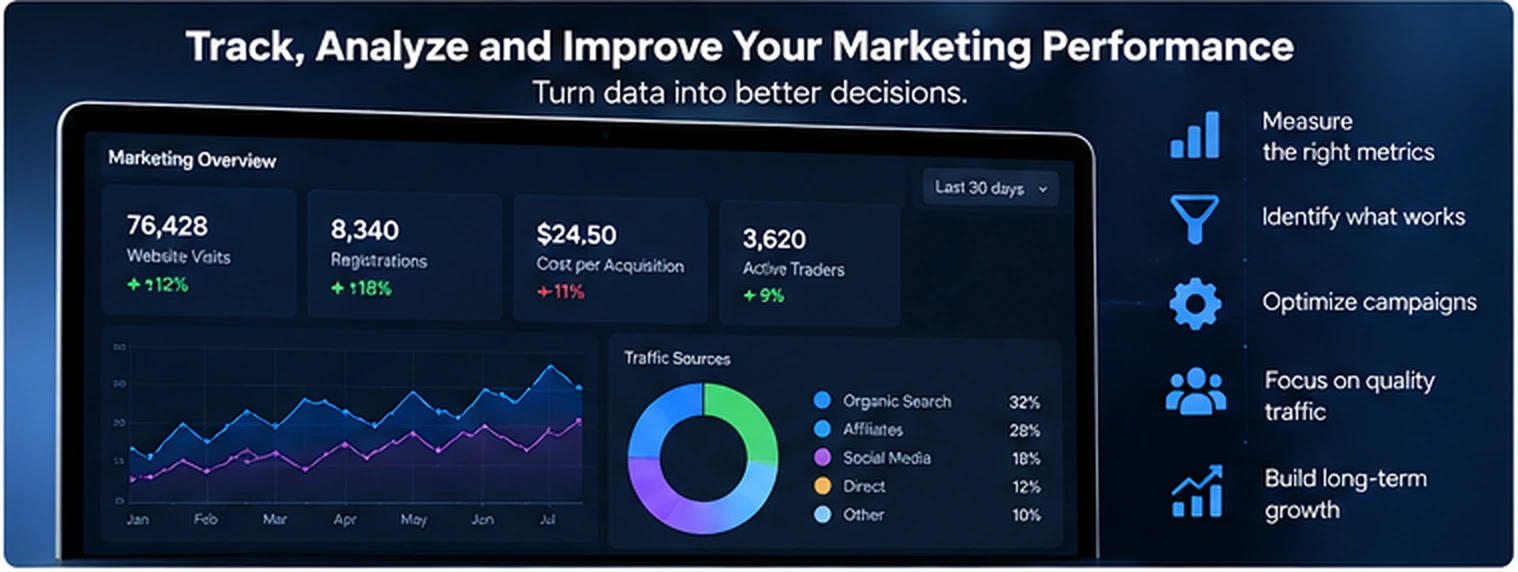
Metrics are useful when each one has a clear definition and supports an operational decision. The following framework is illustrative and does not imply that every metric is automatically available in Bintech’s native reporting environment.
| Metric | What It Measures | What It Helps Evaluate |
| Organic visibility | Relevant search impressions and clicks | Whether content is being discovered |
| Qualified traffic | Visits from relevant and eligible audiences | Traffic-source suitability |
| Registration completion | Completed registrations relative to a defined starting group | Clarity and usability of the registration journey |
| Cost per acquisition | Eligible marketing expenditure divided by the defined acquisitions | Marketing cost efficiency |
| Partner quality | Relevance, validity, and behavior of referred traffic | Affiliate relationship quality |
| Support contact rate | Relevant support contacts within a defined user group | Potential information or usability problems |
| Content engagement | Meaningful interactions with published material | Usefulness of content |
| Repeat visits | Users returning within a defined period | Continued interest and information needs |
Cost per acquisition is only meaningful when the definition of an acquisition remains consistent. If one campaign counts registrations and another counts a different outcome, the resulting figures cannot be compared directly.
Similarly, traffic volume should not be treated as a measure of business quality. Visits from irrelevant or ineligible users may increase reported reach without contributing to a legitimate marketing objective.
How Bintech Supports Marketing Analysis
Bintech provides administrative analytics for finances and traffic sources, together with a built-in affiliate program and tools for reviewing relevant partner and user activity.
These functions can help the operator examine available information related to traffic acquisition and commercial operations. The platform also provides supported website and Telegram notification controls and configurable promotional modules.
Importantly, Bintech’s existing product documentation does not establish that every external marketing automation, email CRM, cross-channel attribution system, or analytics event described in this article is included by default.
Operators may use separate marketing systems according to their requirements. Any proposed integration with the trading platform should be confirmed with the Bintech team rather than assumed to exist.
Bintech also provides ongoing technical support and consultations covering relevant operational subjects, including traffic acquisition and partner-related questions. The client remains responsible for its marketing strategy, content, audience selection, and commercial decisions.
Readers interested in the underlying software rather than marketing processes can explore the Bintech binary options software guide. Information about obtaining a branded platform is available in the White Label Binary Options Platform guide.
Email and Customer Communication Strategy
Email can be useful for communicating service information, responding to customer needs, and sharing relevant updates with people who have agreed to receive those communications.
Its effectiveness should not be evaluated only by the number of messages sent. Frequency, relevance, consent, and the clarity of the information all influence whether recipients regard the communication as useful.
Separate Transactional and Promotional Messages
Account notifications and service-related communications have a different purpose from marketing newsletters.
A customer may need an important notification about account access or a support request without wanting regular promotional emails. These categories should be managed according to their actual purpose and applicable communication requirements.
Use Relevant Information Rather Than Pressure
Appropriate topics can include product updates, explanations of supported features, changes to published conditions, and access to helpful documentation.
Messages should not exploit users’ financial losses, create false deadlines, or imply that increasing trading activity is necessary to recover previous losses.
A useful communication strategy supports informed decisions and a clear understanding of the service.
Measure Engagement Carefully
Open rates alone may be an unreliable indicator of genuine interest because privacy-related features can affect measurement.
Where appropriate, teams can consider meaningful responses, visits to relevant information, unsubscribes, and recurring support questions. These observations should be interpreted within the limits of the actual email and analytics systems being used.
Reputation Management and Customer Trust
A brand’s reputation develops through repeated experiences, not only advertising or public reviews.
For a trading platform, users may pay particular attention to the clarity of financial conditions, customer support availability, accurate account information, and the way questions or complaints are handled.
Marketing and customer support therefore need to communicate consistently. A polished promotional page cannot compensate for misleading information or unresolved contradictions elsewhere in the customer experience.
Use Authentic Reviews
Reviews should reflect genuine experiences. Purchased testimonials presented as spontaneous customer opinions, fabricated success stories, and undisclosed paid endorsements can mislead readers and damage credibility.
Where a review is sponsored or an affiliate relationship exists, the relationship should be disclosed as required by applicable advertising rules.
It is also important to avoid selective presentation that gives an inaccurate impression of typical outcomes.
Respond to Complaints with Specific Information
A useful response explains which issue can be addressed, what information may be needed, and which official support channel should be used.
Public responses should avoid exposing personal account information. Questions involving individual transactions or confidential data should be directed to an appropriate private support process.
Repeated complaints can also identify unclear website content or account procedures that deserve attention.
A Practical 90-Day Marketing Plan
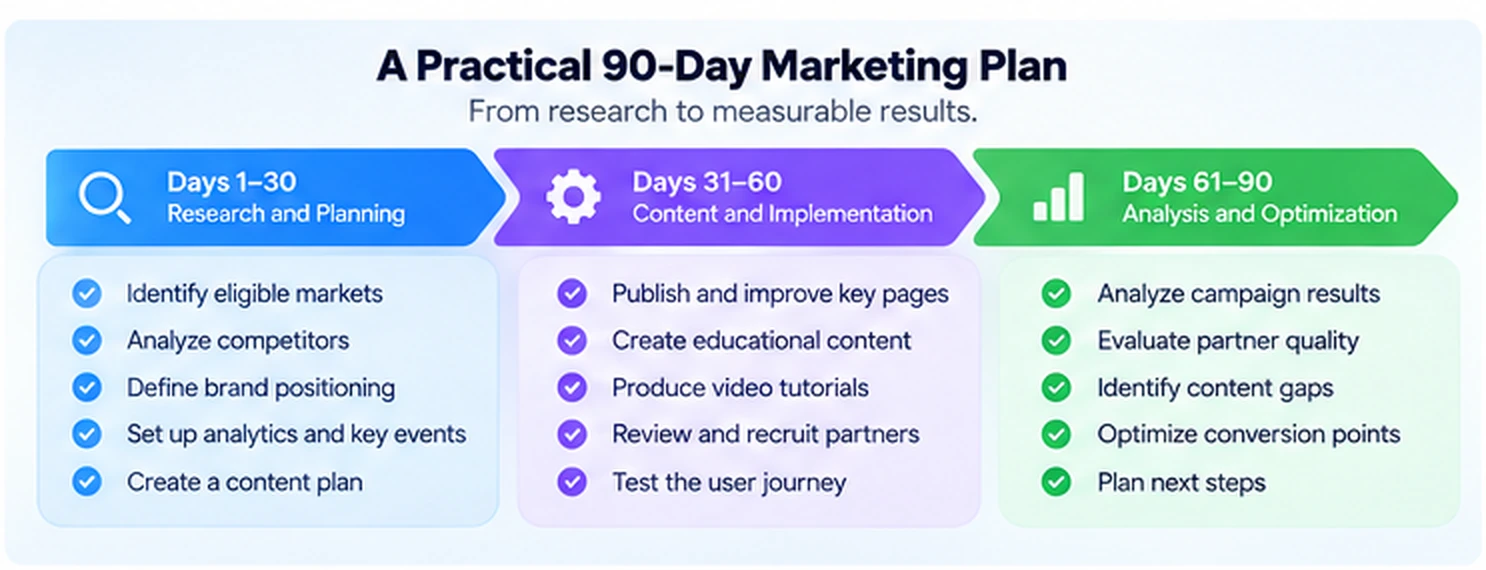
A marketing plan is more useful when it identifies the work to complete, the evidence needed to evaluate it, and the decisions that follow. The following 90-day framework is an illustrative planning structure for a business that has already confirmed its eligible markets and appropriate marketing activities.
Days 1-30: Research, Positioning and Measurement
The first month should establish the foundation for subsequent marketing decisions. Begin by defining the intended audience and confirming which distribution channels and promotional activities are appropriate for that market.
Audit the existing website to identify unclear product explanations, incomplete support information, duplicate SEO topics, technical navigation issues, and inconsistent marketing claims.
Review the competitive search environment and prepare a content map based on distinct user questions. This should identify which existing pages require improvement, which genuinely new topics justify publication, and where internal links will help readers.
At the same time, agree on reporting definitions. Establish which interactions are important, what data is available, and which external analytics tools or configurations are required.
By the end of this stage, the marketing team should have a documented positioning statement, a reviewed channel plan, a prioritized content calendar, and a consistent measurement framework.
Days 31-60: Produce and Validate Marketing Content
The second month should concentrate on executing the approved content plan and testing the quality of the user experience.
Publish or improve the highest-priority pages identified during research. Each should answer its own question comprehensively rather than reproducing material already covered elsewhere on the site.
Develop supporting explanations where they genuinely help readers, such as tutorials, short video demonstrations, and illustrated documentation. Coordinate terminology and factual statements with the relevant product and support teams.
Where partnerships are appropriate, begin reviewing potential collaborators using documented criteria rather than audience size alone. Establish clear expectations for disclosures, content accuracy, permitted audiences, and reporting.
Test the website journey using realistic scenarios. Check whether visitors can locate key information, whether navigation behaves consistently across devices, and whether relevant analytics events are recorded as intended.
By the end of this stage, the business should have published useful material, validated its measurement process, and identified specific issues for improvement.
Days 61-90: Analyze Results and Refine the Plan
The final month focuses on examining the evidence collected during the initial implementation.
Compare relevant content performance, traffic-source quality, and meaningful user interactions using the definitions established during the first month.
Review which questions remain unanswered by the website and whether repeated support issues suggest that certain explanations should be improved.
Assess partners based on the suitability of their traffic and the quality of their public communication. Discontinue or revise activities that create misleading expectations, attract irrelevant audiences, or fail to meet agreed standards.
Prioritize improvements according to observed problems. For example, if users frequently visit a particular help page after encountering an account form, that pattern may indicate a need for clearer information earlier in the process.
At the end of 90 days, prepare a report distinguishing demonstrated results, unresolved questions, and proposed next steps. The purpose of the first planning cycle is not to declare that every channel has succeeded or failed permanently, but to build a reliable basis for further decisions.
How to Allocate Marketing Resources
Budget allocation should follow the approved channel strategy and the team’s actual capacity to execute it.
A common problem is spreading a limited budget across too many unrelated initiatives. A project may simultaneously launch multiple social channels, commission a large amount of content, recruit partners, and develop new landing pages without assigning anyone responsibility for quality control or analysis.
The result can be a high volume of unfinished work and little reliable information about performance.
A more structured approach distinguishes foundational tasks from experiments. Essential website information, measurement, and content accuracy should be maintained consistently. Experimental initiatives should have defined objectives, responsible owners, and a review date.
Resources should also be reserved for maintaining existing material. Outdated instructions, inaccurate account information, and broken navigation can undermine the value of newly published content.
No universal marketing budget split is appropriate for every project. The correct allocation depends on market eligibility, available channels, competition, team skills, and observed performance.
Common Marketing Mistakes to Avoid
One mistake is treating website traffic as the ultimate objective. High visit counts can look impressive while revealing little about audience suitability or the usefulness of the information provided.
Another is copying competitors without verifying their claims. A competitor’s aggressive advertising or exaggerated success stories do not establish that the same approach is effective, permitted, or appropriate.
Publishing large numbers of superficial SEO articles is also a weak substitute for answering genuine questions. Pages with overlapping purposes can create maintenance problems and leave readers searching elsewhere for complete explanations.
A related mistake is presenting affiliated content as independent. Transparency matters particularly when a publisher receives compensation for referring users to a financial service.
Finally, marketing teams should avoid confusing technical functionality with marketing performance. The availability of a platform module, notification tool, or partner dashboard does not guarantee higher acquisition, engagement, or revenue.
Successful measurement requires understanding what the tool actually reports and how those observations relate to the business’s objectives.
Frequently Asked Questions
What is the first step in building a binary options broker marketing strategy?
Begin by identifying eligible target markets, the intended audience, and the channels that can appropriately be used. Then define the brand’s positioning and the information prospective users need before selecting marketing activities.
Can binary options brokers advertise through Google Ads?
Google’s published advertising policy prohibits advertisements for binary options and related categories described in the policy. A marketing plan should not assume that binary options campaigns will be approved simply because the business has a website or uses educational content.
Is SEO useful for a trading platform?
SEO can help relevant audiences discover accurate information where publication and the intended activity are permitted. Its value depends on useful content, clear search intent, sound website structure, and ongoing maintenance rather than keyword repetition alone.
How should affiliate partners be evaluated?
Consider audience relevance, promotional methods, geographic suitability, content accuracy, transparent commercial disclosures, and the quality of available reporting. Follower counts alone are insufficient.
Which metrics matter most?
The most useful metrics depend on the objective. Traffic relevance, meaningful website interactions, defined acquisition costs, partner quality, and customer information needs can all help evaluate marketing activity when measured consistently.
Does Bintech include marketing analytics?
Bintech includes administrative analytics covering finances and traffic sources, along with affiliate functionality and relevant partner activity information. Other marketing tools and external analytics integrations should be confirmed separately.
Does Bintech manage the client’s marketing campaigns?
Bintech provides the trading software, technical support, and consultations on relevant business and traffic-related topics. The client remains responsible for its own marketing strategy, campaign execution, audience selection, and commercial decisions.
Conclusion: Build a Marketing System That Can Be Evaluated
A practical binary options broker marketing strategy combines clear audience research, credible brand positioning, useful information, appropriate distribution channels, responsible partnerships, and consistent performance measurement.
The objective is not to maximize promotional activity regardless of its quality. It is to understand which activities serve an eligible audience, what information users need, and how the organization can improve its communication based on reliable observations.
For project owners, technology and marketing remain connected but distinct responsibilities. A trading platform can provide administrative tools and relevant operational information, while the marketing team develops content, manages external relationships, and interprets campaign results.
Bintech supplies ready-made trading software with built-in affiliate functionality, traffic-source analytics, and ongoing technical support. Our team can explain the available software capabilities and discuss the technical requirements of a proposed project.
Learn more about the Bintech platform and request the current product presentation.