
Binary Options Software: How Trading Platforms Work
Binary options software is more than a trading interface with price charts and transaction buttons. Behind the user-facing terminal is a coordinated software environment responsible for displaying market information, processing trading instructions, maintaining account records, supporting payment operations, and giving authorized personnel access to administrative controls.
For a business evaluating trading software, understanding these functions is essential. A visually attractive terminal may demonstrate how users interact with a platform, but it reveals little about the administrative workflows, monitoring tools, data consistency, account controls, or maintenance arrangements required for ongoing operation.
This guide examines the functional architecture of binary options trading software, explains the relationships between its main components, and identifies the technical questions a prospective operator should ask before selecting a provider. Where relevant, it uses documented Bintech functionality as a practical example without disclosing proprietary code or internal infrastructure details.
What Does Binary Options Software Actually Do?
Binary options are contracts whose outcomes are determined by predefined conditions, typically involving the value of an underlying asset at a specified time. Depending on the contract terms, a trader may receive a predetermined payout when the relevant condition is met or lose the amount committed when it is not.
The platform must therefore coordinate several distinct activities. It presents available instruments and price information, lets users select supported trading parameters, records accepted transactions, determines outcomes according to the applicable contract rules, and makes the resulting information available in account histories and operational records.
These activities cannot be evaluated independently. Consider a transaction submitted shortly before its expiry. The displayed price, the time at which the instruction is accepted, the recorded contract conditions, and the reference data used for settlement all matter. If relevant information is inconsistent, the problem is not simply visual: it may affect the reliability and traceability of the transaction itself.
For this reason, binary options software should be evaluated as a complete system of connected functions, not as an isolated charting application.
The Functional Architecture of a Trading Platform
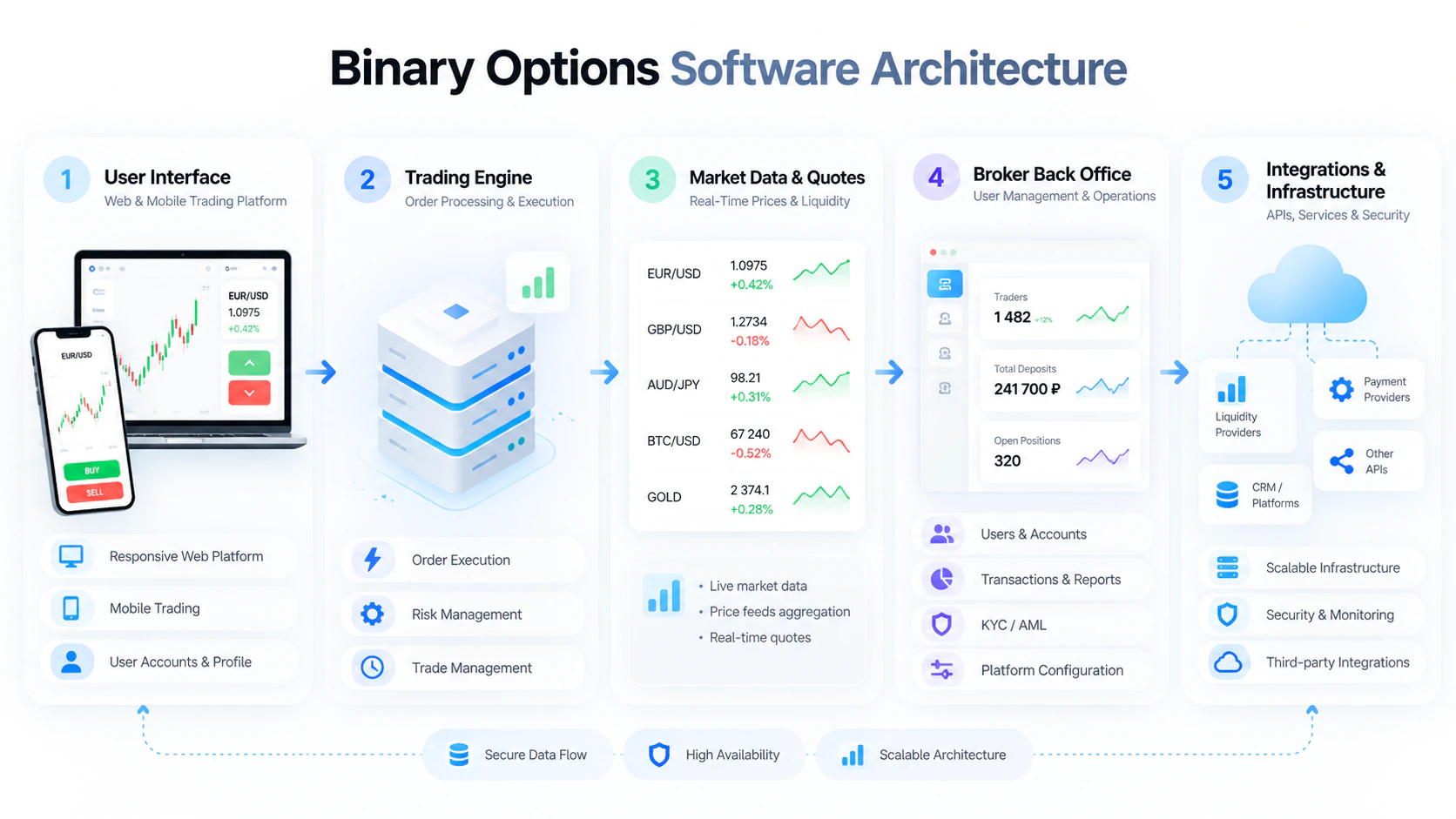
A useful way to understand trading software is to separate its responsibilities into several functional layers. This does not mean that every provider implements them as independent servers, microservices, or specific software packages. The division describes what a complete platform must accomplish, not the internal architecture of a particular vendor.
User Interface Layer
The user interface presents market information, available accounts, trading controls, transaction history, and navigation to other services. It converts the underlying system’s supported functions into interactions that users can understand and operate.
Its responsibilities extend beyond visual design. Relevant information needs to remain understandable when the user changes a timeframe, switches accounts, opens a trade history entry, or works on a smaller mobile screen. The interface should distinguish simulated activity from real-money transactions and present relevant conditions before a transaction is submitted.
Trading and Account Functions
The trading functionality handles the supported transaction parameters and the corresponding account activity. Account services maintain the information needed to display balances, relevant transaction records, and available account features.
The precise implementation varies between products. What matters to a buyer is whether trading activity can be traced through the user interface and authorized administrative records, and whether the system behaves consistently under its documented operating rules.
Market Data Functions
Market data functionality supplies the information used in charts and relevant trading processes. It must be considered together with the source of quotes, timing information, data validation, and the procedures used when unusual values appear.
A provider should explain how anomalous conditions are recognized and what operational safeguards are available. Buyers do not need access to proprietary algorithms to evaluate whether the product provides appropriate monitoring and review tools.
Administrative and Operational Functions
The administrative environment provides authorized teams with access to user records, operational reports, relevant settings, activity histories, and available financial information.
Unlike the trading interface, which is organized around individual user actions, the back office is designed around the responsibilities of the platform operator and its employees.
Integrations and Infrastructure
External integrations connect supported providers or services to the trading platform. Infrastructure services keep the software environment maintained and monitored, while backup and security measures help manage operational risks.
These responsibilities are closely connected. A payment integration, for example, is useful only when the relevant transaction state can also be represented in account information and reviewed through the authorized administrative workflow.
Trading Terminal Technology: Charts and Market Analysis
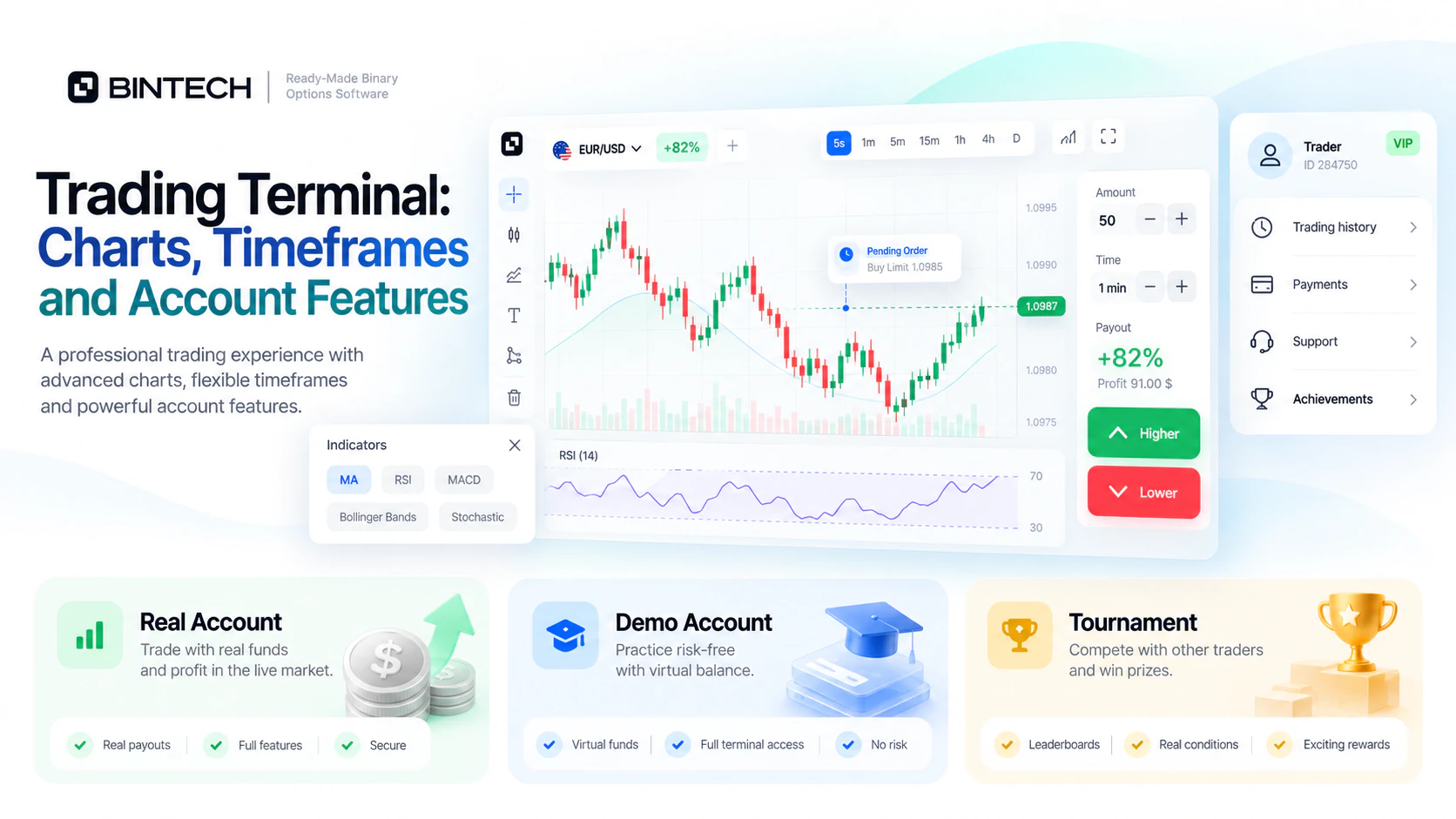
The trading terminal is the most visible component of binary options software. Its quality depends on the clarity of the interface, the supported trading functions, and the way market information is displayed.
When examining a demonstration, a buyer should look beyond the initial screenshot. Switching between chart modes, selecting time intervals, navigating transaction details, and using technical analysis tools can reveal practical differences that are not obvious from marketing images.
Animated Charts and TradingView-Based Charting
Bintech provides two charting approaches: animated charts and TradingView-based charting. The software also includes four chart display modes, multiple time intervals, and technical analysis indicators.
These capabilities give users different ways to view and analyze market information within the supported terminal interface. A trader examining recent price movement may prefer a particular visual presentation, while another may rely more heavily on indicators or a different time interval.
The value of these features lies in making information accessible and allowing users to work with the platform’s available analytical tools. Technical indicators are based on market information and should not be represented as guarantees of future price movements or trading outcomes.
Timeframes and Pending Orders
Time intervals affect how market activity is presented and, depending on the available contract settings, how users interact with supported trading functionality.
Bintech supports different trading timeframes and pending orders. These features should be evaluated through actual use: how settings are selected, what information is presented before submission, and how the resulting activity is recorded.
A pending order introduces an additional consideration because the user’s instruction may be configured before the relevant execution condition occurs. A prospective operator should therefore review the displayed order conditions and the resulting records during the demo.
Responsive Terminal Design
A terminal that works comfortably on a desktop screen may be difficult to operate on a phone if chart controls, account information, and transaction elements compete for limited space.
Bintech includes adaptive mobile layouts in both vertical and horizontal orientations. The software also provides Progressive Web App functionality for compatible Apple and Android devices.
A PWA can deliver an application-like experience through supported web technologies. It should not be confused with a separately developed native application distributed through a mobile app store.
How Trading Instructions and Account Records Relate
One of the most important questions in a software evaluation is how the system represents the lifecycle of a trading transaction.
At a functional level, a typical process begins when the user selects an available instrument and configures the transaction parameters. When the instruction is submitted, the system needs to apply its acceptance rules and record the relevant information. The position or contract then progresses according to the product’s defined conditions, after which the resulting activity becomes available in the appropriate account records.
The exact sequence, contract types, and internal processing mechanisms depend on the software. Without access to verified technical documentation, it would be inappropriate to claim that Bintech uses a particular execution engine, database design, matching mechanism, or messaging protocol.
Nevertheless, buyers can evaluate the user-visible and administrative results. They should examine whether transaction history is understandable, whether relevant account information is consistent, and whether authorized employees can inspect the records needed for operational review.
The quality of this relationship between trading activity and account information is more important than the number of decorative elements on the terminal screen.
Market Data, Quotes and Anomaly Monitoring
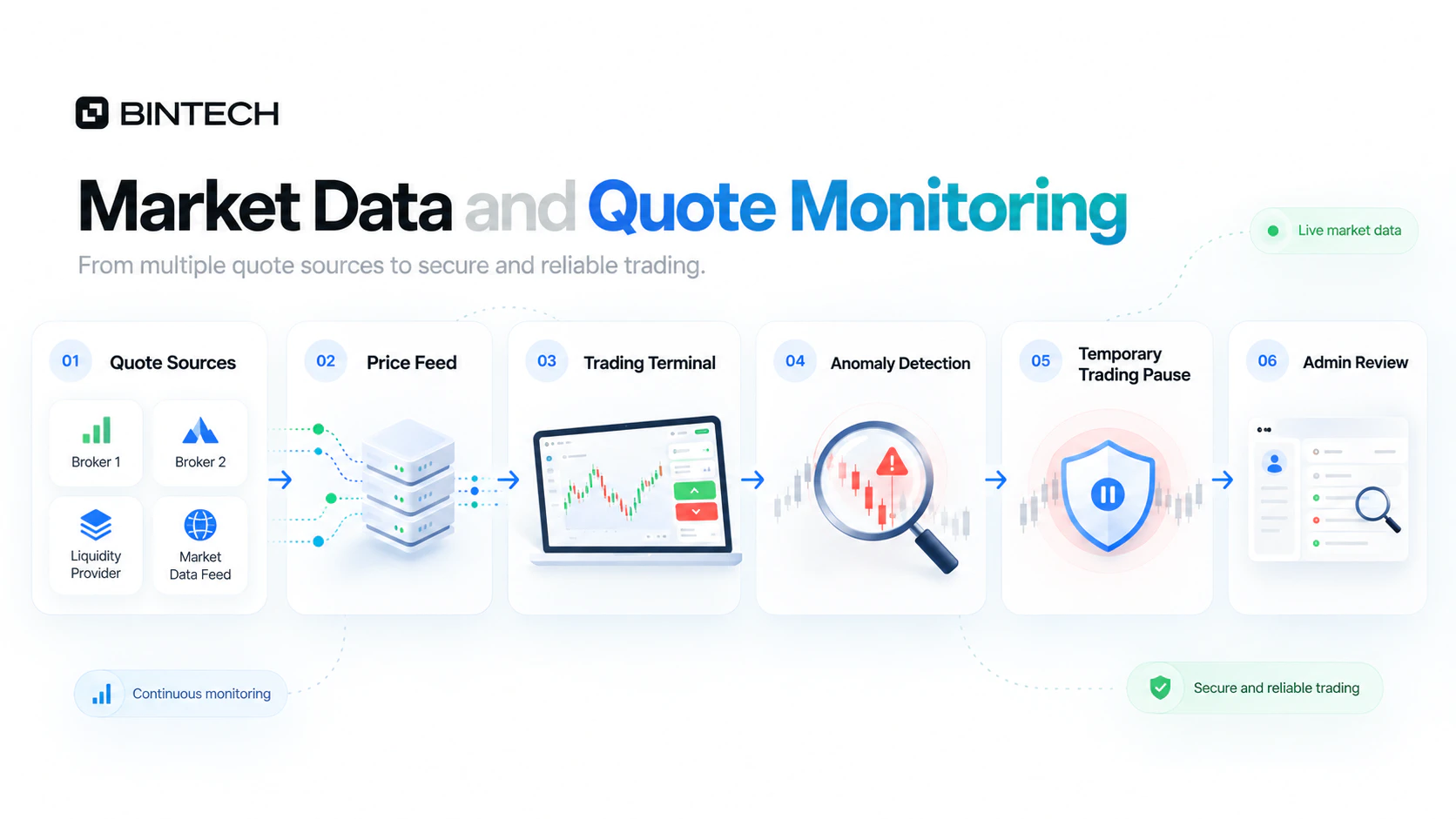
Market information plays an essential role in a platform that displays asset prices and supports contracts linked to price conditions. The relevant software responsibilities include presenting data consistently, identifying unusual information, and making appropriate operational responses possible.
Market and OTC Quote Availability
Bintech’s technical offering includes real-time market and OTC quotes. The distinction between market-sourced and OTC data should be understood in the context of the instruments and operating conditions made available by the platform.
Prospective operators should ask how relevant data sources and applicable pricing conditions are described in their commercial and operational documentation. The availability of real-time information does not by itself establish which particular provider supplies every instrument.
Detecting Anomalous Quotes
The Bintech administration system includes quote monitoring functionality designed to identify anomalies and temporarily suspend trading when necessary.
An unexpected or inconsistent data value can create operational uncertainty. A monitoring function that flags the condition and initiates a defined protective response gives the technical team an opportunity to investigate rather than allowing an abnormal data event to pass unnoticed.
For an operator, the important questions are how incidents are reviewed, what records are available to authorized personnel, and how affected activity is handled according to the platform’s disclosed rules.
Quote monitoring should not be confused with arbitrary manipulation of customer transactions. Consistent price handling, transparent trading conditions, and reliable audit records are essential considerations in evaluating a provider.
Account Management: Real, Demo and Tournament Environments
Different account types serve different purposes. A complete platform needs to distinguish them clearly within the available interface and account information.
Demo Accounts
Demo accounts provide a simulated environment in which users can explore trading functions without committing real funds. They are useful for learning the interface, reviewing available settings, and understanding how supported features are presented.
The simulated environment should be described accurately. Demo results do not establish the financial results a user could achieve with real-money activity.
Real Accounts
Real accounts support the platform’s live trading environment under the applicable conditions. From a software assessment perspective, relevant considerations include the visibility of account information, transaction history, and supported payment-related functions.
A prospective operator should review these features through the available demonstration and clarify any limitations associated with demo access.
Tournament Accounts
Bintech supports tournament accounts and tournament functionality, including a monthly leaderboard.
These modules make it possible to configure supported organized activities within the platform. Their practical use depends on the operator’s selected conditions and the legal requirements applicable to the relevant market.
Unified User Profiles
The Bintech user profile brings together information including the avatar, nickname, achievements, statistics, trading history, password settings, payment-related functions, and support ticket history.
Registration and authentication are available through email and supported social networks.
Combining these functions in one interface provides users with a central place for routine account tasks. It also makes it important that account information, support records, and available security controls are presented clearly.
Broker Back Office: The Operational Side of Trading Software
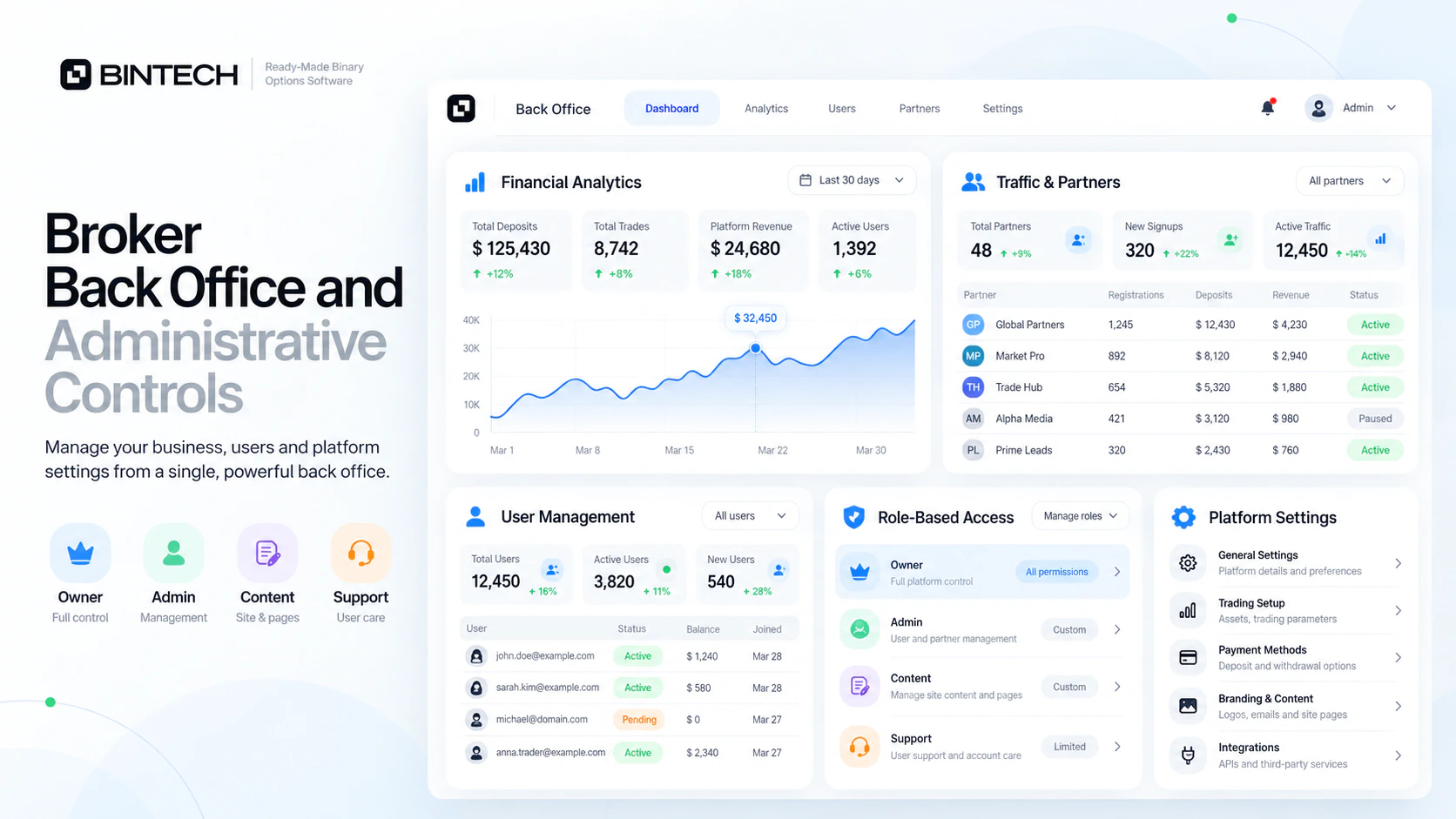
While traders interact with charts and account pages, the operating team needs tools to oversee the broader platform environment.
Back office software serves that purpose. It is not simply a second interface displaying the same information. It organizes operational data, access permissions, configuration options, and administrative actions around the responsibilities of authorized employees.
Financial Reporting and Traffic Analytics
Bintech provides detailed financial analytics and information about traffic sources through its administrative panel. The system supports reviewing individual users, partners, and trades, giving authorized personnel access to more specific records when general reporting is insufficient.
For example, an operator investigating an inconsistency between a partner report and account activity may need to examine the relevant records rather than rely exclusively on totals. The availability of granular information supports a more structured investigation.
Reporting functions do not replace independent accounting, legal obligations, or external reconciliation procedures where these are required.
Administrative Roles and Access Separation
Bintech includes distinct administrative roles for the owner, administrator, content manager, and support team.
This separation matters because employees performing different tasks should not automatically require identical access to financial information or sensitive configuration controls.
A content manager may need to maintain information displayed on the website, while a support specialist may need access to relevant customer requests. The project owner remains responsible for determining how roles and permissions are assigned within the available system.
During implementation, the operator should establish procedures for issuing access, reviewing permissions, and handling personnel changes.
Operational Settings and Content Administration
The Bintech back office provides management of supported functional modules, website content, currency pairs, payout percentages, and notification settings.
This allows authorized staff to configure available platform functions through administrative tools rather than requesting a new software release for every supported routine change.
However, the availability of a setting does not determine how it may lawfully or ethically be used. Any changes affecting financial contract conditions should remain consistent with disclosed rules and applicable requirements.
Activity Logs and Suspicious Account Detection
Account monitoring and activity records support the operator’s ability to examine what has happened within the platform.
Bintech documents logging of actions performed by users and partners, as well as a system for identifying multiple accounts and suspicious activity.
These capabilities serve different purposes. An activity log provides a record that can help reconstruct relevant events. Suspicious activity detection highlights patterns that may warrant closer review.
A detection signal is not conclusive evidence of wrongdoing. Appropriate operational procedures should distinguish between an automated alert, an investigation, and any subsequent account-related decision.
When assessing a software provider, buyers should ask which information is available to authorized reviewers and how access to potentially sensitive records is controlled.
The presence of activity logs is especially relevant in systems where multiple staff members, partners, and users interact with the same software environment.
Payment Integrations and Transaction Administration
Payment functionality involves more than displaying a list of available deposit methods. A trading platform must connect relevant user actions with supported external payment services and internal records.
A typical integration may involve a user’s payment request, interaction with an external provider, a resulting payment status, and relevant account or administrative updates. The exact sequence and technical interfaces depend on the provider and the integration.
Bintech supports payment system integrations, multi-currency functionality, and API-based payout administration through its back office.
What to Verify Before Connecting a Payment Provider
A prospective operator should establish whether the chosen service supports its business model, target jurisdictions, intended currencies, and transaction requirements.
It should also clarify how transaction statuses are handled, what actions authorized administrators can perform, and which operational records are available for review.
The software’s ability to integrate with a provider does not guarantee that the provider will approve a particular project. Commercial approval, transaction fees, settlement arrangements, and account requirements remain separate considerations.
Multi-Currency Operations
Bintech provides multi-currency functionality, allowing a platform to support configured currencies and compatible payment methods.
Currency availability, provider requirements, and regional restrictions should be confirmed for the actual project rather than inferred from the general existence of multi-currency support.
Operators should also distinguish displayed account currencies from external settlement arrangements and maintain appropriate financial records.
Affiliate Software and Traffic Data Integration
For teams already engaged in traffic acquisition, the relationship between partner activity and platform administration can be particularly important.
Bintech includes an affiliate system with advanced functionality and relevant traffic-source analytics.
Through supported administrative settings, the operator can manage its own partner program, configure available referral conditions, and review relevant partner activity.
From a technical standpoint, the important issue is not simply whether the platform has an affiliate dashboard. The operator also needs to understand which partner settings are configurable, what data appears in administrative reports, and how responsibilities are divided between the platform team and affiliate managers.
An established traffic acquisition team may choose to develop an independently branded platform while maintaining existing relationships with other providers, where those arrangements are permitted by its agreements.
The full commercial considerations involved in operating a branded solution are discussed in our white label binary options platform guide.
User Communication and Promotional Modules
Trading platforms also need ways to communicate with users and manage supported promotional functionality. These responsibilities are distinct from core transaction processing, but they affect day-to-day administration.
Bintech includes live chat, a ticket system, website and Telegram notifications, and a Market News module.
Live chat can support direct communication during an active session, while tickets provide a more structured method for recording and following up on requests. Notification controls allow authorized personnel to manage supported messages through the available administration interface.
The platform also provides bonuses, promo codes, risk-free trade bonus mechanics, tournaments, statuses, achievements, missions, daily login rewards, and leaderboard functionality.
These are configurable software features, not evidence that a particular campaign will increase conversion, trading activity, or revenue.
Operators should make relevant promotional conditions understandable and ensure that the available mechanisms are used consistently with the terms communicated to users and applicable marketing restrictions.
Security, Maintenance and Operational Continuity
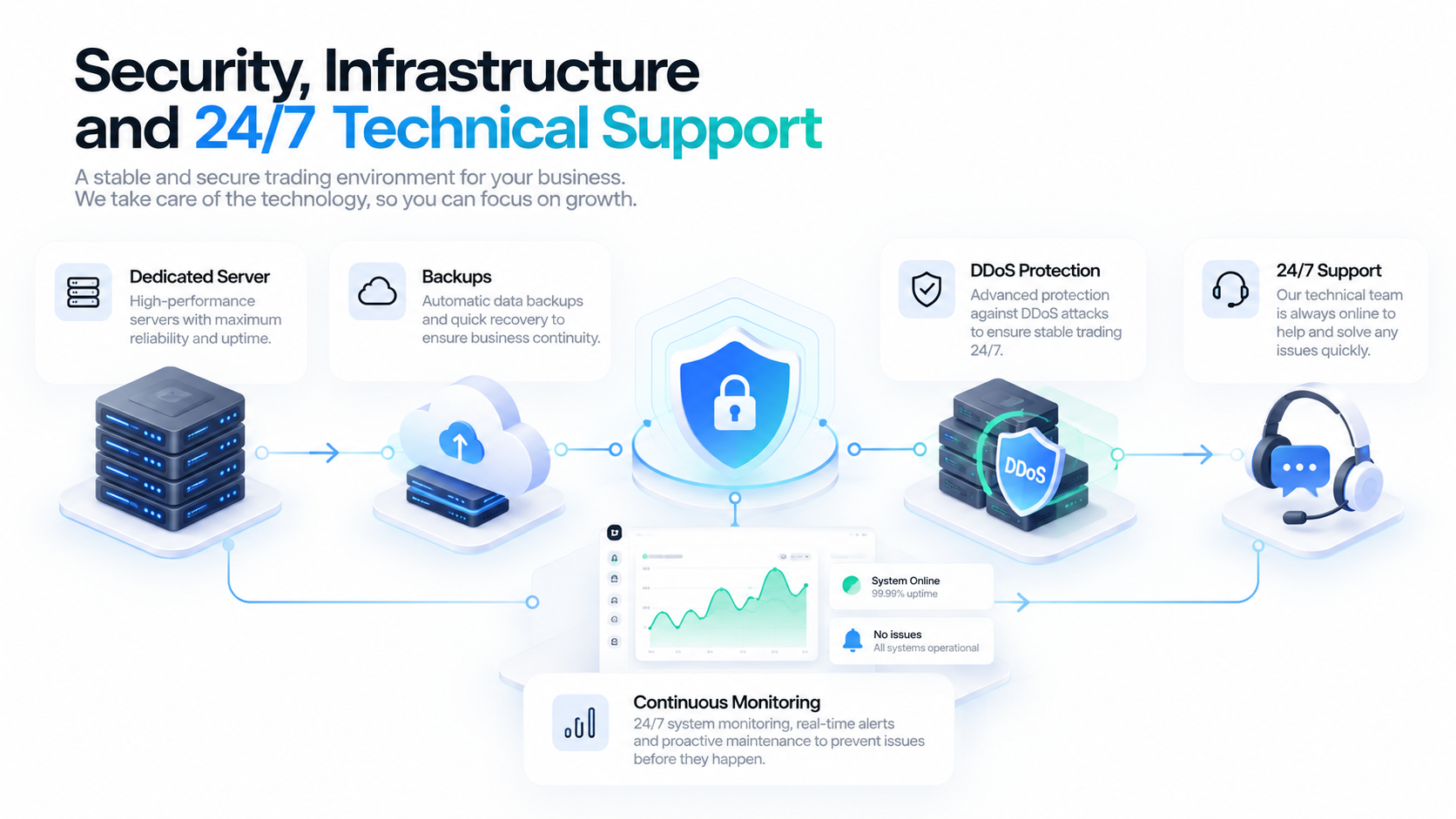
Even a feature-rich trading terminal can become unsuitable for an operating project if maintenance responsibilities, security arrangements, and technical incident handling are unclear.
These considerations should therefore be examined independently from the design and functionality of the user-facing interface.
Infrastructure Monitoring
Bintech provides continuous monitoring of its supported platform environment and 24/7 technical assistance.
Monitoring creates an opportunity to identify conditions that require technical attention. The exact detection procedures, incident handling arrangements, and service commitments should be understood through the applicable support agreement.
Backups and Server Maintenance
Regular backup routines and server maintenance are included in Bintech’s technical service.
Backups are an important part of operational continuity because they support recovery processes when relevant data or system components are affected by a technical incident.
However, the existence of backups alone does not establish a particular recovery time or recovery point. Those details should be confirmed separately if they are important to the client’s operational planning.
DDoS Protection
Bintech also includes protection against distributed denial-of-service attacks. Such measures are intended to help address attempts to disrupt access to the platform by overwhelming its resources.
No protection mechanism can guarantee immunity from every possible attack. Buyers should evaluate security as a combination of preventive measures, monitoring, operational procedures, and support responsibilities.
Technical Onboarding
Bintech provides a guide to the administrative panel, a product overview, online consultation, and a walkthrough of the key available functions during onboarding.
This helps the operator understand routine administrative tasks and the boundaries between settings that can be managed independently and changes requiring technical assistance.
How to Evaluate Binary Options Software Before Purchasing
It is difficult to judge a complete trading system from its marketing presentation alone. A structured demonstration should examine representative user and administrative workflows and confirm the scope of the supplier’s offering.
Evaluate the Terminal Through Practical Tasks
Rather than simply viewing the home screen, switch between available chart modes, inspect the timeframes, use supported technical indicators, and review how trading instructions and account history are presented. For a step-by-step list, use our binary options trading terminal demo checklist.
Test the experience on different screen sizes where demo access permits. Ask which features belong to the standard configuration and which require additional work.
Review Administrative Capabilities
Ask the supplier to demonstrate the types of operational information available to authorized administrators. Important areas include financial reporting, account records, access roles, activity logs, partner information, and supported configuration settings.
A demonstration does not require exposing another customer’s private data or disclosing proprietary implementation details.
Clarify External Dependencies
Identify any services that depend on outside providers, including payment processing and market information. Confirm what is included in the software and what requires separate commercial approval, credentials, or fees.
This prevents the false assumption that every externally dependent service becomes available automatically when the platform is deployed.
Understand the Commercial and Support Model
Determine which modules are included in the quoted software package, what recurring services are provided, how individual development requests are priced, and which technical responsibilities remain with the provider.
The relevant comparison is the total software and service arrangement, not only the lowest advertised starting price.
Verify Contractual and Regulatory Responsibilities
Purchasing software is separate from obtaining any authorizations required to operate a financial services business. Binary options may be restricted or prohibited for particular customer groups or in certain jurisdictions.
Before launch, the prospective operator should obtain appropriate advice on its intended activities, business model, target markets, and applicable regulatory requirements.
Bintech as a Binary Options Software Provider
Bintech supplies ready-made software with a trading terminal, account functionality, administrative tools, partner management, payment integration capabilities, and ongoing technical services.
The software is available through an All Inclusive package that covers the standard modules described in the current commercial presentation. Additional features or non-standard development are evaluated separately.
For clients who want to operate the system under their own brand, Bintech also provides a turnkey binary options platform configuration with agreed branding, deployment, and support arrangements.
Unlike a standalone script, the offering is intended to provide a wider operating environment. To understand how these product categories differ, see our guide to binary options scripts.
The goal of a software evaluation should be to confirm that the available product meets the project’s technical and operational requirements, not to assume that software alone guarantees a successful business outcome.
Request a Demo and Review the Technical Features
The most practical way to assess Bintech is to review the available trading interface, ask about administrative capabilities, and compare the standard functionality with the requirements of the planned project.
Bintech provides demo access and an official PDF presentation containing information about the software modules and current commercial conditions.
The team can explain the technical setup, included functionality, ongoing support, and options for individually requested development.
Request the presentation and demo access through our official Telegram bot.