
Binary Options Script: What to Check Before Buying
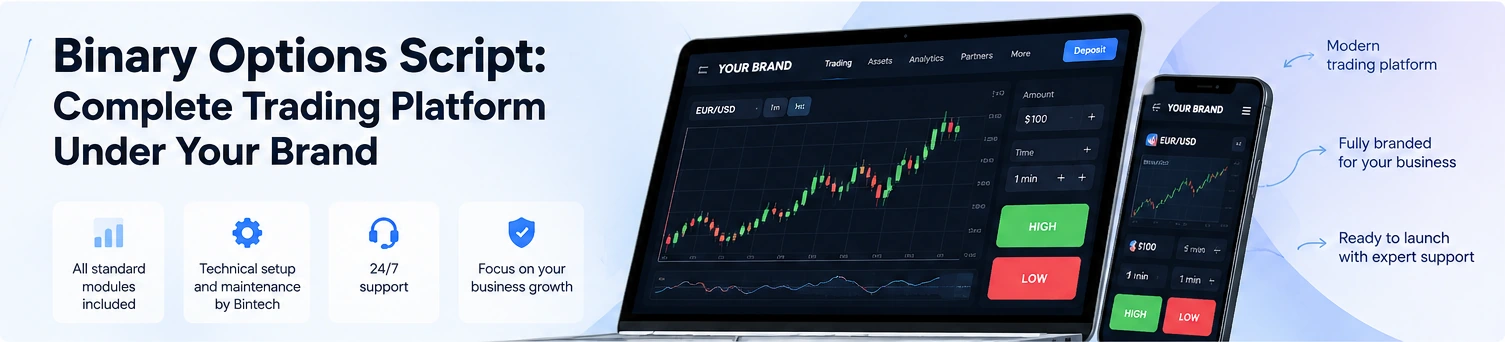
Searching for a binary options script is often the first step toward finding software for a new trading project. Yet the term can mean very different things. One supplier may offer a website template that still requires development, another may provide application files for independent installation, while a third offers a ready-to-use trading platform with deployment, maintenance, and technical support.
These differences have a direct impact on the work required before launch, the resources a project needs, and its ongoing operating expenses. Two offers may feature similar trading screens but differ significantly in their standard functionality, technical responsibilities, support arrangements, and additional costs.
For a prospective buyer, the important question is not whether a product is advertised as a binary options script. It is whether the proposed solution meets the project’s actual requirements, what is included in the quoted price, and who will take responsibility for keeping the software operational.
This guide explains how to evaluate a binary options trading script, identify incomplete offers, compare different software delivery approaches, and make a more informed purchasing decision. It also examines when a complete, professionally maintained platform may be more practical than purchasing separate software components.
What Is a Binary Options Script?
A binary options script is a commercial term commonly used to describe software intended for building or operating a binary options trading website. However, it is not a standardized product category with a universally defined set of features.
In its narrowest interpretation, a script may consist of application files or specific software components. In a broader commercial context, suppliers use the same expression for complete web applications that include trading functionality and administrative tools.
This ambiguity creates an important challenge for buyers. A product advertised as a ready-made script may still require substantial configuration, additional modules, external integrations, and ongoing technical work before it can be used as a complete platform.
A professional evaluation should therefore focus on the actual deliverables rather than the terminology used in an advertisement.
The buyer needs to establish whether the offer includes a functioning software environment, the tools necessary to manage it, the services required for deployment, and a clear arrangement for subsequent maintenance.
A Trading Script and a Ready-to-Use Platform Are Not Always the Same Product
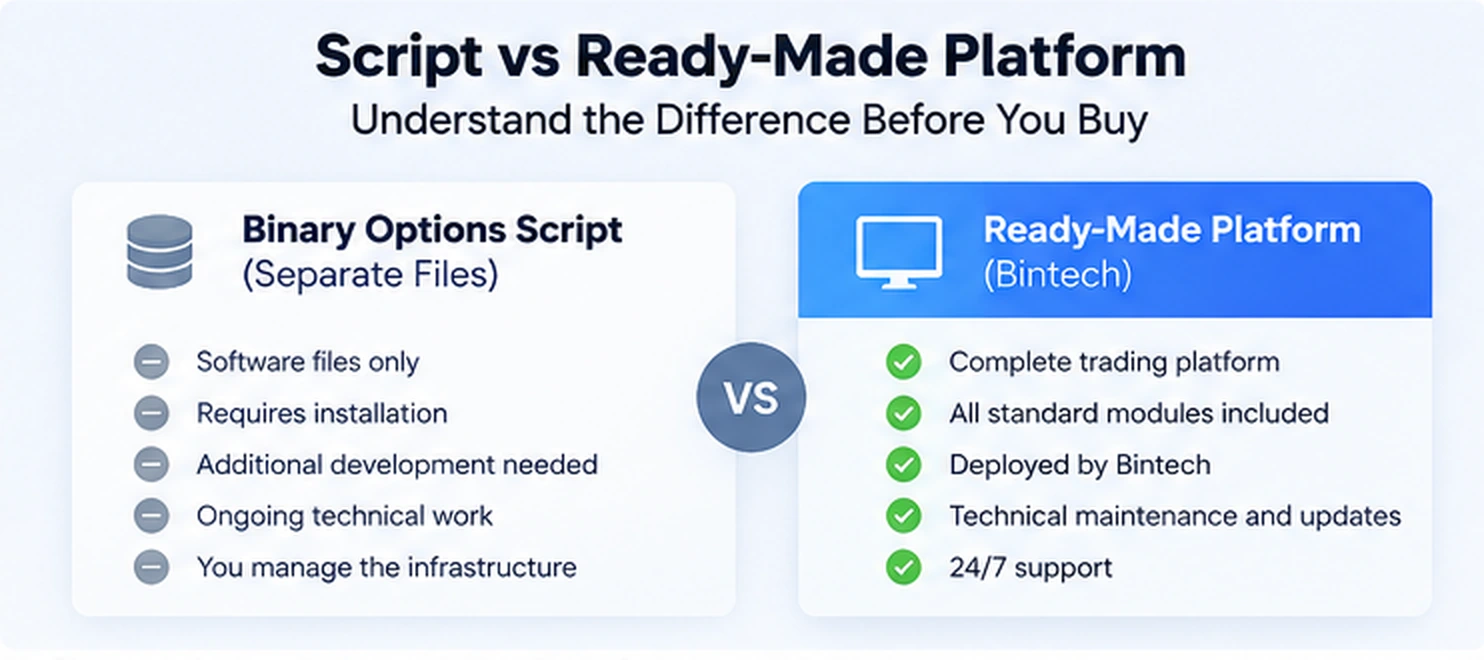
The distinction between separate software components and a complete trading platform is primarily practical.
A collection of software files may contain useful functionality, but someone still needs to configure the environment, connect the required services, test the application, and maintain it after deployment. Even when the interface appears complete, there may be unresolved dependencies that are not visible in screenshots.
A ready-to-use platform, by contrast, is offered as an integrated product with an agreed technical configuration and defined responsibilities for implementation and support.
Neither approach should be dismissed automatically. A company with its own experienced development department may prefer working directly with software components. A team whose main expertise lies in attracting trading traffic may have little reason to manage the underlying technical environment independently.
The correct choice depends on the buyer’s resources and intended operating model.
Why a Working Interface Is Not Enough
A trading website can look convincing without being ready for regular operation. Attractive charts, account pages, and registration forms demonstrate aspects of the interface, but they do not establish the completeness of the underlying product.
For example, a visible deposit button does not confirm that the payment workflow has been configured. An administrative dashboard does not establish which actions are supported or whether the underlying data is connected to the relevant processes. A mobile screenshot says little about actual behavior across different devices.
These are not necessarily indications of a defective product. Demonstration environments often contain intentionally limited functionality. The problem arises when the supplier fails to explain which capabilities are operational, which are simulated, and which are planned for future development.
Before proceeding, the buyer should distinguish a design presentation from a working software demonstration and a working demonstration from a fully configured project.
What Exactly Is Included in the Supplier’s Offer?
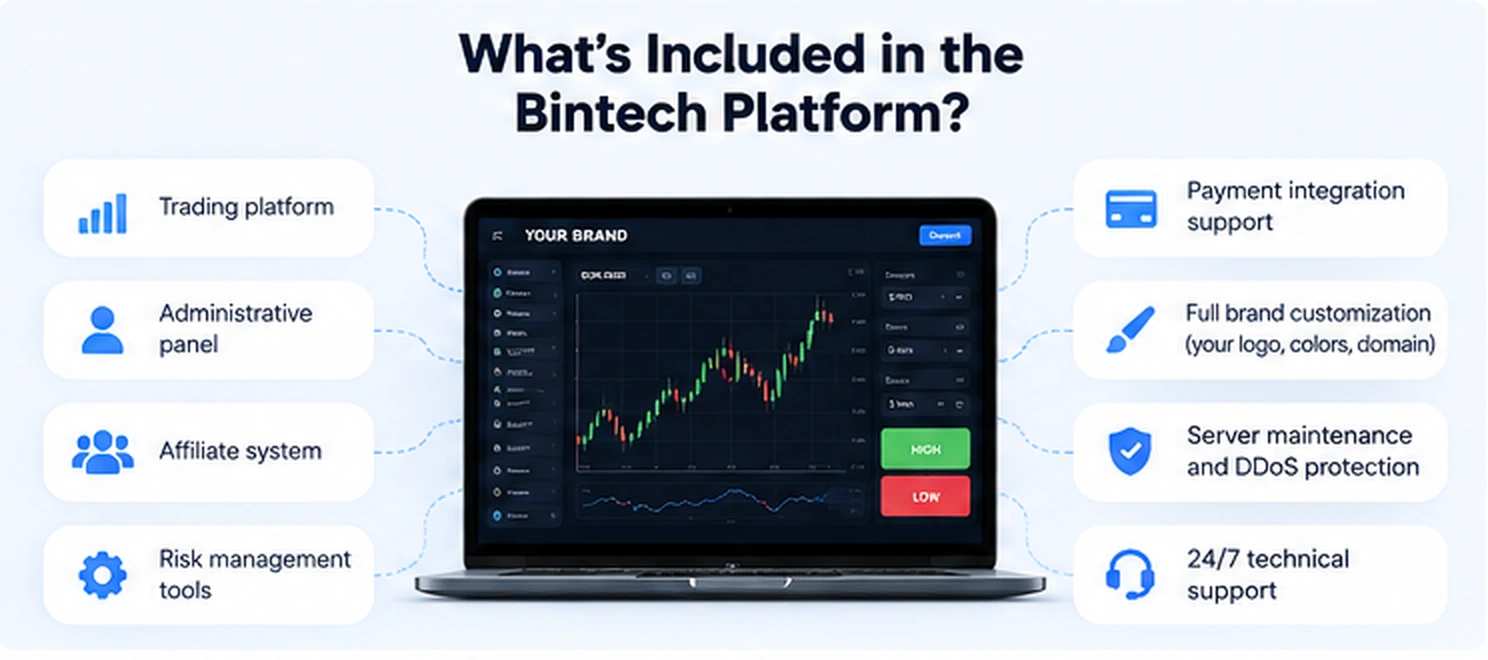
One of the most important purchasing decisions is determining the boundaries of the standard package.
Suppliers may divide functionality into separate commercial modules, provide selected components as part of a basic package, or offer a more comprehensive solution with standard features already included.
A buyer should not assume that a module shown on the supplier’s website is automatically part of the quoted price.
The commercial proposal should clearly distinguish existing software functionality from additional services and individual development requests.
Standard Functionality
The first question is which features are available without commissioning new development. This includes the software environment itself and the modules identified as part of the standard offer.
For a trading project, the buyer should confirm whether the demonstrated product includes the relevant operational and administrative components rather than relying on a general statement that the solution is complete.
The exact technical functions of such systems are examined in our binary options software guide. At the purchasing stage, however, the priority is to establish which of those capabilities are actually included in the proposed package.
Configuration vs Additional Development
Configuration and development are different types of work.
Configuration involves selecting or adjusting functionality that already exists within the software. Depending on the product, this may include available interface settings, content, supported administrative parameters, or promotional options.
Additional development involves changing or extending the existing product beyond its standard capabilities.
That distinction should be understood before signing an agreement. If the buyer expects a particular feature but the supplier considers it a separate development project, the difference can affect both the budget and the implementation schedule.
Third-Party Integrations
External integrations deserve separate attention because they often depend on services outside the software supplier’s direct control.
A product may support integration with certain payment providers or other external systems. However, technical compatibility does not necessarily mean the buyer will automatically receive access to every supported service.
External providers may have their own commercial conditions, approval processes, technical requirements, and regional restrictions.
The purchasing discussion should therefore distinguish the available software integration from the external service itself. This helps prevent misunderstandings about what the supplier can deliver independently and what depends on another organization.
How to Evaluate a Binary Options Script Demo
A demonstration is most useful when it answers specific questions about the product rather than simply presenting a sequence of attractive screens.
The prospective buyer should begin by identifying the functions that are essential for the intended project. The demonstration can then be organized around representative tasks and the corresponding software behavior.
This method makes it easier to compare products from different suppliers because the evaluation is based on comparable requirements rather than marketing presentations.
Establish the Purpose of the Demo
Before opening the platform, ask whether the demonstration represents an existing product configuration, a specially prepared example, or a limited interface preview.
Some functions may be intentionally restricted in the demo environment. That can be reasonable, particularly when the supplier wants to protect proprietary technology or sensitive administrative features.
What matters is that these restrictions are explained and do not create misleading expectations about the actual software package.
Follow Realistic User Scenarios
Instead of evaluating screens independently, review a realistic sequence of actions using the available demonstration features.
For example, examine the process of accessing an account, selecting available platform settings, navigating the relevant interface, and reviewing the information associated with a completed demonstration activity.
The objective is not to reproduce every possible user action. It is to understand whether the interface behaves consistently and whether important information remains accessible throughout the process.
A well-organized demonstration should also allow the buyer to identify functions that require further explanation.
Review the Administrative Environment
Not all administrative capabilities need to be publicly displayed. A software provider may reasonably limit access to sensitive functions, internal configuration details, or confidential operating information.
Nevertheless, a prospective customer should be able to understand the general purpose of the available administrative tools and how they relate to routine project management.
This can be achieved through a controlled demonstration, documentation, or an explanation from the technical team without exposing another customer’s data or the supplier’s internal implementation.
Clarify What Happens After the Demonstration
A demonstration should lead to a clear understanding of the next steps: what information the buyer must provide, which configuration options are available, what requires separate approval, and which services are covered by the commercial proposal.
If these questions remain unanswered, the buyer has not yet received enough information to evaluate the full offering, regardless of how polished the demo appears.
Evaluating the Supplier’s Technical Responsibilities
When choosing between separate software components and a maintained platform, technical responsibility is often more important than the initial purchase price.
Someone must prepare the software environment, deploy the application, maintain the infrastructure, investigate technical incidents, and manage changes that affect the system.
These tasks require time, expertise, and coordination. If they are not part of the supplier’s service, the buyer must arrange the necessary resources independently.
Deployment Responsibilities
Before purchasing, establish who will configure the software and prepare it for the agreed operating environment.
The answer should cover the responsibilities for installation, initial configuration, deployment, and verification that the agreed components are functioning.
A supplier may deliver files and expect the customer to handle installation. Another may include deployment services as part of the complete project. Neither arrangement should be assumed without confirmation.
Maintenance and Updates
Software requires attention after deployment. Technical issues may arise, dependencies can change, and additional configuration or development may become necessary.
The customer should know who will maintain the application and which changes are covered by the existing service arrangement.
It is also important to distinguish routine technical maintenance from new feature development. These activities may be handled by the same team but are not necessarily included under the same commercial conditions.
Incident Handling and Support
Support availability should be evaluated separately from claims about the software’s reliability.
A supplier may advertise a stable product, but unexpected technical problems can still occur. The buyer therefore needs to understand how technical assistance is organized and which responsibilities the support team accepts.
Where continuous support is important, the agreed service should clearly describe the available communication and incident-handling arrangements.
Understanding the Real Cost of a Binary Options Script
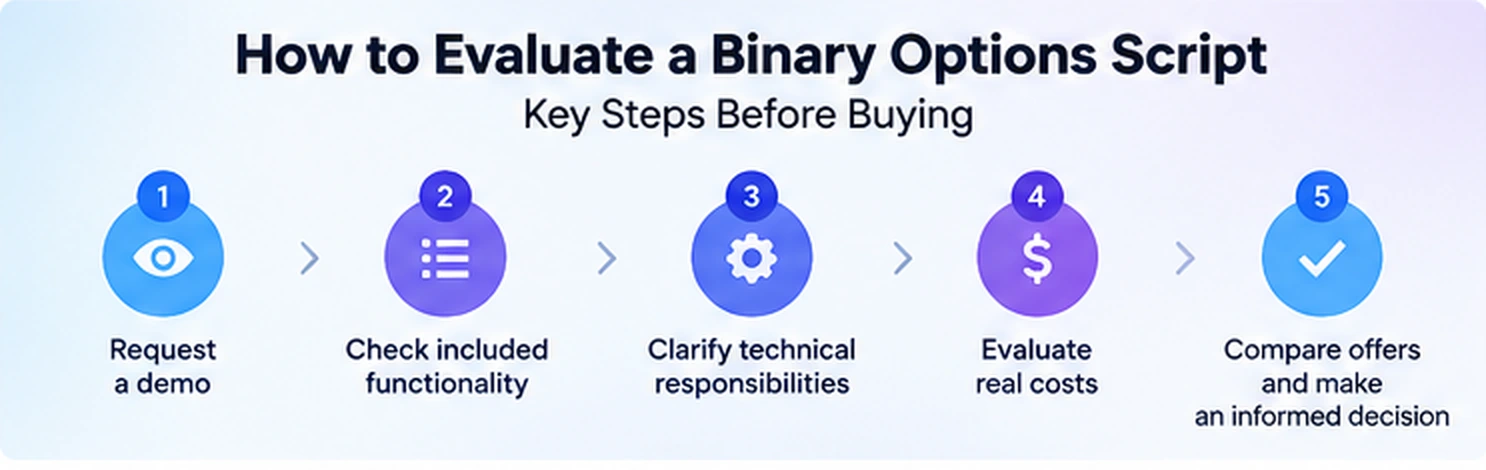
The total cost of a software project cannot always be determined from the initial purchase price.
A relatively inexpensive package may require additional development, installation, integration work, and continuous maintenance. A more comprehensive offer may include these responsibilities in its standard commercial model.
This does not mean the second option will always be cheaper. It means that meaningful price comparisons require a consistent understanding of what the customer receives.
Initial Software and Deployment Costs
The initial payment may cover different services depending on the supplier. In one arrangement, it could relate primarily to delivery of software components. In another, it could include configuration, branding, technical deployment, and preparation of the agreed working environment.
When comparing prices, the buyer should establish whether the quoted amount covers the entire implementation scope or only the first stage.
Any design changes, integrations, or additional requirements should be identified before the project begins wherever possible.
Ongoing Technical Expenses
Maintenance, monitoring, hosting-related services, and technical assistance may create recurring expenses.
If the buyer acquires a standalone package, these responsibilities may need to be handled through its own team or external contractors. A maintained platform can provide a different arrangement in which the supplier performs the agreed technical work.
The actual commercial value depends on what those recurring payments cover and how the responsibilities are divided.
Individually Requested Features
Additional development can become a significant source of unexpected expense when requirements have not been defined clearly.
A buyer should distinguish changes to supported settings from requests to build new functionality. The supplier should be able to explain whether the proposed modification is available within the current product or requires separate technical work.
Where additional development is necessary, the scope, expected cost, and implementation period should be agreed before work starts.
External Operating Costs
Some project expenses fall outside the software itself. These may include services provided by external organizations, independent professional advice, customer acquisition, and other operating requirements.
Even a complete software package should not be interpreted as including every expense associated with running the buyer’s business.
For that reason, a responsible cost comparison separates software delivery and technical services from the operator’s wider commercial responsibilities.
How to Compare Software Offers Without Being Misled by the Price
A practical comparison begins with the same questions for every supplier. Instead of comparing one headline price with another, evaluate the complete scope and the responsibilities attached to each offer.
| What to Compare | Questions to Ask the Supplier |
| Product format | Will I receive separate software components or a fully configured platform? |
| Included functionality | Which standard modules are included in the quoted price? |
| Demo access | Can I review the existing product before making a decision? |
| Technical deployment | Who prepares and deploys the software environment? |
| Administration | Which routine settings can I manage independently? |
| Technical support | Who handles maintenance, monitoring, and technical incidents? |
| Additional work | How are non-standard features and design requests evaluated? |
| Recurring expenses | Which services require ongoing payments? |
| External dependencies | Which integrations require third-party approval or additional charges? |
Using a consistent set of questions makes it easier to distinguish an inexpensive but incomplete product from a more comprehensive solution.
It also helps establish expectations before the commercial relationship begins. A buyer who understands the supplier’s responsibilities can plan internal resources more accurately and avoid treating unconfirmed assumptions as included services.
Common Mistakes When Choosing a Ready-Made Trading Script
Many purchasing problems arise not from the software’s visible design but from insufficient evaluation of the actual offer.
Choosing Based Only on Screenshots
A modern-looking interface can create a favorable first impression. However, screenshots cannot confirm how the application behaves, which modules are operational, or what technical work remains.
The better approach is to request a product demonstration and connect it to specific requirements.
Assuming Every Advertised Feature Is Included
Marketing materials often describe the supplier’s overall capabilities rather than the exact configuration provided at a particular price.
Buyers should request a clear description of the standard package and identify any features that are optional or subject to separate development.
Ignoring Technical Maintenance
Focusing exclusively on the initial installation can lead to underestimating ongoing operating requirements.
Maintenance and support arrangements should be considered before purchase, especially when the project does not have its own technical department.
Confusing Demo Features with Production Services
A demonstration may use simulated activity, sample data, or restricted functions. It should not be assumed that every externally dependent service is automatically available in a live environment.
Clarify which functions are included and which require additional configuration, provider approval, or technical preparation.
Expecting Unlimited Customization
Ready-made software can provide extensive configuration options without allowing every underlying component to be changed freely.
It is important to identify the boundary between routine settings and individually requested development. This protects both parties from unrealistic expectations about cost and implementation time.
Overlooking Business and Regional Requirements
A functioning software product does not automatically make every intended business activity permissible in every market.
Operators should evaluate the restrictions and obligations applicable to their own activities and target jurisdictions before launching a project.
What Experienced Traffic Acquisition Teams Should Look For
The requirements of an experienced affiliate team may differ from those of a company planning to develop proprietary software internally.
A team with established traffic acquisition capabilities may already understand audience development, partner relationships, advertising costs, and operational planning. Its main challenge may be obtaining a suitable technical platform without building an independent development department.
In this situation, the most important product characteristics are not necessarily access to the underlying code or the number of development technologies used by the supplier.
Instead, the team may prioritize a working platform, available administrative configuration, a suitable partner management environment, and reliable technical assistance.
Such a team can then concentrate on the activities it understands best: attracting relevant users, developing its brand, organizing partner relationships, and managing the commercial side of the project.
Where existing partnership agreements permit it, a team may also continue cooperating with other brokers while developing a separate branded platform.
The software solution should support the intended operating model, but it cannot replace the commercial expertise and responsibilities of the project owner.
Why Bintech Offers a Complete Platform Instead of a Standalone Script

Bintech takes a different approach from suppliers offering individual software files for independent installation.
The company provides a complete, ready-made trading platform under the customer’s brand, together with the agreed technical setup, infrastructure maintenance, and ongoing support.
The product is offered through a single All Inclusive package. The standard modules described in the current commercial presentation are included rather than divided into separate software tiers.
This structure allows prospective customers to review the complete standard offering before deciding whether they require any individual modifications.
Technical Work Remains with Bintech
Bintech handles the technical setup, deployment, maintenance, and updates of its platform. The service also includes 24/7 technical support and continuous infrastructure monitoring.
Clients manage the available operational settings through the administrative panel and concentrate on their own business activities.
This division of responsibilities is particularly relevant for teams that want a functioning software solution without independently managing application development and ongoing technical maintenance.
Source Code Is Not Transferred
Bintech provides a ready-to-use platform rather than handing over its underlying source code. The source code remains with Bintech and is not provided to customers.
This arrangement protects the company’s proprietary technology and prevents unauthorized copying or resale of its software. Customers use the configured platform under their own brand, while the Bintech team continues to handle the technical side.
The practical benefit is straightforward: the client does not need to maintain the application’s underlying code or organize a separate development team for the standard platform.
Standard Modules Are Included
Bintech does not divide its standard platform functionality into multiple separately priced software packages.
The All Inclusive offering covers the existing modules described in the commercial presentation. Features that some providers may offer as additional paid options are included within Bintech’s standard package.
When a project requires functionality or design work beyond the included modules, the request is discussed separately with the manager. The team evaluates the additional scope and provides information about the cost and implementation schedule.
Technical Support Is Available 24/7
Bintech provides round-the-clock technical support together with ongoing monitoring and infrastructure maintenance.
Its technical service includes server maintenance, backup routines, and DDoS protection. At launch, customers also receive guidance on the administrative interface and available platform functions.
This support arrangement allows the operator to focus on business management while the technical team handles the services included in the agreed scope.
Demo Access and Current Pricing
Bintech provides demo access so prospective customers can examine the available software before making a purchasing decision.
The official PDF presentation includes the current commercial conditions and information about the standard modules. Additional development requests can be discussed with the manager.
To review the complete offering, visit our White Label Binary Options Platform page or request the presentation directly.
Frequently Asked Questions About Binary Options Scripts
Is a binary options script always a complete platform?
No. The term can refer to separate application components, a website package, or a complete trading system. The actual scope depends on the supplier’s offer.
How can I tell whether a script is ready to use?
Request a demonstration and a description of the included functionality. Clarify whether the supplier provides deployment, configuration, maintenance, and other required technical services.
Can I run a trading platform without my own developers?
Yes, if the supplier provides a complete maintained solution and handles the agreed technical tasks. Bintech offers this approach, including technical setup and 24/7 support.
Does Bintech provide source code?
No. Bintech provides a complete trading platform under your brand. The source code remains with Bintech, which handles the technical maintenance and updates.
Are all standard Bintech modules included in the price?
Yes. The All Inclusive package includes the standard modules described in the current presentation. Additional custom development is discussed and priced separately.
Can I use Bintech if my team already works with other brokers?
Yes. Experienced traffic acquisition teams can develop their own branded platform while maintaining existing broker partnerships, provided their current agreements allow this arrangement.
Can I review the platform before making a decision?
Yes. Bintech provides demo access and a PDF presentation with current pricing and information about the available software modules.
Conclusion: Choose the Complete Solution, Not Just the Lowest Price
A binary options script should be evaluated according to what the customer actually receives, not simply the name of the product or its advertised starting price.
The most important purchasing considerations are the completeness of the standard package, the availability of a working demonstration, the division of technical responsibilities, recurring expenses, and the process for handling additional requirements.
For businesses with internal development resources, separate software components may be a practical option. For teams that want to concentrate on traffic acquisition and operating their own brand, a complete platform with ongoing technical services may be better aligned with their needs.
Bintech provides a ready-made trading platform with all standard modules included, technical maintenance, and 24/7 support. The client manages the commercial side of the project while Bintech handles the agreed technical work.
Request demo access and review the current All Inclusive offer before making a decision.