
What Is a White Label Broker? How the Model Works
A white label broker is a brokerage that runs under its own brand on technology built by someone else. A client opens the website, signs up, deposits and trades, and only ever sees the owner’s logo, domain and interface. The trading platform, servers, price feed and updates belong to a provider that maintains them for a fee. The term comes from retail, where a “white label” product is made by one company and sold under another company’s brand.
At Bintech we provide a white label platform for binary options, so we see the model from the inside: what the provider takes on, what stays with the owner, and where new projects most often get their expectations wrong. This article explains the model in general rather than one product. What our own platform includes is covered on the white label platform for binary options page.
How a white label broker works: three layers
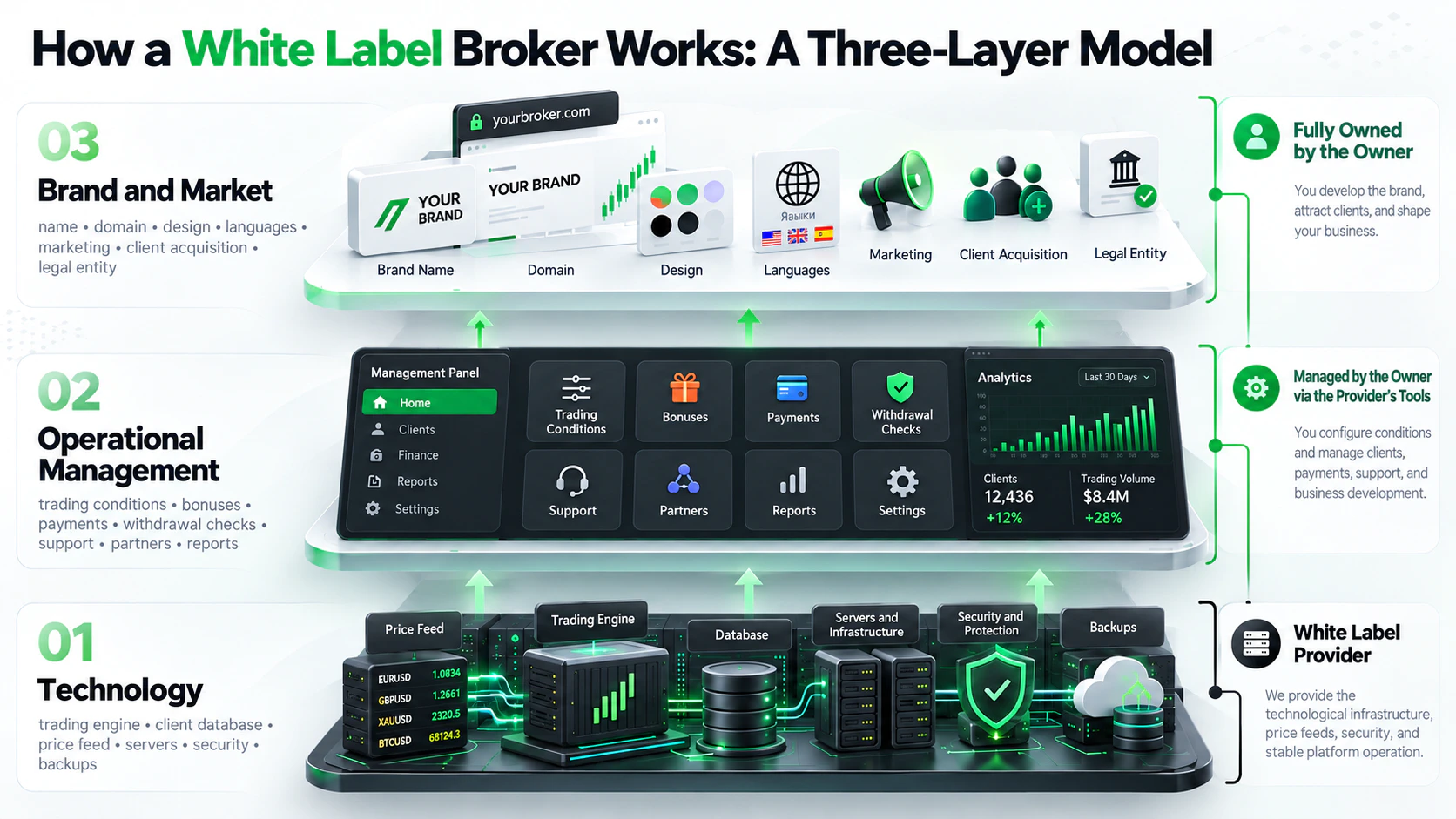
The easiest way to understand the model is to split a brokerage into three layers. The bottom layer is technology: the trading engine, client database, price feed, servers, security and backups. The middle layer is operations: trading conditions, bonuses, payments, withdrawal checks, support, affiliates and reporting. The top layer is brand and market: the name, domain, design, languages, marketing, client acquisition and the company’s legal form.
In a white label setup the provider owns the bottom layer completely. The owner’s team runs the middle layer, but through the provider’s tools: the admin panel, CRM and analytics. The top layer belongs entirely to the owner. That is why one engine can power dozens of independent brokers at the same time, competing on brand, marketing, service quality and conditions rather than on code.
| Layer | What it contains | Who runs it |
| Technology | Trading engine, terminal, price feed, database, servers, security, updates | Provider |
| Operations | Trading conditions, bonuses, deposits and withdrawals, support, affiliates, reports | Owner, using the provider’s tools |
| Brand and market | Name, domain, design, languages, marketing, legal structure, payment provider agreements | Owner |
Types of white label brokerage solutions
“White label” is used for quite different offers, and mixing them up is a common reason negotiations go nowhere. Before comparing prices, it is worth being clear about what exactly a provider is selling.
White label trading platform. The provider gives you a branded copy of its trading system: terminal, client area and admin panel. White label offers built on popular forex terminals usually work this way. Often this is only the trading part, and the owner assembles the CRM, affiliate system, payment layer and website separately.
Full white label broker platform. On top of trading, it includes client accounts, CRM and back office, payments, analytics, an affiliate programme, retention tools, hosting and maintenance. The owner gets white label broker software that can take its first client without buying anything else. Bintech works on this model.
White label with liquidity or execution. In forex and CFDs, some providers supply market access and sometimes execution through their own licensed entity as well as technology. That is less a software purchase and more a partnership with another broker, and the regulatory picture is different.
Standalone white label modules. A branded CRM, affiliate system or mobile app that plugs into an existing business. These suit established brokers rather than new projects.
| Type | What you get | What you still solve yourself | Best for |
| White label trading platform | Terminal, client area, admin | CRM, affiliates, payments, website, sometimes hosting | Companies with an in-house tech team |
| Full platform | Everything from terminal to maintenance | Brand, marketing, legal setup, payment provider agreements | New brokers and marketing-led teams |
| White label with liquidity | Technology plus market access via a partner | Relationship with the partner broker, split of responsibility | Forex and CFD projects |
| Standalone modules | One branded tool | Integration with your other systems | Established brokers |
Who is responsible for what
The key thing to understand about white label is that the provider is responsible for the technology working and the owner is responsible for the business working. If a provider promises a “complete ready-made business”, ask who will then be accountable to clients, payment providers and regulators. The line usually falls like this.
| Task | Provider | Owner |
| Platform uptime, servers, updates | Responsible | Reports issues |
| Security, backups, attack protection | Responsible | Enforces staff access rules |
| Price feed and its control | Supplies the feed and automatic protection | Decides how to act and how to inform clients during incidents |
| Brand, domain, design | Configures | Chooses and owns |
| Trading conditions, bonuses, tournaments | Provides the tools | Sets and changes them |
| Payments | Integrates compatible providers | Signs the agreements and processes withdrawals |
| Client support | Provides chat and tickets | Answers clients |
| Legal structure and licensing | – | Fully |
| Marketing and acquisition | – | Fully |
At Bintech, our team runs the technology side: a dedicated server, 24/7 monitoring, backups, DDoS protection, logging and updates. The project team manages clients, conditions and money through an admin panel with separate owner, administrator, content manager and support roles. How to organise that work is covered in our article on broker CRM and back office.
How money flows in a white label brokerage
Money is where white label causes the most confusion, so here is the flow step by step. A client deposits through a payment provider that the owner has an agreement with. The funds go to the owner, not to the technology provider. The client’s balance appears on the platform, and from that moment the transaction shows up in analytics with its traffic source and affiliate.
From there, the broker’s revenue depends on client trading results, while costs include bonuses, payment fees, affiliate payouts and marketing. The owner pays the technology provider under the contract, usually a one-off launch fee plus a monthly fee, and sometimes a share of turnover or revenue. Bintech has a single All Inclusive plan with a one-off launch payment and monthly maintenance; we send the current terms in our presentation on Telegram.
The practical takeaway is that the payment model matters as much as the price. A revenue share looks cheaper at the start but grows with the business. A fixed fee is heavier at the start but stays the same as you scale. For a full breakdown of setup fees, monthly costs and the expenses outside the software, see our guide to binary options platform cost.
Who a white label broker is built for
White label works best for people who already have the hardest asset in the brokerage business: access to clients. The technology can be bought ready-made; an audience and traffic cannot.
Trading influencers and channel owners
A channel owner already has an audience that trusts them. Today they may send followers to a third-party broker through an affiliate link and receive a fixed payment. On their own white label platform, the same followers register under the owner’s brand and stay their clients. That also shifts responsibility: every delayed withdrawal or unclear bonus term now reflects on the owner’s name, so service quality and transparent terms matter more here than anywhere else.
Affiliate teams and media buyers
Teams that already buy traffic for broker offers know their numbers: cost per registration, per deposit, per retained client. Their own brand removes the ceiling of affiliate payouts but adds work an affiliate never sees — payments, support and fraud control. Our guide on turning traffic into your own broker covers this move in detail.
Established brokers adding binary options
A company with a forex or crypto product can launch a separate binary options brand on white label, test demand in specific markets and keep its own engineering team focused on the core product.
When white label is not the right fit
If a project has no clear source of clients, no team for support and payments and no budget for the first months of operation, a platform will not create a business on its own. In that case it is better to test demand through an affiliate model first.
What a white label broker needs besides the platform
A platform covers the technology, but it does not turn into a broker by itself. To start operating, the owner needs four more things, and each is best started alongside the technical setup.
A legal structure. Where the company is registered, whether it needs a licence and which countries it can accept clients from are questions for a lawyer, and the answers depend on the product. For example, the sale of binary options to retail clients is banned in the European Union and the United Kingdom, so such projects operate in other markets. A technology provider does not replace a licence or take compliance off the owner’s plate.
Payment providers. The owner signs these agreements, and approval often takes longer than setting up the platform. Before launch, check which payment methods your audience actually uses and which providers accept your business model.
A team. Even a small project needs people for support, withdrawals, affiliate management and marketing. Duties and access rights are best assigned before the first client arrives.
A traffic source. White label shortens the road to a working product, but it does not bring clients. The fastest launches we see come from teams that already know how to buy traffic and build a funnel. See our article on the broker onboarding funnel.
White label or custom development
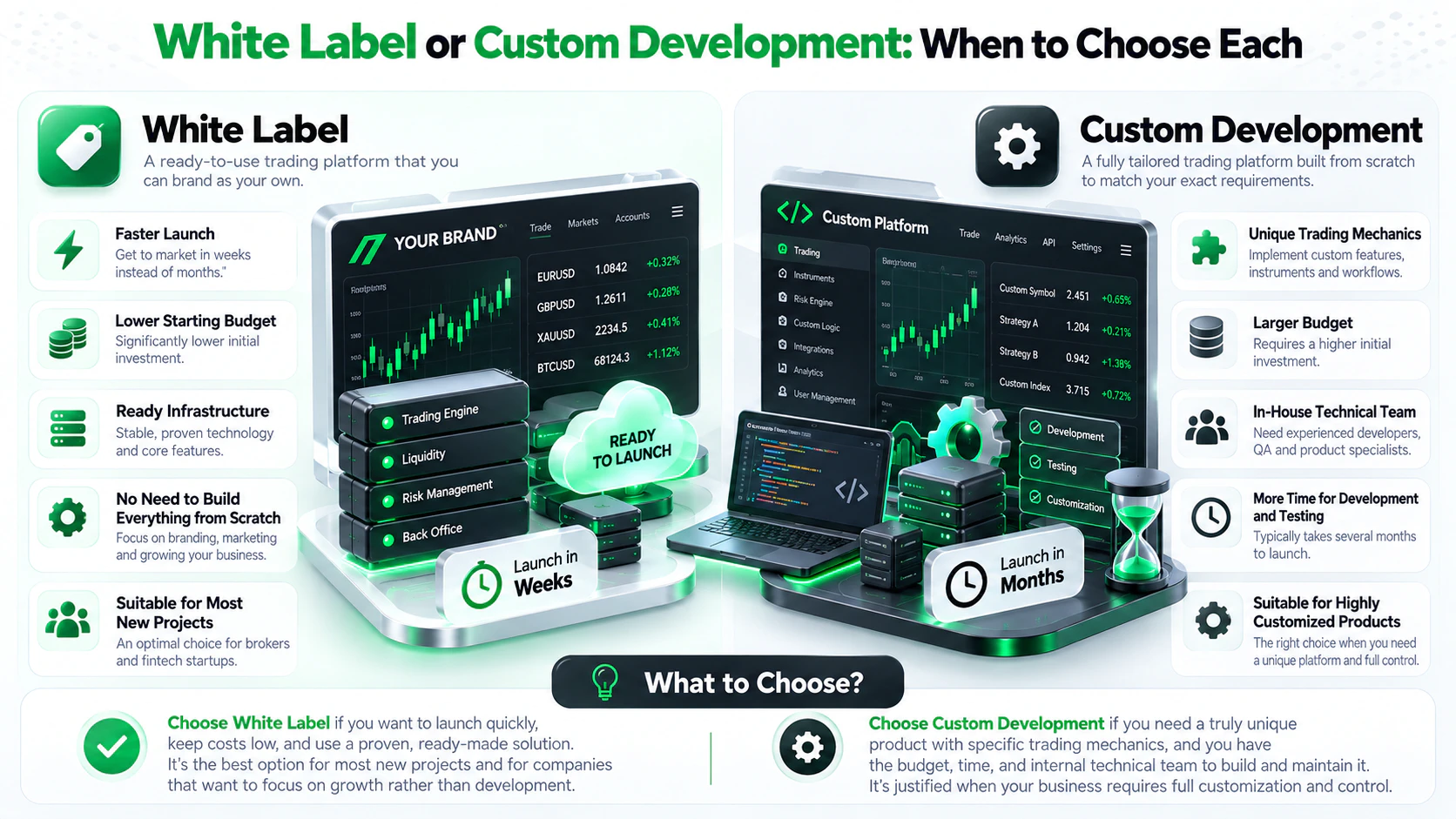
White label is not the only route, and an honest comparison helps. Building your own platform makes sense if you have a unique trading mechanic, a large budget, your own engineering team and time to build and test the system. Most new projects have none of these, and then a ready white label trading platform is faster and cheaper.
| Criterion | White label | Custom development |
| Time to first client | Weeks | Months to years |
| Upfront investment | Provider fee | Engineering team, infrastructure, testing |
| Risk of technical bugs | The system already runs for other projects | Every bug is yours to find |
| Product uniqueness | Within the provider’s modules and custom work | Complete |
| Code ownership | Provider | Owner |
| Maintenance | Provider | Your own team |
There is also a lighter route: an affiliate programme with someone else’s broker, where you only send clients. It costs even less to start, but neither the clients nor the brand are yours. For a full step-by-step view of launching a brokerage, see how to start an online brokerage.
Five misconceptions about white label
“It is a ready-made business.” It is ready-made technology. It becomes a business once a legal structure, payments, a team and traffic are added.
“All white label platforms are the same.” They differ in scope (terminal only or the full stack), infrastructure (shared or dedicated server), payment model, depth of configuration and who handles maintenance. Compare them against the same list of questions, not on price alone.
“The provider will own my clients.” Under a sound contract, the client base, brand and domain belong to the owner. Spell this out, together with how data is exported.
“Nothing can be changed.” Design, languages, currencies, modules and trading conditions are configurable, and new features can usually be ordered as custom work. The real limit is that deeply rebuilding the core for one client rarely makes economic sense in white label.
“White label is forever.” You can leave if the brand, domain and data are yours. But the platform stays with the provider, so moving to another system is a separate migration project worth considering when you choose. The contract questions below help you assess these risks up front.
Binary options requirements to check
Most white label guides are written for forex and CFDs. A binary options platform has its own requirements, and they live mostly in the admin panel rather than in the terminal.
Asset and payout settings
You should be able to manage the list of assets and currency pairs and change payout percentages in real time from the admin panel, without filing a request with the provider each time.
Quote feed and feed monitoring
Fixed-time trades are settled on quotes, so one error in the data feed can close many trades at the wrong price. Ask where quotes come from, whether OTC quotes are available and what happens when the feed sends bad data. In Bintech, quote monitoring detects anomalies in incoming data and pauses trading automatically.
Real, demo and tournament accounts
Demo accounts let new clients learn the terminal before depositing, and tournament accounts power competitions that keep active clients engaged. Check that each account type is separate and reported separately, so demo or tournament activity never mixes with real money.
Mobile access
Many clients trade from a phone. Check how the terminal works in portrait and landscape mode and whether the provider offers a PWA, which installs from the browser on iOS and Android without app store review.
What to check in a white label provider contract
Every white label trading platform provider looks good in a demo, and features are easy to compare. Contracts are compared far less often, yet they decide what your project looks like a year from now. Before signing, get written answers to the questions below; they apply to any white label trading software you are considering.
| Question | Why it matters |
|---|---|
| Who owns the domain, brand and client base? | It decides whether you can change provider without losing the business |
| How is data exported if the partnership ends? | Without a clear export procedure, the client base effectively stays with the provider |
| Is the project on a dedicated server or in a shared environment? | It affects performance, data isolation and exposure to other clients’ incidents |
| How are updates rolled out, and are you warned in advance? | An unexpected interface change in the middle of a campaign hurts conversion |
| How fast does the provider respond to an outage, and who is on call at night and at weekends? | A brokerage runs around the clock, and downtime costs money every hour |
| How is custom work estimated and billed? | Without this, your development budget becomes unpredictable |
| Can the maintenance fee change, and on what terms? | Your unit economics depend on stable costs |
| Does your team have access to action and trade logs? | Without logs you cannot resolve a dispute with a client or affiliate |
A good sign is a provider that answers these specifically and offers to put the answers into the contract itself. If the answers are vague, ask again before you pay, not after launch.
How to run a white label provider demo
A demo is where marketing claims meet reality. Send every provider the same scenarios in advance and ask them to show each one live:
- Open the admin panel first and the terminal second.
- Find a test client and walk through their full history: registration, deposit, trades, withdrawal and support requests.
- Change a payout percentage and confirm the change appears in the terminal and in the action log.
- Show how a multi-account case is detected and investigated.
- Show what happens when the quote feed sends suspicious data.
- Log in with a support role and confirm that financial settings are out of reach.
- Open the terminal on a phone in portrait and landscape mode.
If a step cannot be shown live, the function is probably missing or works differently from the description. The way a provider handles these scenarios tells you more than any feature list.
How a white label broker launch works
Technically, a launch means agreeing the configuration (product, languages, currencies, account types, payment solutions, team roles), setting up the brand and domain, deploying to the server, testing the full client journey end to end and training the team. On the Bintech platform the launch takes from 4 weeks; a manager confirms the exact timeline, which depends on the technical team’s workload and the amount of custom development. The legal and payment work runs in parallel, and that is what most often sets the real start date. For a step-by-step launch plan, see our turnkey broker platform guide.
The short version
A white label broker is your brand, your clients and your team on a provider’s technology. The provider keeps the platform running; the owner handles the legal side, payments, service and client acquisition. The model beats custom development on time and upfront cost, and beats an affiliate deal because the business and the client base are yours. If you are considering a white label brokerage solution for binary options, request a Bintech demo and presentation on Telegram.
FAQ about white label brokers
What is a white label broker in simple terms?
A white label broker is a brokerage that operates under its own brand on technology built by another company. Clients only see the owner’s brand, while the provider supplies and maintains the trading platform, servers and updates.
How is a white label broker different from an affiliate or IB?
An affiliate or introducing broker sends clients to someone else’s brokerage and earns a commission. A white label broker keeps clients on its own platform, sets its own trading conditions, bonuses, payments and support, and is responsible to those clients.
Does a white label broker need a licence?
It depends on where the company is registered and where it accepts clients. A technology provider does not replace a licence or a legal structure; the owner should settle these questions with a lawyer before launch.
Who owns the clients of a white label broker?
The client base, brand and domain belong to the project owner. This should be written into the provider contract, together with how data is exported if the partnership ends.
How long does it take to launch a white label broker?
On the Bintech platform, the technical launch takes from 4 weeks; a manager confirms the exact timeline, which depends on the technical team’s workload and any custom development. The legal setup and payment provider agreements run in parallel and often take longer than the technology.
Can you leave a white label provider?
Yes, if the brand, domain and client base are yours and the contract describes data export. The platform itself stays with the provider, so moving to another system is a separate migration project.
Can I change the design of a white label platform?
Yes. You can start from a ready design template or order a custom design. Languages, currencies, modules and trading conditions are configurable, and new features can be ordered as custom work, with cost and timing agreed before it starts.
What is the difference between white label and turnkey?
The terms overlap. Turnkey stresses that everything needed to start is delivered ready to use; white label stresses that it runs under your own brand. A good binary options solution is both: a complete set of modules under your brand, on your domain and a dedicated server.