
White Label Trading Platform Branding: How to Create a Recognizable Brand
Why Branding Decides the Success of a White Label Trading Brand
Launching a brokerage on a white label platform takes weeks, not years. That speed is the main advantage of the model, and also its main trap. Dozens of new brokers go live every month on the same underlying technology, with similar instruments, similar spreads and similar onboarding flows. When the product is comparable, the brand becomes the reason a trader chooses you, deposits a second time and recommends you to a friend.
White label trading platform branding is the process of turning ready-made trading infrastructure into a product that traders recognize as yours. It goes far beyond adding a logo to a traderoom. It covers your positioning, visual identity, platform design, tone of voice and every touchpoint a client meets, from the first ad to the first withdrawal.
In this guide you will learn:
- what elements make up a strong white label trading brand;
- how to build a visual identity that works inside a trading interface;
- how to customize platform design without hurting usability;
- how to keep messaging consistent across marketing, support and compliance;
- which customization options Bintech offers, and a launch checklist you can use today.
What White Label Trading Platform Branding Includes
A recognizable brand rests on four layers. If one of them is missing, traders feel the gap, even if they cannot name it.
| Layer | What it covers | What the trader experiences |
| Brand strategy | Positioning, target audience, value proposition, brand name | A clear answer to “why this broker?” |
| Visual identity | Logo, color palette, typography, icons, imagery | Instant recognition on any screen |
| Platform design | Traderoom layout, themes, mobile apps, onboarding screens | A product that feels built for them, not borrowed |
| Messaging | Tone of voice, key messages, support scripts, notifications | One consistent personality across every channel |
The common mistake is to start with the second layer. A logo designed without a strategy rarely survives the first year, and a rebrand after launch costs far more than doing the groundwork upfront.
Step 1. Build the Brand Strategy Before the Design

Every strong white label trading brand starts with three answers: who you serve, what you promise and why traders should believe you.
Define your target trader
A brand for beginner traders in Southeast Asia and a brand for experienced CFD traders in Europe will look and sound completely different. Describe your core audience in detail:
- Experience level: first-time traders need guidance and reassurance; active traders want speed, data and control.
- Region and language: colors, symbols and wording carry different meanings in different markets.
- Devices: in many emerging markets most traders open and manage positions on mobile, so the brand must work on a small screen first.
- Motivation: extra income, investing, speculation, learning. Each calls for a different emotional tone.
Choose a clear positioning
Positioning is the one idea you want traders to associate with your name. Pick one and commit to it:
- Simplicity: “Trading made clear for everyone.”
- Speed and technology: “Built for traders who act fast.”
- Education and support: “We grow with our traders.”
- Regional expertise: “A local broker that speaks your language.”
- Low cost: tight spreads and transparent fees as the core promise.
Pick a name that works for trading
A good brokerage name is short, easy to pronounce in your target languages and free as a domain and trademark. Avoid names that sound like existing brokers, and avoid words that promise profit, since regulators in many jurisdictions treat them as misleading. Check social media handles and app store availability before you finalize it.
Step 2. Create a Visual Identity That Works Inside a Trading Interface
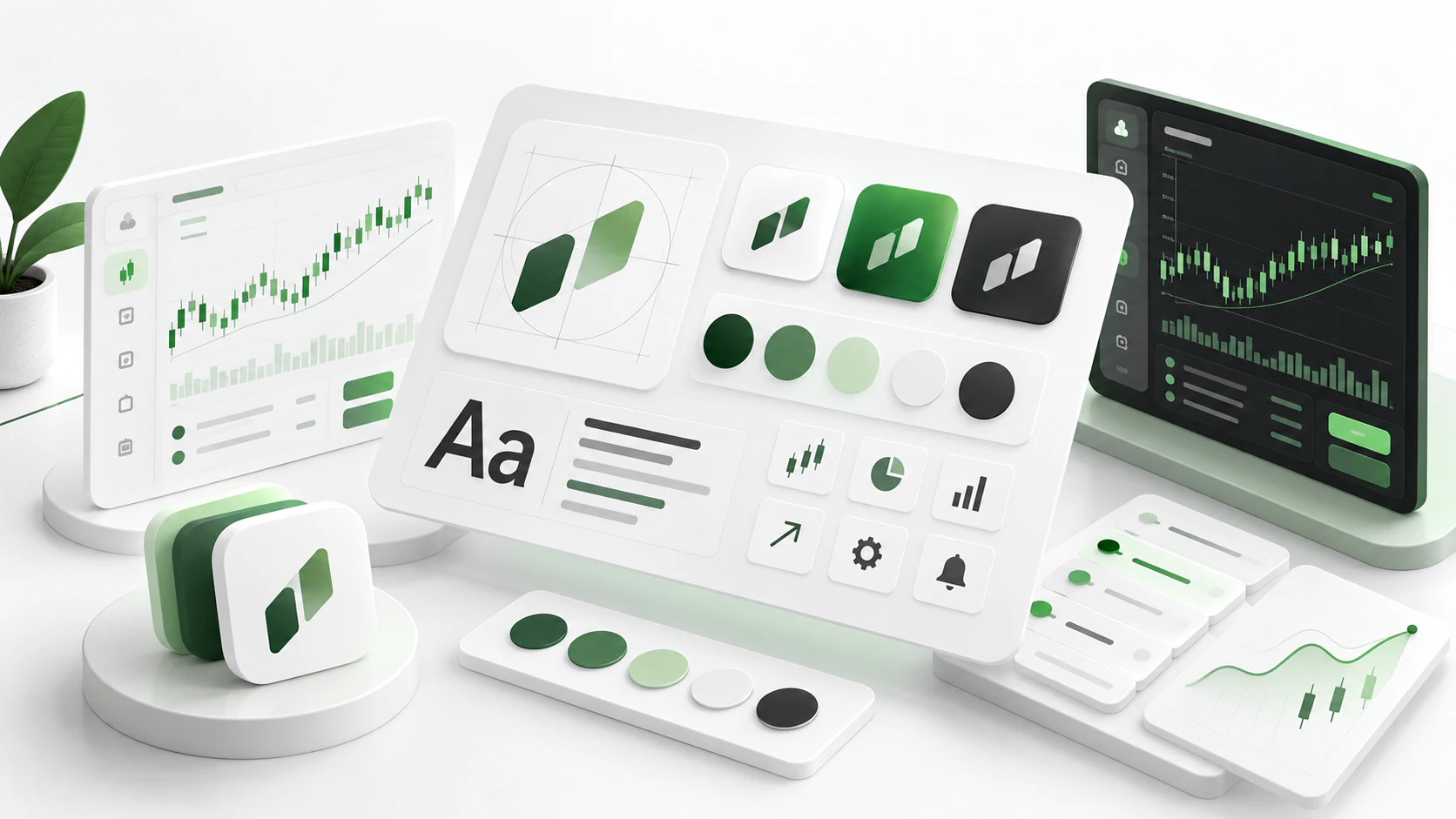
A trading platform is a dense, data-heavy environment. Your visual identity has to look good on a landing page and stay readable next to candlestick charts, order books and red and green P&L numbers.
Logo
Prepare at least three versions: a full logo for the website and documents, a compact sign for the app icon and favicon, and a monochrome version for dark and light themes. Test the app icon at 48 px: if it is not recognizable at that size, simplify it.
Color palette
Color is the fastest way to become recognizable, and the easiest place to make mistakes in trading platform design.
- Keep red and green for profit and loss. If your brand color is red, traders will read it as a loss signal. Use brand colors for buttons, headers and accents, not for market data.
- Build a full system, not one color: primary, secondary, neutral greys and semantic colors for success, warning and error.
- Check contrast. Text and key numbers should meet WCAG AA contrast (4.5:1) in both dark and light themes.
- Design the dark theme on purpose. Many traders keep the platform open for hours, and most prefer a dark interface.
Typography
Choose one font family with clear tabular figures, so prices and balances line up in columns and digits like 1, 7 and 0 are easy to tell apart. Use a second, more expressive font only for marketing headlines.
Imagery and icons
Avoid stock photos of people celebrating in front of charts: they look generic and may break advertising rules on financial promotions. Instead, use a consistent icon set, product screenshots and illustrations in your brand palette. Write all of this down in a short brand book so designers, marketers and affiliates use the same assets.
Step 3. Brand the Platform Design Without Hurting Usability

A custom branded trading platform should feel unmistakably yours while staying as fast and predictable as the best platforms on the market. Traders forgive a plain design; they do not forgive a confusing order ticket.
Where branding adds value
- Login and registration screens: the first impression of the product. Use your strongest brand visuals here.
- Onboarding and KYC flow: branded progress steps, friendly microcopy and clear document instructions reduce drop-off.
- Dashboard and empty states: a welcome message, tips and educational links in your tone of voice.
- Themes: branded dark and light themes built on your palette.
- Promo areas: bonuses, tournaments and campaigns designed in brand style.
- Mobile and desktop apps: your name, icon and splash screen in the App Store and Google Play.
Where to stay conservative
- Order placement: keep buy and sell buttons, volume fields and stop loss and take profit controls in familiar places.
- Charts: standard candle colors and tools traders already know.
- Numbers and P&L: maximum readability, no decorative fonts.
- Navigation: no more than one or two taps to deposit, trade or withdraw.
Test before launch
Run a quick usability test with 5–7 traders from your target audience. Ask them to register, deposit on a demo account, open and close a trade, and find support. Every hesitation is a design issue to fix before real money is involved.
Step 4. Keep Messaging Consistent Across Every Channel

Traders meet your brand through ads, the website, the platform, emails, push notifications, support chats and account managers. If each speaks differently, the brand dissolves. Consistent messaging is what makes trading platform branding feel trustworthy.
Define your tone of voice
Describe it in three or four pairs of “we are / we are not”:
| We are | We are not |
| Clear and direct | Full of jargon |
| Confident | Pushy or hyped |
| Supportive | Patronizing |
| Honest about risk | Promising easy profit |
Write key messages once, reuse everywhere
Prepare a short message house: one core promise, three supporting messages and proof points for each. For example, if your promise is speed, the proof points are execution time, instant deposits and 24/7 support. Use the same wording on the landing page, in ads, in onboarding and in sales scripts.
Make compliance part of the brand voice
Risk warnings, terms and KYC requests are part of the brand experience too. Write them in plain language, in your tone, without hiding them. In financial services, honesty about risk builds more trust than any slogan, and it protects your license and payment partnerships.
Step 5. Brand Every Touchpoint of the Client Journey

Recognition comes from repetition. Map the journey of a typical trader and check that each stage looks and sounds like your brand.
| Stage | Touchpoints | Branding priority |
| Awareness | Ads, social media, affiliate creatives, reviews | Recognizable visuals, one clear promise |
| Consideration | Website, landing pages, account types, FAQ | Trust signals, transparent conditions |
| Registration | Sign-up form, KYC, welcome email | Simple flow, friendly microcopy |
| First deposit | Payment page, confirmation, receipts | Security cues, branded payment screens |
| Trading | Web traderoom, mobile and desktop apps, notifications | Usability first, brand in themes and accents |
| Retention | Emails, push, tournaments, bonuses, education | Consistent campaigns in brand style |
| Support and withdrawals | Live chat, tickets, account manager, withdrawal emails | Fast, human, on-brand communication |
The withdrawal stage deserves special attention. A smooth, well-communicated withdrawal is the moment that turns a client into a promoter of your brand.
White Label Platform Customization Options at Bintech
Bintech gives brokers the tools to turn a ready-made trading infrastructure into a fully branded product. White label platform customization with Bintech covers every layer described in this guide:
| Customization area | What you can brand |
| Visual identity | Logo, color palette, fonts, icons, favicon |
| Platform themes | Branded dark and light themes for the web traderoom |
| Domain | The platform runs on your own domain and subdomains |
| Mobile and desktop apps | Apps published under your name, icon and splash screen |
| Onboarding and KYC | Registration steps, document requests and microcopy |
| Client communication | Email, push and in-platform notification templates |
| Marketing tools | Bonuses, promo campaigns and tournaments in your brand style |
| Account settings | Account types, instruments, trading conditions shown to clients |
The Bintech team supports you from the brand brief to launch: we help adapt your visual identity to the trading interface, check readability and contrast, and make sure your brand looks consistent on web, iOS, Android and desktop.
Want to see how your brand would look on the platform? Request a demo and get a branded preview of your traderoom.
Common Branding Mistakes New Brokers Make
- Logo swap only. Changing the logo and leaving default colors, texts and emails makes the platform look rented.
- Brand colors on market data. A red brand color on buttons next to red loss figures confuses traders.
- Copying a big broker. A look-alike brand is forgettable at best and a legal risk at worst.
- Hype instead of trust. Promises of guaranteed profit hurt credibility and can trigger regulatory and ad platform bans.
- Ignoring mobile. A brand tested only on desktop often breaks on a 6-inch screen.
- No brand book. Without written rules, affiliates and new team members slowly dilute the brand.
Launch Checklist for Your White Label Trading Brand
- Target trader profile and positioning statement written
- Name checked for domain, trademark, social handles and app stores
- Logo set: full, compact, monochrome, app icon tested at small sizes
- Color system with separate brand and P&L colors, contrast checked
- Dark and light platform themes approved
- Onboarding, KYC and payment screens branded and tested
- Tone of voice and message house shared with marketing and support
- Email, push and notification templates rewritten in brand voice
- Risk warnings and legal texts written in plain, on-brand language
- Brand book shared with affiliates and partners
- Usability test with 5–7 target traders completed
How to Measure Brand Strength
Track a few metrics from the first month:
- Branded search volume: how many people search for your broker by name.
- Direct traffic share: visitors who type your URL or open the app directly.
- Registration-to-deposit conversion: a sign of trust in the product.
- Second deposit and retention rates: whether the experience matches the promise.
- Referral share and reviews: whether traders recommend you.
Growth in branded search and direct traffic shows that your brand is becoming recognizable and your marketing costs per client will fall over time.
FAQ
What is white label trading platform branding?
It is the process of adapting a ready-made trading platform to your own brand: name, logo, colors, platform design, apps, domain and communication. Clients see your brokerage, not the technology provider behind it.
How long does it take to brand a white label trading platform?
Basic visual customization can be done in days. A complete brand, with strategy, brand book, themes, apps and rewritten communication, usually takes a few weeks. Starting the brand work in parallel with the technical setup saves time.
Can I fully customize the trading platform design?
You can customize the visual layer, themes, onboarding, notifications and marketing tools. Core trading controls are best kept close to industry standards, so traders can use the platform without relearning familiar actions.
Do I need a designer to create a white label trading brand?
A professional designer is recommended for the logo and brand book. Applying the brand to the platform can be done with the provider’s team, which knows the interface limits and best practices.
Will my clients know the platform is white label?
With full customization, clients see only your brand: your domain, apps, emails and support. The technology provider stays in the background.
Conclusion
A white label platform gives you the technology. The brand is what you build on top of it, and it is what traders remember. Start with a clear strategy, create a visual identity that respects the logic of a trading interface, keep your messaging consistent and brand every touchpoint, from the first ad to the first withdrawal.
Bintech helps brokers launch a custom branded trading platform that looks and feels like their own from day one. Request a demo to discuss your brand and see your platform in action.